
The Smart Link Revolution: Why Every Artist Needs a Centralized Hub
Executive Summary
Summary
The way musicians promote themselves has quietly broken.
Today’s artists release music across dozens of platforms, share links across social feeds, and send fans in every possible direction — yet still struggle to turn attention into real momentum. The problem isn’t effort. It’s fragmentation.
The smart link revolution emerged as a response to this chaos. What began as a simple “link in bio” workaround has evolved into something far more powerful: a centralized digital hub that gives artists control over their narrative, their audience journey, and their growth.
A true smart link isn’t just a list of destinations. It’s a strategic home base — one place where music, video, shows, stories, and data converge. When used correctly, it replaces scattered promotion with intentional design, guiding fans from discovery to connection without friction.
This shift isn’t about trends or tools. It’s about how modern artists survive in an attention economy where clarity beats volume and ownership matters more than reach. Understanding this revolution is the first step toward building a sustainable fan ecosystem instead of chasing clicks that disappear.
Key Takeaways
When music, videos, tickets, and identity are scattered across platforms, fans never form a complete understanding of the artist, and promotion becomes maintenance instead of momentum.
A strategy built on constant redirection resets attention with every click, making it impossible for familiarity, trust, and engagement to build over time.
Artists needed a single destination that could anchor promotion across platforms, campaigns, and moments without breaking the fan experience.
What started as simple link collections transformed into dynamic, campaign-aware hubs designed to adapt alongside an artist’s releases and audience behavior.
Every extra click, unfamiliar platform, or unclear priority increases friction and drop-off, while centralization replaces confusion with immediate clarity.
Instead of being defined by platform templates, artists shape their identity through layout, media, and storytelling inside an environment they control.
Algorithmic visibility is temporary, but a centralized hub preserves presentation, prioritization, and connection regardless of platform shifts.
The Problem With Modern Music Promotion
Modern artists don’t struggle because they lack platforms — they struggle because their presence is fractured across too many of them.
Music lives on streaming services. Videos live on social feeds. Tickets live on third-party event platforms. Artist bios shift depending on where a fan discovers them. Each platform asks for a slightly different version of the same story, and over time that story becomes fragmented.
From the outside, this looks like visibility. From the inside, it feels like dilution.
A listener might hear a song on Spotify, see a clip on TikTok, notice a tour date on Instagram, and still have no clear sense of where everything comes together. Discovery happens everywhere, but understanding happens nowhere. Fans are constantly redirected, yet never grounded.
This is why so many artists experience activity without momentum. Plays increase. Posts perform. Views spike. But nothing compounds — because there is no single destination where interest can settle and deepen. As explored in Smart Links in the Streaming Age: Convert Casual Listeners into Lifelong Fans, discovery alone doesn’t build relationships unless there’s a place for listeners to land.
Fragmentation turns promotion into perpetual maintenance. Every release requires rebuilding context. Every campaign resets the journey. Instead of strengthening a foundation, artists are constantly patching together disconnected touchpoints. Over time, this erodes clarity — not just for fans, but for the artist themselves.
As more musicians begin to recognize this pattern, the shift away from scattered promotion toward unified systems has become unavoidable. The artists who adapt stop chasing attention and start designing where it goes, a transition already reshaping how bands build their audiences across platforms (How Smart Links Are Changing the Way Bands Build Their Fanbase).
The real problem with modern music promotion isn’t effort or ambition.
It’s the absence of a center.
Why the “Link Everywhere” Strategy Stopped Working
For years, musicians were told that visibility was the goal. Be everywhere. Share every link. Post constantly. As long as fans could find you on every platform, growth would follow.
That advice worked — briefly — when platforms were fewer and attention was less fragmented. But as feeds multiplied and algorithms tightened, the “link everywhere” strategy stopped building momentum and started erasing it.
Each link sent fans somewhere different. One post led to a streaming app. Another opened a video platform. Another dropped them onto a ticketing page with no context. Every interaction forced fans to re-orient themselves from scratch. Instead of building familiarity, the journey reset again and again.
This is where growth quietly breaks.
Fans don’t disengage because they lose interest — they disengage because the experience becomes disjointed. When there’s no consistent destination, no recognizable home base, attention never has a chance to settle. Engagement spikes in isolation, then disappears back into the feed, a pattern explored more deeply in Smart Links vs. Link-in-Bio Tools: What Musicians Really Need.
What looks like reach on the surface often masks a deeper problem underneath. Metrics rise, but relationships don’t. Artists accumulate clicks without continuity, impressions without memory. The audience grows wider, but not closer. As behavioral research around fan decision-making shows, people don’t convert when choices feel scattered or unclear — they convert when paths feel intentional (The Psychology of Fan Conversion: Why Smart Links Outperform Link-in-Bio Tools Every Time).
In an environment where attention is fleeting and competition is constant, sending fans everywhere is no longer a strength. It’s a liability. Without a central point of reference, promotion becomes noise instead of narrative, and activity replaces progress.
The failure of the “link everywhere” strategy didn’t happen overnight. It happened gradually — as artists realized that visibility without structure doesn’t compound, it dissipates.
The Rise of the Smart Link as a Central Hub
Smart links didn’t emerge because artists wanted another tool to manage. They emerged because the modern music ecosystem made fragmentation unavoidable — and artists needed a way to regain control.
As platforms multiplied, one question became increasingly difficult to answer: Where should everything point? Streaming links, videos, tour dates, merch, and stories all lived in different places, but promotion required a single destination that could hold context instead of breaking it.
This is where the smart link shifted from convenience to necessity.
Rather than acting as a shortcut, the smart link became a central hub — a place where fans could land, understand the artist, and choose how to engage next. Instead of scattering attention across disconnected platforms, artists could finally anchor discovery to one intentional experience. This structural role is why smart links moved beyond simple bio tools and into something closer to infrastructure.
At its core, a smart link solves the same problem artist websites once tried to solve — but in a way that fits how music is actually discovered today. Mobile-first. Campaign-driven. Fast-moving. Always changing. As outlined in What Are Smart Links for Musicians? The Complete 2026 Guide, modern smart links are designed to adapt alongside releases, tours, and content drops without forcing fans to re-learn where to go.
This evolution also explains why generic link tools began to fall short. Artists didn’t just need a place to list destinations — they needed a place that felt built for music, not retrofitted for it. Smart links tailored for bands and musicians answered this gap by prioritizing embedded media, narrative flow, and fan clarity over raw link quantity (The Smart Link Alternative Built for Bands).
The rise of the smart link wasn’t about replacing platforms. It was about creating a center that platforms could orbit. Once artists had a reliable hub, promotion stopped feeling like constant redirection and started feeling like guidance.
That shift — from scattering links to anchoring attention — is what defines the smart link revolution.
From Static Bio Links to Living Artist Hubs
The earliest bio links were built for convenience, not strategy. They solved a narrow problem — where to place multiple URLs — but they didn’t help artists shape how fans actually experienced their work.
These early tools functioned like digital directories: static lists of destinations with no context, no hierarchy, and no sense of what mattered most in a given moment. For fans, every option looked equally important. For artists, every campaign required rearranging links and hoping people clicked the “right” one.
Modern smart links evolved to fix this.
Instead of acting as lists, they became living hubs — pages designed to change alongside an artist’s releases, tours, and content cycles. A living hub isn’t defined by how many links it contains, but by how clearly it guides attention.
At a functional level, this evolution introduced key differences:
- Embedded media replaces outbound clicks, allowing fans to listen or watch without leaving the page.
- Visual hierarchy communicates priority, making it obvious what an artist wants fans to experience first.
- Campaign-aware layouts adapt over time, so the same link supports new releases without being rebuilt.
- Context travels with the fan, instead of being lost after every redirect.
This shift is what transformed smart links from passive tools into active systems. When music, video, and calls-to-action live together in one place, engagement stops feeling fragmented. Fans stay longer, explore more, and understand the artist faster — outcomes explored in depth in How Embedded Content Turns Smart Links Into Fan-Converting Machines.
Just as importantly, living hubs give artists a repeatable structure. Instead of reinventing promotion for every release, they build once and refine over time. Pages evolve, but the destination stays familiar. This is why smart link design has become as important as the content itself, a principle broken down in The Anatomy of a Perfect Smart Link Page for Musicians.
What began as a workaround for bio limitations has matured into something more durable. A living artist hub doesn’t just collect attention — it organizes it, preserving momentum instead of resetting it with every campaign.
Centralization vs. Chaos: What Fans Actually Experience
From a fan’s perspective, fragmentation doesn’t feel strategic — it feels like work.
Each time a listener clicks a link and lands somewhere unfamiliar, they have to re-orient themselves. What is this page for? What should I do next? Is this still the same artist? Every extra decision increases friction, and friction quietly kills engagement.
Centralization removes that burden.
When fans land on a single, intentional hub, the experience becomes immediately legible. They don’t have to hunt for context or guess what matters most. The page itself communicates priority and flow.
In practice, the difference between chaos and centralization shows up quickly:
- Fans understand the artist faster, because music, visuals, and story live together.
- Engagement lasts longer, because content can be explored without constant redirects.
- Decision fatigue disappears, replaced by clear next steps.
- Return visits feel natural, because the destination becomes familiar.
This isn’t accidental — it’s behavioral. Visual hierarchy, layout, and embedded media shape how people move through information, a dynamic explored in Smart Link Design Psychology: How Layout Impacts Fan Behavior. When design reduces uncertainty, fans stay present instead of bouncing.
Just as importantly, centralization builds trust. A consistent hub signals intention. It shows that the artist has thought about the fan experience instead of outsourcing it entirely to platforms. This sense of coherence is why music-first tools built around fan psychology consistently outperform generic link solutions (Built for Musicians: The Fan-Psychology Design Principles Behind MusicBizQR).
Fans don’t disengage because they lack interest. They disengage because the path forward isn’t clear. Centralized hubs solve this not by demanding more attention, but by respecting it.
How Centralized Hubs Reshape Artist Identity
An artist’s identity isn’t defined only by their music — it’s shaped by the environments where that music is experienced.
When discovery happens exclusively on third-party platforms, artists inherit the constraints of those platforms. Layouts are fixed. Context is stripped away. Every profile looks roughly the same, regardless of genre, vision, or intent. Over time, artists begin to feel interchangeable — not because their work lacks personality, but because the environment erases it.
A centralized hub changes that relationship.
Instead of being defined by platform templates, artists define themselves through an experience they control. The way content is ordered, what media appears first, how visuals and tone are balanced — all of it contributes to how the artist is perceived. Identity becomes intentional rather than incidental.
This shift is subtle, but powerful.
Centralized hubs allow artists to:
- Present their work in a deliberate sequence, rather than leaving discovery to chance
- Balance music, visuals, and narrative, instead of forcing everything into a single format
- Signal what matters now, without rewriting their story on every platform
- Create continuity across releases, so identity evolves instead of resetting
Branding stops being something borrowed from platforms and starts becoming something built. This is why smart links increasingly play a role in long-term artist positioning, not just promotion — a theme explored more deeply in Beyond the Bio Link: How Smart Links Are Changing Artist Branding Forever.
As artists gain control over how they are experienced, confidence replaces improvisation. Promotion becomes an extension of identity rather than a reaction to algorithms. It’s also why forward-looking musicians are beginning to align their entire presence around artist-first systems that preserve coherence as they grow (Why Every Serious Musician Will Be Using MusicBizQR by Next Year).
Centralization doesn’t flatten identity — it clarifies it. And in a landscape crowded with noise, clarity is what makes artists recognizable, memorable, and distinct.
Why Ownership Beats Reach in the Attention Economy
Reach feels powerful because it’s visible. Follower counts rise. Views spike. Streams accumulate. From the outside, it looks like progress.
But reach is borrowed.
Platforms decide who sees what, when, and for how long. Algorithms shift. Feeds refresh. Visibility disappears without warning. Artists who rely solely on platform reach are constantly rebuilding momentum that never truly belongs to them.
Ownership works differently.
A centralized hub gives artists control over how their work is presented, prioritized, and experienced — regardless of where discovery happens. Instead of fighting for attention inside platforms, artists guide fans into an environment they own. This distinction is why so many musicians eventually outgrow generic link tools and begin looking for systems designed around artist control rather than platform convenience (MusicBizQR vs Linktree: Why Artists Are Switching to Smarter Tools).
The difference between reach and ownership shows up in what lasts.
- Reach creates spikes, driven by algorithms and trends.
- Ownership creates continuity, where fans return without being prompted by a feed.
- Reach depends on permission, granted temporarily by platforms.
- Ownership builds leverage, because the connection persists beyond any single channel.
This is why artists who centralize their presence are less vulnerable to platform changes. When a release underperforms on one channel or a post fails to surface, the relationship doesn’t vanish. Fans who’ve entered an artist-owned experience know where to go next. They aren’t lost to the scroll.
Comparisons between smart links and traditional bio tools often frame the difference as features or pricing. The real difference is structural. One approach rents attention. The other compounds it — a contrast explored in depth in Smart Link vs Linktree: What Every Musician Should Know in 2026.
In an attention economy built on volatility, reach is temporary by design. Ownership is what remains. And for artists who want longevity instead of constant recovery, that distinction changes everything.
The Smart Link as the Foundation of a Fan Journey
Smart links become powerful when they stop acting like destinations and start acting like pathways.
Most fan relationships don’t fail at discovery — they fail in the moments that follow. A listener hears a song, enjoys it, and then has no clear sense of what to do next. The experience ends not because interest disappears, but because direction does.
A centralized hub turns isolated moments into a journey.
Instead of scattering fans across disconnected platforms, smart links create a familiar starting point where engagement can unfold naturally. Discovery leads to exploration. Exploration leads to connection. Over time, this progression feels less like marketing and more like momentum.
When designed intentionally, a smart link supports this journey by making a few things effortless:
- Fans can move between music, video, and context without friction, staying engaged instead of bouncing.
- Each visit builds familiarity, because the destination stays consistent even as content changes.
- Next steps feel obvious, reducing hesitation and decision fatigue.
This is what transforms links into systems. Rather than asking fans to re-learn where to go for every release, artists guide them along a recognizable path — a concept explored in Music Links for Artists: Build a Seamless Fan Journey Across Platforms.
Just as importantly, journeys create relationships. Fans who return to the same hub begin to associate that space with the artist, not the platform that introduced them. Over time, this familiarity deepens trust and encourages repeat engagement, a dynamic at the heart of How Smart Links Help Indie Artists Build Fan Relationships.
Smart links don’t force fans through funnels — they remove obstacles from paths fans already want to follow. When the journey feels intuitive, connection becomes a natural outcome rather than a conversion tactic.
Why Centralized Hubs Compound Over Time
Most music promotion creates spikes — brief moments of attention that rise quickly and disappear just as fast.
A post performs well. A release gets shared. A video catches traction. Then the cycle resets, and the next campaign starts from zero. This pattern feels productive, but it’s fragile. Nothing carries forward because each effort points somewhere different.
Centralized hubs change this dynamic by giving momentum somewhere to accumulate.
When every campaign, release, and piece of content leads back to the same destination, value begins to stack. Fans recognize the link. They remember where to go. Each interaction reinforces the last instead of replacing it.
Over time, this creates compounding effects that scattered promotion never can:
- Fans return without being prompted, because the destination feels familiar.
- New releases benefit from past attention, instead of starting cold.
- Campaigns layer on top of each other, rather than competing for space.
- Engagement deepens naturally, as repeat visits reduce friction and uncertainty.
This is why artists who treat smart links as long-term systems experience steadier growth than those who treat them as disposable tools. Centralization turns promotion into infrastructure — a concept reinforced in Why Every Indie Artist Needs a Smart Link Strategy.
The difference becomes especially clear over months and years. Artists who build around a consistent hub stop chasing bursts of attention and start benefiting from continuity. Relationships strengthen. Habits form. Trust compounds. As explored in Smart Links for Musicians: Build Real Fan Connections That Last, long-term connection is rarely the result of a single moment — it’s the result of repeated, familiar experiences.
Spikes feel exciting. Compounding feels quiet.
But it’s compounding that builds careers.
The Strategic Difference Between Smart Links and Websites
For years, the default advice to musicians was simple: build a website.
Websites were meant to be the digital home — the place where everything lived. But as music promotion shifted toward mobile discovery, fast-moving campaigns, and social-first behavior, traditional websites quietly stopped matching how fans actually engage.
Most artist websites are static by nature. They’re designed to be complete, not responsive. Updating them takes time. Navigation assumes patience. And the experience often feels disconnected from the moment that sent the fan there in the first place. A listener clicks from a post or QR code and lands on a page that doesn’t clearly answer why they’re there right now.
Smart links evolved to solve that mismatch.
Rather than trying to be everything, smart links focus on being relevant. They’re built for immediacy — for releases, tours, videos, and campaigns that change frequently. Instead of asking fans to explore menus or hunt for context, smart links surface what matters most in the moment, directly in front of them.
This doesn’t mean websites are useless. It means they serve a different role. Websites archive. Smart links activate.
The strategic shift happens when artists stop treating these tools as interchangeable. A smart link isn’t a smaller website, and a website isn’t a flexible campaign hub. Smart links meet fans where discovery happens and guide them forward without friction, a positioning that has made them the foundation of modern link-in-bio strategies (The Best Link in Bio Alternative for Musicians: Build a Fan Funnel).
This is also why comparisons between smart links and traditional bio tools increasingly miss the point. The real advantage isn’t just convenience or design — it’s alignment with how music is promoted today. When smart links incorporate embedded media, analytics, and clear fan pathways, they become something websites were never designed to be: agile (The Best Linktree Alternative for Musicians: QR Codes, Music Embeds & Fan Analytics).
Websites tell a complete story.
Smart links tell the right story at the right moment.
Understanding that difference is what allows artists to stop forcing old tools into modern workflows — and start building systems that actually move with their careers.
Where the Smart Link Revolution Is Headed Next
The smart link revolution didn’t stop at centralization — that was only the first step.
As artists gained control over where fans landed, a new question emerged: What happens once they arrive? The answer has pushed smart links beyond simple hubs and toward intelligent systems that respond to behavior, context, and intent.
The next phase of smart links is about depth, not destinations. Embedded media already reduced friction by letting fans listen and watch without leaving the page. What follows is a tighter integration between content and insight — understanding which moments resonate, which paths fans take, and how engagement evolves over time. Tools that surface this intelligence are redefining what a “link” can do, a shift explored in The Best Music Smart Link Tools in 2026 (And Why Most Fall Short).
At the same time, smart links are becoming more adaptive. Pages change based on campaigns. Priorities shift without breaking familiarity. The destination stays consistent, but the experience stays relevant. This adaptability is why embedded content continues to play a central role in future-facing smart link design (How Embedded Content Turns Smart Links Into Fan-Converting Machines).
What’s emerging isn’t just a better way to share links — it’s a new layer of artist infrastructure. One that blends storytelling, media, and insight into a single experience that grows smarter with every interaction.
The artists who benefit most from this evolution won’t be the ones chasing every new platform feature. They’ll be the ones investing in systems that absorb change instead of reacting to it. As discovery becomes more fragmented and attention more scarce, centralized hubs with intelligence built in won’t be optional enhancements — they’ll be the backbone of sustainable careers.
The smart link revolution is still unfolding. But its direction is clear: fewer destinations, deeper understanding, and stronger relationships built on systems artists actually control.
Final Takeaway: Why Every Artist Needs a Centralized Hub Now
The smart link revolution isn’t about convenience, trends, or tools. It’s about control — and artists who delay building that control are already feeling the cost.
Modern music promotion no longer fails because artists aren’t visible. It fails because visibility without structure doesn’t last. Attention arrives in fragments, disappears quickly, and rarely compounds unless it has somewhere consistent to go.
A centralized hub changes that equation.
When artists anchor their presence to a single, intentional destination, everything downstream becomes clearer — for fans and for the artist alike. Promotion stops feeling reactive. Identity becomes coherent. Growth begins to stack instead of reset.
At its core, centralization allows artists to:
- Turn discovery into continuity, so every new listener knows where to return
- Replace scattered promotion with a recognizable home base, reducing friction at every step
- Guide fans intentionally, instead of leaving journeys to chance or algorithms
- Build assets instead of spikes, creating momentum that compounds over time
- Own the relationship, regardless of how platforms evolve or fragment
This is why smart links are no longer optional accessories in an artist’s toolkit. They’ve become the foundation that modern promotion is built on — the place where music, story, and connection converge.
Artists who embrace centralization early gain leverage. They stop rebuilding context with every release and start strengthening the same foundation again and again. Those who resist it remain trapped in cycles of noise, constantly chasing attention that never quite settles.
The smart link revolution marks a shift away from scattered presence and toward intentional systems. And in an attention economy defined by volatility, the artists who last won’t be the loudest — they’ll be the clearest.
Centralization isn’t the future of music promotion.
It’s the present.
Frequently Asked Questions
What is a smart link for musicians?
A smart link is a centralized hub that brings together an artist’s music, videos, tour dates, and key actions in one place. Unlike basic link-in-bio tools, smart links are designed to guide fans through an intentional experience instead of sending them in scattered directions.
Why do artists need a centralized hub instead of multiple links?
Multiple links fragment attention. A centralized hub gives fans a clear destination where they can understand the artist, explore content, and return over time. This consistency is what allows engagement to compound instead of resetting with every click.
Are smart links replacing artist websites?
No. Smart links and websites serve different roles. Websites archive an artist’s full story, while smart links are built for fast, mobile-first promotion tied to releases, tours, and campaigns. Smart links activate attention; websites preserve information.
How do smart links help turn listeners into real fans?
Smart links remove friction from the fan journey. By embedding music and video directly, prioritizing what matters most, and keeping the experience consistent, they make it easier for casual listeners to stay engaged and return without relying on algorithms.
Do smart links improve fan engagement and retention?
Yes. Because fans return to the same destination across campaigns, familiarity builds. Over time, this creates stronger relationships, longer engagement sessions, and more repeat interactions compared to scattered promotion.
What makes a smart link different from Linktree or basic bio tools?
The difference isn’t just design — it’s structure. Smart links built for musicians focus on embedded media, narrative flow, and fan clarity, while generic bio tools prioritize listing destinations without guiding experience or continuity.
Can smart links work for independent artists and bands?
Absolutely. In fact, independent artists benefit the most because smart links allow them to control their narrative, unify promotion across platforms, and build long-term fan relationships without needing large teams or budgets.
When should an artist start using a smart link?
As early as possible. The sooner an artist establishes a central hub, the sooner promotion begins to compound. Waiting only increases fragmentation and makes it harder to build continuity later.
Do smart links still matter if social platforms keep changing?
That’s exactly why they matter. Platforms evolve, algorithms shift, and reach fluctuates. A smart link provides stability — a destination the artist controls regardless of where discovery happens.
Built for Musicians. Powered by Smart Links.
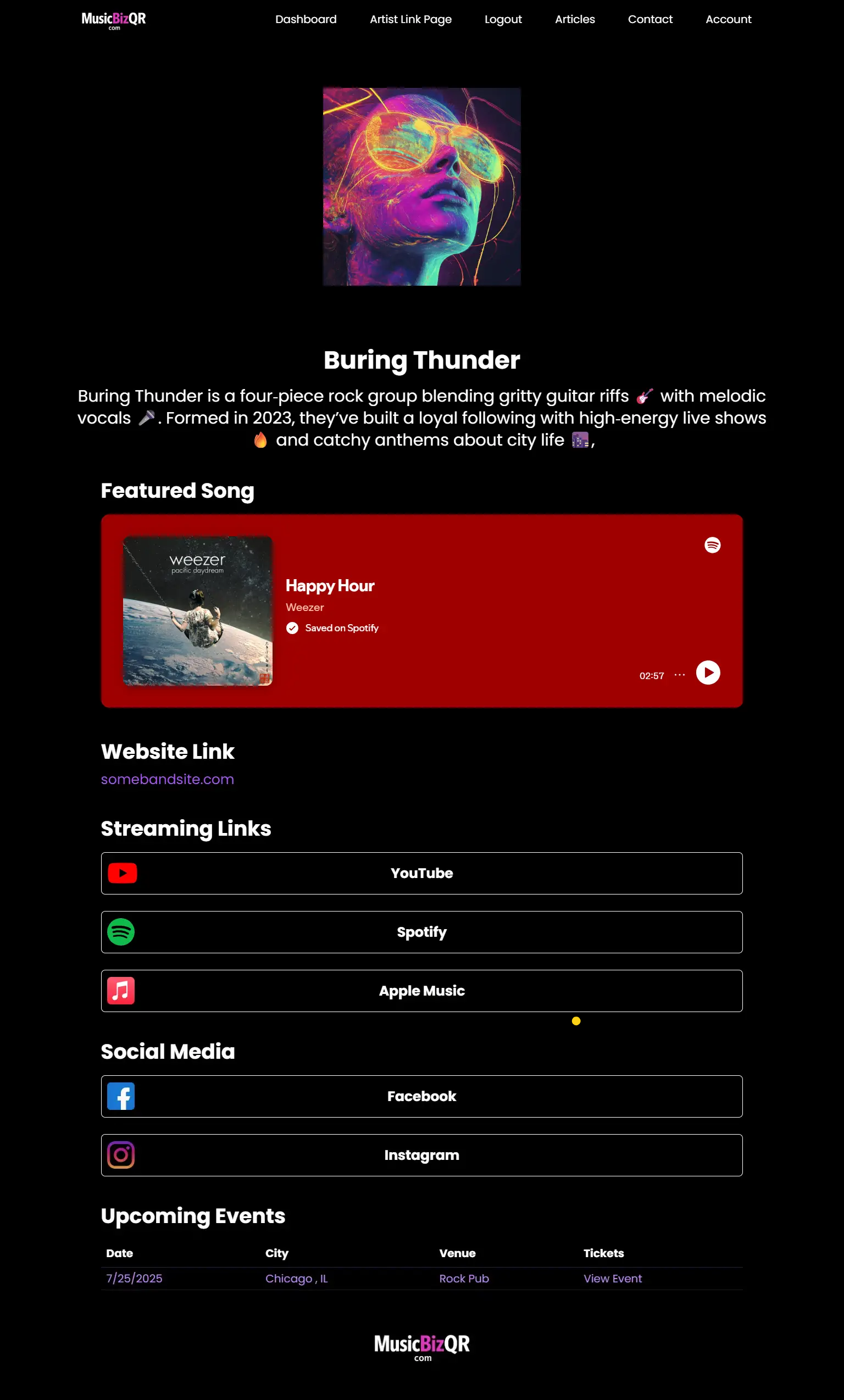
Faneqo gives you a powerful landing page with streaming links, videos, social buttons, and real-time fan analytics — all from a single QR code.
- 🎯 Unlimited link clicks & analytics
- 📈 Track Spotify streams, YouTube plays, and QR scans
- 📱 Mobile-optimized artist pages
- 🚀 Create your first Smart Link in seconds
Related Posts
Most link-in-bio tools weren’t built for musicians. Discover why smart links create better fan journeys, stronger branding, and higher conversions for your music.
Smart links for musicians explained—how they work, why they matter in 2026, and how to build a fan-converting link that drives your music career.
Discover how music links can help artists guide fans across platforms effortlessly. Learn strategies to boost engagement, streams, and merch sales.
Most link-in-bio tools weren’t designed for musicians. Learn why smart links deliver better fan engagement, stronger branding, and real music-driven revenue.
Smart links aren’t just utility tools — they’re the new frontier in artist branding. Learn how visual design, consistency, and fan-centric smart links define a musician’s digital identity.
Discover how smart links can transform fleeting music streams into lasting fan connections. Learn the strategies indie artists use to grow their audience in the streaming era.
Discover how smart links empower indie artists to create deeper, lasting relationships with fans. Turn every click into meaningful engagement.
Discover 2026’s best smart link tools for artists. We compare top platforms, fan engagement features, and why MusicBizQR stands above the rest.
Learn how direct-to-fan video turns your smart link into a conversion machine. Build trust, drive streams, and make real fan connections with MusicBizQR.
Learn how to use music links to drive fan engagement, increase streams, and promote your music like a pro. Built for modern artists and bands. Shall I begin writing the Markdown content for this article now?
In 2026, discovery is chaotic — and smart links are how artists bring it all together. Explore how music smart links guide fans, boost streams, and create real momentum across every platform.
Tired of generic link tools? Discover the smart link platform built for music: video previews, analytics, and full artist control—all in one sleek page.
Every new release deserves more than a link in your bio. Learn how to use smart links to drive streams, collect fans, and turn a single drop into lasting momentum.
The layout of your smart link page can make or break your fan engagement. Learn the design psychology that turns clicks into superfans.
If you're still sending fans to scattered links, you're leaving money on the table. Here's why every indie artist needs a smart link strategy to grow, connect, and convert.",
Most smart links just sit there. This guide shows musicians how to build a smart link page that turns casual clicks into lifelong fans. Real strategies that work.
Discover the psychology behind smart link layout design and how it shapes fan engagement, conversions, and merch sales.
Master the art of launching music with smart links. This guide shows how to create hype, drive streams, and maximize impact every time you drop a new release.
Your smart link is your new homepage. Learn how to design a 2026-ready page that plays your music instantly, tells your story, and converts fans the moment they land.
Learn how musicians can use smart links to connect directly with fans, bypass algorithms, and drive engagement, streams, and merch sales.
Discover how embedded content like music, videos, and social posts can turn your smart link into a fan engagement engine. Boost streams, merch sales, and loyalty.
Discover why smart links are transforming music marketing in 2025. Learn how a centralized hub can grow your audience, boost streams, and drive real fan engagement.
From Spotify embeds to merch and tour links, MusicBizQR makes music promotion easy. Learn how to use smart links to streamline your entire fan funnel.
Learn five powerful ways smart links can revolutionize your band's music promotion, amplify fan engagement, and strengthen fan loyalty.
Discover how smart links are revolutionizing music promotion, increasing fan engagement, boosting streaming numbers, and enhancing concert attendance.