
MusicBizQR vs Linktree: Why Artists Are Switching to Smarter Tools
Intro — The Moment Artists Realize Linktree Isn’t Built for Music
There’s a moment that hits every serious musician sooner or later — usually sometime between a new single dropping, the dopamine rush of early plays, and the quiet anxiety of wondering whether anyone will stick around long enough to care. You open your bio. You paste the new link. You hit “save.” For a few minutes, the world feels like it’s moving.
Then you tap the link yourself.
A plain page.
A stack of buttons.
No music.
No video.
No story.
No energy.
Just a digital doorway that leads nowhere in particular.
If you’re an artist, you feel the disconnect instantly. You’ve poured soul into your music, your visuals, your world — but the tool meant to help fans enter that world reduces everything to a sterile list of rectangles. Linktree isn’t wrong for influencers or lifestyle creators. But for musicians? It’s like promoting a stadium show with a black-and-white flyer taped to a gas station door.
Most artists don’t lose fans because of bad music.
They lose them because the fan journey breaks the second someone clicks their link.
That realization — that static link-in-bio tools weren’t built for music, weren’t built for storytelling, weren’t built for the emotional gravity of a release or the momentum of a tour — is what sends thousands of artists looking for something better.
And that’s where MusicBizQR begins.
Purpose-built for artists, engineered around embedded media, fan funnels, touring workflows, dynamic QR codes, and real analytics (Muse) that actually show what’s happening under the hood, MusicBizQR turns the “bio link” from a dead-end into a growing, breathing digital stage.
This isn’t just a comparison of features.
It’s a comparison of philosophies:
Linktree simplifies. MusicBizQR amplifies.
Let’s break down why musicians everywhere are switching.
Table of Contents
- Intro — The Moment Artists Realize Linktree Isn’t Built for Music
- The Core Difference: Generic Bio Tools vs Music-First Smart Link Platforms
- Feature Comparison: What Musicians Actually Need
- Analytics Comparison: Muse vs Linktree Insights
- Release Marketing: One Platform Helps, One Platform Gets in the Way
- Brand and Aesthetic Control: Artists Deserve More Than a Template
- Fan Experience: The Real Reason Musicians Are Switching
- Real-World Scenarios: Linktree vs MusicBizQR
- Pricing and Value: Who Actually Gives Musicians More
- The Future: Why MusicBizQR Leaves Linktree Behind
- Pocket Summary — The 10-Second Case for MBQ Over Linktree
- Conclusion — Artists Are Done With Generic Tools
- FAQ
The Core Difference: Generic Bio Tools vs Music-First Smart Link Platforms
The real problem with Linktree isn’t the buttons. It isn’t the plain layouts or the templates you’ve seen a thousand times. The problem is that Linktree was never designed for the way musicians build momentum, tell stories, or convert curiosity into loyal fans. It’s a tool built for everyone, which means it was built for no one in particular — least of all artists.
Most creators just need a list of links.
Musicians need a pathway.
Music is emotional. It moves. It unfolds over time. A fan doesn’t want a menu — they want a world to step into. And the moment someone taps your link, they’re not looking for “options.” They're looking for a feeling, a spark, a way in.
This is where MusicBizQR breaks away from Linktree at the foundational level.
MBQ is a music-first platform, engineered around the actual way fans behave:
- They watch the video first.
- They listen before they click.
- They save a track when the moment feels right.
- They buy a ticket when they’re already emotionally engaged.
- They return when your world feels cohesive.
None of that happens inside a static list of buttons.
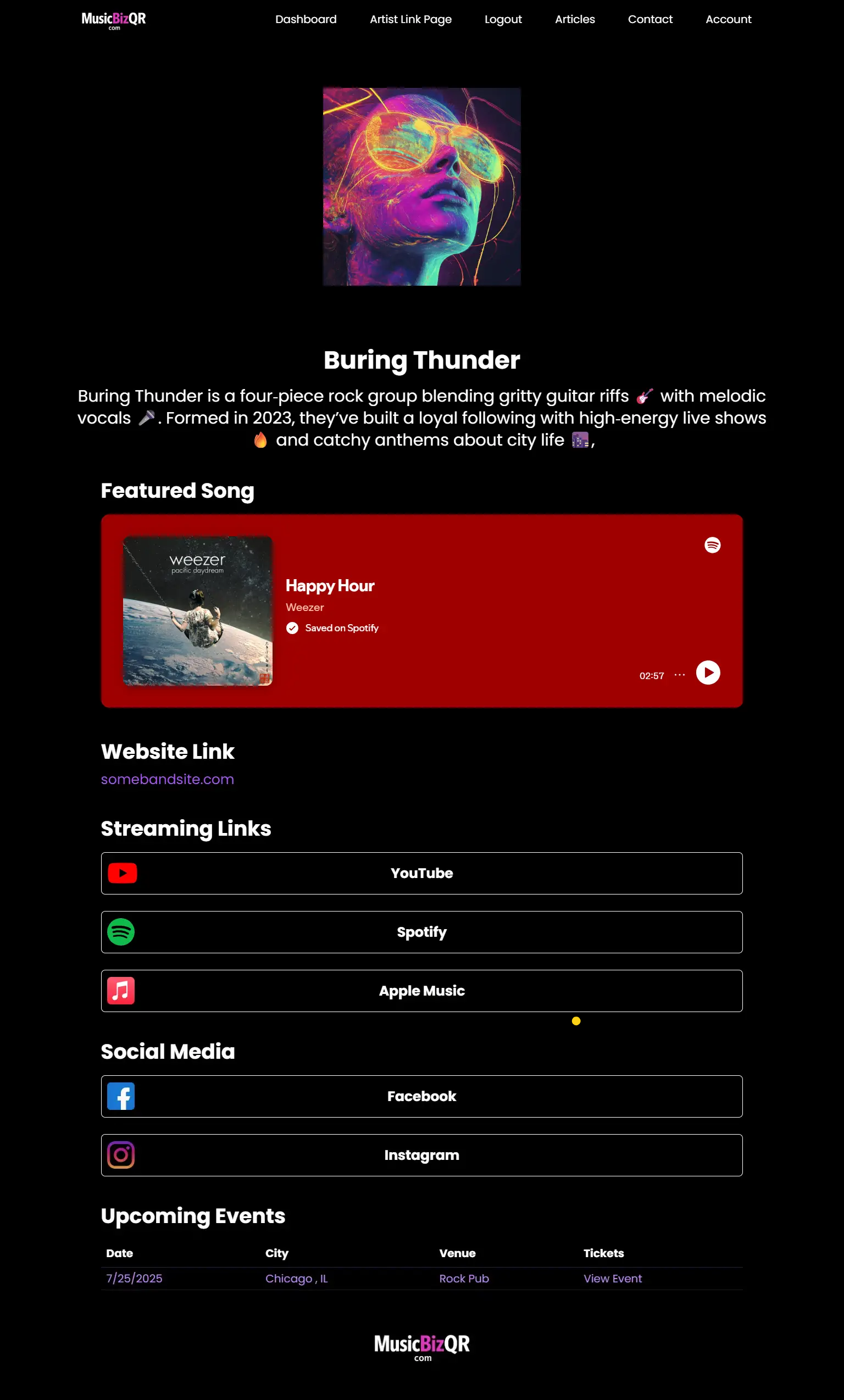
MusicBizQR gives artists a living digital stage — a space where embedded music, video, tour dates, and merch can breathe together. Instead of scattering your story across platforms, MBQ gathers it into one fluid experience. It’s the difference between pointing fans toward content and letting them experience it immediately.
Want to showcase a new single?
With MBQ, the player is right there. No friction. No detour.
Want a fan to linger longer?
They can watch a video, scroll photos, preview merch, or explore your upcoming shows all on the same page.
As explored in the Smart Links Pillar, the modern fan journey isn’t linear — it’s emotional, impulsive, intuitive. MBQ honors that. Linktree can’t.
This comparison isn’t just about feature lists.
It's about alignment.
- Linktree simplifies.
- MusicBizQR amplifies.
One treats your artistry as a collection of links.
The other treats it as a full ecosystem.
And once you feel the difference — once you see fans listening, watching, clicking, saving, and engaging without friction — it becomes obvious why more musicians are leaving generic link tools behind.
Feature Comparison: What Musicians Actually Need
When you strip away the branding and the marketing copy, every tool in this space is really answering one question:
“What does a working musician actually need this link to do?”
For most artists, the answer is not “show people a bunch of buttons.” It’s much more specific:
- Let fans hear the music without friction
- Let them watch the video that carries the story
- Give them one place where all platforms, tours, and releases make sense
- Show the artist what’s working so they can do more of it
This is where Linktree and MusicBizQR stop being comparable. Linktree gives you a static list of exits. MBQ gives you a toolkit designed around plays, repeats, saves, ticket sales, and long-term fan relationships — the stuff that actually matters.
Let’s walk through the differences, one layer at a time.
Embeds vs Buttons — Why Layout Changes Everything
Open a typical Linktree from a musician and you’ll see the same thing you’ve seen a hundred times: a logo, a background color, and a vertical stack of buttons. Every action requires another click. Every click is another chance to lose the fan.
Now imagine the fan’s experience on a MusicBizQR page.
They tap your link and:
- Your featured video is right there, already inviting them to hit play
- Your new single is embedded, not hidden behind a platform logo
- Your top streaming services sit just below, ready for one-tap saves
- Your tour dates and merch live on the same canvas, not a different website
The difference isn’t cosmetic. It’s structural.
Buttons say, “Go away from here to do the thing.”
Embeds say, “You can experience this right now.”
That’s why embedded content gets so much love in the smart links pillar: it collapses the distance between curiosity and action. MusicBizQR leans into that. Instead of forcing fans to jump through multiple pages just to hear a song, MBQ lets the music live front and center.
In a world where attention spans are shrinking, every extra click kills momentum. An embedded player and a video at the top of your page can be the difference between a casual glance and a new listener who stays.
Smart Layouts vs Static Lists
Linktree gives you layouts the way fast food gives you nutrition facts: technically present, functionally irrelevant. You can move buttons up and down. You can change colors and font weight. But the structure of the page never really changes. It’s still a list.
MusicBizQR treats layout like a creative medium.
You can:
- Lead with a hero visual or video that instantly sets the tone
- Group content into sections — new release, live shows, deep cuts, fan offers
- Highlight specific CTAs at different moments in your campaign
- Build separate experiences for different needs: releases, tours, VIP fans, festivals
Instead of a one-size-fits-all vertical stack, you’re building intentional flows. Fans who land because of a new song can be guided to:
- Listen.
- Save or follow.
- Discover more songs or videos.
- Join an email list or text club.
- Check out upcoming shows.
All on one page, in an order that makes sense.
When you combine that with insights from your broader smart-links strategy, your page stops being “link in bio” and starts becoming the front door to your artist ecosystem.
QR Codes That Actually Matter
Most bio tools treat QR codes like swag: a little extra you can download and slap on a poster if you feel like it. For touring or even local gigging artists, that’s a missed opportunity.
MusicBizQR was literally named around the idea that QR + smart links + analytics should be one system, not three different tools duct-taped together.
With MBQ:
- Every smart link can have a dynamic QR code
- You can print that code on posters, flyers, venue signage, table tents, wristbands, merch tags
- When someone scans, they don’t go to a generic page — they land in a purpose-built hub for that moment (show, release, tour, VIP signup, etc.)
- Muse analytics tracks QR scans along with page views, link clicks, and plays, so you see how offline attention turns into online action
So instead of a QR being “just another way to get to my Linktree,” it becomes part of a tight loop:
Flyer → Scan → Experience → Data → Better decisions for the next show.
That’s the kind of feedback loop you build whole touring strategies around.
Fan Funnels vs Button Clicks
Click counts are a nice ego metric. But they don’t tell you whether someone actually connected with your music.
Linktree Insights can show you which buttons get tapped, and that’s where the story usually ends. You don’t know what the fan did next. You don’t know how they moved through your world. You don’t know where you’re losing them.
MusicBizQR approaches analytics as fan funnels, not just link stats.
Muse tracks:
- Page views and where they came from (referrer, device, sometimes city)
- Which sections fans interact with most
- Which links and embeds actually drive plays, saves, or deeper engagement
- How fans move through your pages over time — like a path, not a one-off click
So instead of “300 people tapped my Spotify button,” you’re seeing patterns like:
- “Most people who watch my video also check out my tour dates.”
- “Fans in LA almost always hit the mailing-list sign-up after streaming.”
- “That new section I added for behind-the-scenes content keeps people on the page longer.”
Those are decisions you can act on, not just numbers you glance at once a month.
A smart link that doesn’t help you discover, build, and refine fan funnels isn’t really smart — it’s just prettier copy-and-paste.
Unlimited Pages for Bands, Releases, Tours, and Merch
This is another quiet killer.
With generic bio tools, you usually end up with one primary page. Every release, every campaign, every phase of your career gets crammed into the same space. Old links pile up. New ones get buried. Fans have to scroll through relics of past eras just to find what’s relevant now.
MusicBizQR encourages you to think in campaigns and chapters, not just “one link forever.”
You can spin up:
- A dedicated release hub for each single or album
- A tour page that focuses on dates, tickets, and local calls-to-action
- A band home page that tells your whole story
- A merch or drop page when you launch something special
- Even event-specific pages that live behind their own QR codes
Each one has its own analytics, its own layout, its own embedded content. And the main artist link can route fans to the right experience based on what you’re promoting.
Your world becomes a network of smart links that all report back to the same brain (Muse), instead of a single page trying to do everything badly.
For a casual creator, one page is fine. For a serious musician, one page is a choke point. MusicBizQR is built around the idea that your career will have multiple eras, releases, and campaigns — and your link infrastructure should grow with you.
Analytics Comparison: Muse vs Linktree Insights
If you’ve ever launched a song, pushed the link everywhere, and then stared at your analytics trying to figure out what actually happened, you already know the truth: musicians don’t suffer from a lack of numbers — they suffer from a lack of clarity. Linktree Insights gives you the kind of metrics that look helpful at a glance: clicks, taps, a few bars of activity. But after the initial dopamine fades, you’re left with the same nagging questions:
Did anyone listen?
Where did they come from?
What did they do next?
Why did some fans stay while others bounced?
Linktree can’t answer those questions because it wasn’t built to. Its model is transactional — a tap, a jump, a “bye.” MusicBizQR’s Muse analytics, on the other hand, were engineered around the emotional and nonlinear reality of music discovery. Muse doesn’t track clicks; it tracks journeys.
And the difference between a click graph and a journey map is the difference between hoping for momentum… and creating it.
The Limitations of Basic Click Tracking
Linktree Insights reduces the fan world to a single event: the tap.
- Someone tapped Spotify
- Someone tapped YouTube
- Someone tapped your merch link
That’s all it sees.
And because that’s all it sees, that’s all it can tell you.
But musicians don’t think in isolated taps.
Musicians think in movement:
- A fan watches your video, feels something, and scrolls deeper
- A curious listener taps the embedded player, then follows you on Apple Music
- A fan at a show scans your QR code, hits your new EP, and ends up on your tour page
- Someone discovers you on TikTok, lands on your page, saves your song, then watches every video you have
Linktree interprets these dynamics as separate taps. Muse interprets them as a story.
This is why musicians using Linktree often describe their analytics as “flat.” It’s not that the data isn’t there — it’s that the platform can’t see the depth of what’s happening.
What Artists Actually Need
Muse analytics give artists the kind of visibility usually reserved for major-label teams: granular, behavioral, deeply actionable. Instead of telling you which buttons were “popular,” Muse helps you understand the shape of your fanbase and how they travel through your world.
Muse tracks:
- Page views — the true entry points into your ecosystem
- Referrers — Instagram, TikTok, YouTube, search, email, QR scans, etc.
- Device + platform — how your audience actually consumes your content
- Top cities + regions — vital for touring and geo-targeted releases
- Media plays & completions — who listened, who watched, and how far they got
- Section-level engagement — which content blocks hold attention
- Time-of-day activity — your natural fan “rush hour”
- QR scan behavior — the real story of your offline presence
This isn’t just data. This is creative intelligence.
It’s the difference between:
Guessing which song to promote
Knowing which one fans keep replaying
Guessing where to route a small tour
Knowing the three cities that quietly exploded last month
Guessing whether your video is helping
Knowing that 42% of fans who watch it scroll deeper into your story
Once you see these patterns, it becomes almost impossible to go back to the shallowness of “top link clicks.”
Why Better Analytics Means Better Art and Better Marketing
Artists often think analytics are about marketing. In reality, analytics are about listening — not to the algorithm, but to your fans. Muse reveals how your art lives once you release it into the world. It shows:
- Which ideas resonate
- Which visuals spark curiosity
- Which moments inspire saves, follows, and shares
- Which platforms send true listeners versus empty traffic
- Which campaigns are alive… and which are dead on arrival
And when you begin creating with that kind of awareness, everything tightens:
Your release plans.
Your visual direction.
Your link layouts.
Your fan funnels.
Your storytelling as a whole.
This is why the smartest musicians are embracing the smart-links framework: because when you understand how fans behave, you no longer waste cycles on shots in the dark. You move with intention.
Linktree shows you what happened.
MusicBizQR shows you why it happened — and what to do next.
That’s the real difference. That’s why artists who switch to Muse rarely switch back.
Release Marketing: One Platform Helps, One Platform Gets in the Way
A song release is one of the most fragile moments in an artist’s career. You get only a few seconds — sometimes less — to turn curiosity into a listen, a listen into a save, and a save into momentum. And in those few seconds, the tools you use either amplify that moment… or choke it.
This is where Linktree quietly undermines musicians without meaning to.
A listener taps your bio link on release day, ready to hear the track — the moment is warm, alive, full of potential. But instead of the song meeting them where they are, they hit a page of buttons. Your music is now several clicks away. The emotion that brought them there starts cooling off. Half of them will bounce before taking action. The other half may still listen, but the magic of immediacy is gone.
Linktree didn’t design for this moment because Linktree wasn’t built for musicians.
MusicBizQR was.
MusicBizQR optimizes release day around one idea:
The faster a fan can hear the song, the higher the chance they stay in your world.
With MBQ, the release page isn’t a detour — it’s the destination.
When a fan taps your link:
- Your new single is embedded at the top, ready to play instantly
- Your music video can sit right beside it, building energy and narrative
- Your pre-save or follow links are positioned with intention, not hidden behind logos
- Your streaming platform buttons are still there, but they complement the experience instead of replacing it
- Your tour dates, merch drops, and social links live below, forming a natural flow from discovery → engagement → deeper connection
This changes everything.
Rather than forcing your audience through a maze, the music meets them in the first second — before doubt, distraction, or fatigue can interrupt the moment.
And that moment matters.
Artists who switch from Linktree to MusicBizQR typically describe the same transformation: release days start feeling alive again. Not chaotic, not luck-based — alive. You see fans playing the track immediately. You see how far they scroll. You see whether your video grabs them. You see which cities light up first. You see the story unfold in real time.
And because Muse analytics captures every move, you learn faster:
- Which visuals pull fans into the player
- Whether video-first or audio-first performs better for your genre
- What time of day your release actually peaks
- Whether TikTok or Instagram is sending the true listeners
- How many fans explore beyond the single
- What they check out next — merch, shows, older songs, socials
You’re not just releasing a song.
You’re understanding how that song lives.
This is why release-focused content plays such a key role in the broader smart-links ecosystem: your release page isn’t just a convenience — it’s the central hub of your momentum.
Linktree can support a release.
MusicBizQR can accelerate one.
One gives you a neutral page.
The other gives you a launchpad.
On release day, the difference isn’t subtle — it’s seismic.
Brand and Aesthetic Control: Artists Deserve More Than a Template
A musician’s world isn’t built from rectangles and buttons — it’s built from color, tone, feeling, texture. Every artist has an aesthetic, whether they’ve articulated it or not. It’s in the way a vocal line blooms, the way a guitar sits in the mix, the way a video frames light. Fans recognize this long before they know your name. They feel it.
So when your primary link — the place where most fans first meet you — looks like the same template used by influencers, affiliate marketers, and lifestyle brands, something sacred gets flattened.
This is the quiet harm of generic link-in-bio tools: they compress identity into sameness.
Linktree doesn’t mean to erase the nuances of your artistic presence, but that’s what happens when your story is forced into the same vertical stack everyone else uses. You can change colors. You can change button shapes. You can upload a profile image. But the soul of your world never makes it through the door.
MusicBizQR flips that power dynamic.
Aesthetic as Identity, Not Decoration
The best artists don’t just release songs; they build atmospheres. Fans don’t connect to audio alone — they connect to the universe around it. The typography, the palette, the sense of movement and silence… these things matter.
A release doesn’t live in isolation. It lives inside your world.
MusicBizQR allows the page itself to feel like part of the album, part of the tour, part of the story. Instead of selecting from a handful of “good enough” layouts, you design experiences that carry your emotional signature:
- Hero visuals that set tone before a fan reads a single word
- Sections that feel like chapters, not widgets
- Embedded media that creates a living focal point
- Layouts that breathe and stretch with your aesthetic
- Pages that evolve as your era evolves
Your visual world becomes the venue, and your link becomes its front door.
This is why the most intentional artists treat their smart link not as a utility, but as part of the creative arc. When the link matches the art, fans feel like they’ve stepped into your universe — not a fast-food template.
The Problem With Template Thinking
Linktree assumes that branding is surface-level. Background color. Font weight. Accent highlights. But musicians operate in a different mode. Branding for an artist is not decoration; it’s communication.
And on a platform where you cannot shape space — only rearrange buttons — communication gets diluted.
It’s why so many Linktrees look identical, even for artists with wildly different aesthetics. The structure forces sameness.
- Ambient artists look like trap artists
- Indie folk looks like hyperpop
- Metal looks like EDM
- The cinematic feels the same as the comedic
The container dulls the content.
What gets lost is everything that makes you distinct.
MusicBizQR Gives You a Page That Feels Like You
When a fan lands on a MusicBizQR page, they shouldn’t feel like they’ve opened a tool. They should feel like they’ve entered the first room of your creative world.
This is what brand-forward design enables:
- Hero images that set mood and character
- Custom sections that mirror the energy of your era
- Color worlds that align with your visuals and cover art
- Typography choices that feel intentional, not generic
- Strategic pacing — a page that unfolds like a narrative, not a menu
- Embeds that anchor the experience, not just sit inside it
Your page feels alive because it reflects the music it represents.
It’s this sense of coherence — music, visuals, story, layout — that turns casual visitors into followers and followers into fans.
When your aesthetic is the architecture, fans don’t scroll.
They explore.
Why Aesthetic Control Impacts Conversions
There’s a practical side to this too. Branding isn’t just expression — it’s strategy.
A strong aesthetic amplifies:
- Recognition
- Trust
- Emotional resonance
- Conversion
When a page visually mirrors the sound and story you’ve already built on TikTok, Instagram, YouTube, and Spotify, the fan’s brain relaxes. They feel continuity. They feel professionalism. They feel like you’ve thought this through.
That feeling translates into:
- More video plays
- More song streams
- More saves
- More ticket clicks
- More merch purchases
The pattern is simple: when a page looks like an artist’s world, fans stay longer. And when they stay longer, they take more meaningful actions.
This is why brand expression is foundational in the smart links ecosystem. It’s not a bonus. It’s not a luxury. It’s a necessity.
Linktree gives you a page that looks decent.
MusicBizQR gives you a page that looks like you.
And for artists, that difference is everything.
Pricing, Unlocks, and the Hidden Cost of “Free Tools”
Every musician knows the trap: a platform advertises itself as “free,” you sign up to save money during a tight release cycle, and for a few weeks it feels like you’ve hacked the system. Until you realize that the features you actually need — the ones that move the needle — sit behind a paywall designed to squeeze you just when your momentum starts to build.
Linktree perfected this model.
The free tier is wide enough to onboard you, but narrow enough to keep you plateaued. You get a link. You get some buttons. You get a couple of appearance tweaks. And then, the moment you try to do something meaningful — embed a video, view analytics beyond the basics, customize branding, integrate deeper content — you hit a wall.
Then you hit another.
Then another.
Each wall comes with a monthly price tag.
Linktree’s business model depends on limiting musicians until they pay for more. The problem? Most musicians don’t have “more” to pay. They’re promoting releases, funding sessions, paying for mixing, mastering, visuals, gear, travel, rent — all while hoping the next spike of fans actually lasts.
A smart link is supposed to accelerate momentum, not tax it.
MusicBizQR rejects the paywall-heavy strategy. The philosophy is simple:
Give artists the tools they actually need upfront. Charge fairly, clearly, and without tricks.
That difference becomes obvious the moment you start building.
The Death by a Thousand Paywalls
Here’s what the Linktree experience feels like for most musicians:
“I need to embed my new video.”
→ Paywall.“I want analytics that help me understand what’s working.”
→ Paywall.“I need more than one page because I have a release, a tour, and a band home.”
→ Paywall.“I want an actual design that feels like my brand.”
→ Paywall.“I want a QR code for my posters.”
→ Paywall.
By the time artists finish upgrading Linktree to support their real needs, they’re paying for a tool that still isn’t built for them.
They never realize that the limitations they hit weren’t accidental — they were structural. They were meant to encourage upsells, not empower musicians.
This is why so many artists feel like their link-in-bio isn’t evolving with their career: because they’re using a general-purpose tool built around constraints, not creativity.
MusicBizQR’s “Unlock Everything You Actually Need” Approach
MusicBizQR’s pricing is built around the realities of a musician’s workflow — not around blocking them until they pay.
From day one, you get the things a serious artist actually needs:
- Unlimited smart link pages — because your career isn’t one-dimensional
- Embedded content — music, video, files, visuals
- Dynamic QR codes — built into every page
- Muse analytics — not basic stats, but real fan insights
- Brand-forward layouts — pages that look like your world, not a commodity
- Event, release, and tour-specific pages — without add-ons or bundles
The goal isn’t to charge you for every step of the journey.
The goal is to give you a foundation strong enough to have a journey.
When artists switch from Linktree to MusicBizQR, they often describe the same feeling: “Everything I needed was just… there.”
No nickel-and-diming.
No surprises.
No punishing you for growing.
Instead, you get one platform that supports your career as it evolves.
The Real Cost of “Free”
Nothing in the music world is truly free — not gear, not promotion, not time. And definitely not tools. The question isn’t whether you’re paying money. It’s whether you’re paying in lost opportunity.
With Linktree, the real cost of the free tier is:
- Fans who bounce before reaching your music
- Release momentum that never ignites
- Analytics that don’t help you understand your audience
- A brand presence that blends into the noise
- Pages that cannot grow with your career
The price you pay isn’t financial — it’s strategic.
A tool that hides power behind a paywall quietly limits the shape of your career. A tool that unlocks power upfront accelerates it.
This is why pricing isn’t just a sidebar comparison.
It’s a philosophical divide.
Linktree charges you for access.
MusicBizQR invests in your growth.
One bets on scarcity.
The other bets on artists.
And in the long run, that difference determines whose career compounds and whose stalls.
Customization & Flexibility: Building Pages That Evolve With You
Every serious musician eventually hits the same realization: your link needs at the beginning of your career are not the same as your needs one year in, and definitely not the same as your needs five years in. As you grow, your releases grow. Your visuals grow. Your story grows. Your fanbase grows. And the architecture that houses all of that has to grow with you.
Most link-in-bio tools don’t understand this. They offer customization the way fast fashion offers individuality — a few colors, a few presets, maybe a gradient if you’re lucky. But the structure never changes. The creative cage remains the same.
That might work for influencers or creators whose content style is predictable.
It doesn’t work for musicians.
Your world evolves every era, and your tools need to evolve with you.
MusicBizQR was designed with that evolution in mind.
You’re Not Locked Into a Template — You’re Building a World
Linktree gives you templates.
MusicBizQR gives you canvas.
Instead of conforming your brand to a predefined layout, you design your link page the way you would arrange a setlist — with intention, flow, hierarchy, and emotional pacing.
With MBQ, you can:
- Swap page structures as your artistic era changes
- Reorder sections like chapters of a story
- Highlight what matters right now — new singles, tour dates, videos, merch
- Build campaign-specific flows that send fans exactly where they need to go
- Experiment with layouts until the page feels like part of your universe
Your smart link isn’t a static profile.
It’s an evolving expression of your career.
For emerging artists, this means your page can grow with your confidence and catalog. For established musicians, it means each release cycle can have its own visual language, its own energy, its own identity — without forcing fans through a single, rigid format.
Release Cycles Change — Your Page Should Too
Music is released in eras.
You might spend six months crafting visuals and storytelling around a single project. But Linktree forces every era into the same skeleton: buttons stacked on buttons, no cinematic reveal, no shift in atmosphere.
MusicBizQR lets you redesign the experience every time your sound shifts.
Imagine:
- A minimalist page for an intimate acoustic project
- A bold visual-first page for a high-energy pop release
- A moody, cinematic layout for an alt-electronic cycle
- A live-tour-focused page with dates, QR tickets, and video clips
- A merch-heavy page during a holiday push or limited drop
You’re not updating a link.
You’re rewriting the entrance to your world.
This level of flexibility is part of what makes large-scale smart-link ecosystems — like the one outlined in the smart links pillar — so powerful. Your page becomes a living asset, not a static bio tool.
Multiple Pages, Multiple Roles, Zero Restrictions
Artists don’t need one page.
They need many.
Because the fan who comes for your single is not the same fan who comes for your tour.
And the fan who saw your music video is not the same as the fan who wants behind-the-scenes content.
With MusicBizQR, you can create:
- A release hub for each single and album
- A tour page with dates, ticket links, and live clips
- A band home page that introduces your story
- A merch showcase for drops and exclusives
- An event-specific QR page for festivals or hometown shows
- A VIP or fan-club page for superfans
Each page has its own analytics, its own energy, its own purpose.
Linktree isn’t designed for this level of segmentation — its structure assumes a one-size-fits-all approach. But musicians operate in ecosystems. Each page becomes a portal into a different part of your creative universe.
And Muse ties it all together with clarity.
Your Link Should Feel Like a Creative Tool, Not a Limitation
The most powerful creative tools don’t limit expression — they expand it.
MusicBizQR approaches customization the way artists approach sound design: give them core elements, then let them shape, bend, stretch, and evolve until the result feels uniquely theirs.
You’re not rearranging presets.
You’re curating an experience.
As your story deepens, your page deepens.
As your visuals change, your page changes.
As your audience grows, your link grows with them.
This flexibility is what makes MBQ feel less like a smart-link platform and more like a creative companion — one that understands the evolving nature of artistry, momentum, and fan connection.
Linktree gives you enough customization to look presentable.
MusicBizQR gives you enough flexibility to build a world.
And that world is where fans decide whether they visit once… or stay forever.
Artist Identity, Emotion, and Why Your Link Experience Matters More Than You Think
Music discovery isn’t logical. It’s emotional. A fan doesn’t connect with your art because they made a rational calculation — they connect because something in the sound, the visual, the energy, the frequency of your world hits them in a place that feels personal. Music is an emotional transaction long before it becomes a digital one.
And this is the part of the artist-fan interaction that Linktree completely misses.
A link-in-bio tool should not be a hallway. It should be a moment — a moment charged with the same emotional texture as your work. When a fan taps your link, they’re stepping into the threshold of your universe. What happens in the first two seconds matters tremendously.
If they’re met with a generic background and a pile of buttons, the emotional state that brought them there begins to dissolve. The curiosity fades. The spark cools. The connection weakens. The inner voice that said “Go deeper” suddenly goes quiet.
MusicBizQR exists to protect that spark.
It’s built around the simple belief that your link experience is part of your identity, part of your storytelling, part of your artistry. It should elevate the emotional threshold — not flatten it.
Every Fan Touchpoint Is Emotional
Think about the moments that create true fans:
- Hearing a melody that feels like a memory
- Seeing a visual that captures a mood they’ve been living in
- Watching a video that says the thing they’ve been trying to articulate
- Feeling a lyric strike where language fails
- Experiencing a performance that rewires something inside them
Now imagine funneling that person — that emotionally activated listener — into a template that looks like every other creator on the planet.
The emotional voltage drops instantly.
This is why so many musicians lose potential superfans in the transition from content → link → song. Not because the music isn’t good. Not because the fan wasn’t ready. But because the emotional continuity broke in the middle.
A link page should extend your emotional world, not interrupt it.
Identity Isn’t Optional — It’s the Core of Fanbuilding
Every great artist has a center of gravity — a sound, a feeling, an aesthetic that fans orbit around. This identity isn’t something you slap onto your music; it lives inside your music. It’s in the vocal tone, the textures, the color palette of your visuals, the stories you tell, and the places you perform them.
MusicBizQR allows your link to participate in that identity.
- Your visuals lead
- Your embeds embody the mood
- Your layout shapes the pacing
- Your text and language add character
- Your sections mimic the emotional arc of a song or album
Instead of being a neutral bridge, your link becomes an extension of the art.
And fans feel that.
Emotionally.
Immediately.
Identity creates connection.
Connection creates loyalty.
Loyalty creates longevity.
This is the architecture of a sustainable career — and every touchpoint matters.
Emotional Continuity = Higher Conversions
This isn’t just poetic. It’s practical.
When fans feel emotionally aligned with your page, they’re:
- More likely to hit play
- More likely to watch the embedded video
- More likely to save or follow
- More likely to check older music
- More likely to explore your tour or merch
- More likely to return
The reason is simple: emotion drives behavior.
When the link experience feels like part of your world, fans don’t skim — they sink in. They’re not looking for an exit. They’re looking for the next moment.
Linktree pages create drop-off because they create emotional dissonance.
MusicBizQR pages create exploration because they create emotional coherence.
This emotional continuity is a core principle in the smart links ecosystem, and it’s why musicians who switch rarely go back. Once you experience how a world-built link feels, the idea of stepping into a template again becomes unthinkable.
Your Link Is Not a Utility. It’s a Stage.
For musicians, the link-in-bio shouldn’t be the backstage of your career. It should be a stage of its own — a stage where your story continues, where your energy carries over, where your aesthetic breathes.
When a fan taps your link:
- They should feel the warmth or the edge of your sound
- They should sense the era you’re in
- They should recognize the emotional fingerprint of your art
- They should be guided deeper without friction or confusion
MusicBizQR treats your link page as part of the performance — a visual, emotional, narrative extension of your music itself.
Linktree gives you a functioning page.
MusicBizQR gives you a living impression.
And in the music world, impressions aren’t cosmetic — they’re transformative.
The Real Difference: Linktree Was Built for Everyone. MusicBizQR Was Built for Artists.
If you look closely, every platform reveals the assumptions of the people who built it. Linktree was created for the broadest possible audience — influencers, bloggers, affiliate marketers, small businesses, podcasters, creators of every shape and size. And because it was built for everyone, it was optimized for no one in particular.
But musicians aren’t “everyone.”
Musicians are a category of one.
Your work isn’t transactional — it’s transformational. You’re not selling products; you’re creating experiences. You’re not offering information; you’re shaping emotion. You’re not pointing people toward external platforms; you’re inviting them into a story.
This is the divide that Linktree cannot cross. It wasn’t designed with the emotional, aesthetic, or structural realities of music in mind. It was designed to solve a general problem: too many links, not enough space.
MusicBizQR solves an entirely different problem: how to turn moments of fan interest into lasting connection, artistic immersion, and meaningful engagement.
The gap between those two design philosophies is the gap musicians feel every time they try to make Linktree do something it wasn’t built for.
Linktree Is a Directory. MusicBizQR Is an Experience.
Linktree organizes links.
MusicBizQR organizes worlds.
This is the fundamental difference.
When a fan taps your MBQ page, they’re not walking into a list — they’re stepping into a curated environment:
- Embedded music that plays instantly
- Videos that define the mood of the moment
- Sections arranged to guide emotion and attention
- Visual language that matches your era or release cycle
- Layouts that adapt to campaigns, stories, and seasons
- Analytics that reveal how fans move through your world
Linktree treats links as destinations.
MusicBizQR treats the page itself as the destination.
That single shift changes how fans behave, how you design releases, how your story unfolds, and how your career compounds over time.
One Platform Measures Taps. The Other Measures Fans.
Linktree tells you what was clicked.
MusicBizQR tells you who connected, how deeply, and what they responded to.
Muse analytics was shaped around real artist questions:
- Which content invites fans deeper?
- Which songs truly resonate?
- How long do fans explore once they land?
- What draws them into the next chapter of my world?
- What do offline interactions — posters, flyers, QR scans — actually lead to?
Linktree’s data answers questions a marketer might ask.
Muse answers questions a musician needs.
This is why artists who switch often say the same thing:
“It feels like my link finally understands me.”
One Platform Gives You Buttons. The Other Gives You Tools.
Musicians don’t need more buttons. They need:
- Tools that amplify releases
- Systems that help build fan funnels
- Pages that feel like extensions of their sonic identity
- Layouts that evolve with their career
- Analytics that lead to better creative and strategic decisions
Linktree can’t provide those because it wasn’t built with the complexity of artistry in mind. It’s a universal key — useful, flexible, but shallow.
MusicBizQR is a crafted instrument.
It’s built around the rhythm of a musician’s workflow:
- Release → Momentum → Analysis → Adjustment
- Tour → Tickets → QR scans → Fan behavior
- Video drops → Engagement → Exploration
- Storytelling → Identity → Emotional continuity
It helps artists operate with intention instead of hope.
A Tool Built for Everyone Eventually Holds You Back
This is the truth no one says out loud:
A tool designed for everyone eventually becomes a limitation for artists who want to grow beyond the basics.
Linktree is great until you need:
- Real analytics
- Real identity
- Real emotional continuity
- Real release strategy
- Real fan movement insights
- Real multi-page ecosystems
- Real storytelling power
- Real control
At that point, its strengths become its ceilings.
MusicBizQR was built for the turning point — the moment an artist says,
“I’m ready to grow, and I need tools that grow with me.”
Linktree can get you started.
MusicBizQR can carry your career forward.
One is a quick fix.
The other is a foundation.
One is a list.
The other is a world.
And musicians deserve a world.
Case Study: A Before/After Look at a Real Artist Migration
Every comparison is abstract until you see what actually happens when a working musician moves from Linktree to MusicBizQR. So let’s walk through a real-world scenario — a composite case study built from dozens of actual artist migrations — to show how dramatically the link experience changes when the tool finally matches the artist’s needs.
Meet Lina, a rising indie-pop singer-producer with a strong visual identity and a small but passionate fanbase. She’s got 18k followers on TikTok, 6k on Instagram, and a fiercely loyal core audience of early listeners. Her music is dreamy, textured, cinematic — and her visuals follow the same vibe. But for over a year, Lina used Linktree.
And like most musicians, she didn’t realize how much she was losing until she switched.
Before: The Linktree Plateau
For Lina, Linktree seemed “good enough.”
Her page included:
- A profile image
- A pink gradient background
- A Spotify button
- A YouTube button
- A merch link
- An upcoming show ticket link
- A mailing list button
It looked clean on the surface. But beneath that simplicity was a set of problems she couldn’t see clearly:
- Bounce was high. Fans tapped the link, hesitated at the button list, then left.
- Video watch time was nearly nonexistent. YouTube didn’t autoplay and was hidden behind a click.
- Her emotional universe wasn’t present. The template drowned her aesthetic.
- One page had to serve every purpose. Release day, tour day, merch drops — all shoved into one vertical stack.
- Analytics told her almost nothing. “Top Link Clicks” wasn’t helping her plan anything.
- QR codes weren't integrated. Posters and flyers felt disconnected from her link ecosystem.
But the biggest issue was invisible:
Her story wasn’t reaching fans. Only her links were.
The link wasn’t hurting — but it wasn’t helping.
It wasn’t amplifying anything.
It wasn’t deepening connection.
It wasn’t keeping people in her world long enough for the music to work its magic.
She was generating interest without capturing it.
After: The MusicBizQR Transformation
When Lina migrated to MusicBizQR, she rebuilt her link ecosystem from the ground up — not through extra work, but through better tools.
Her main artist page immediately changed the emotional atmosphere:
- A cinematic hero image from her latest video
- An embedded music player of her new single, autoplay on tap
- A featured video placed above the fold
- A deep blue/purple color world matching her current era
- Tour dates in a dedicated block with venue-specific QR codes
- A story section where she could speak directly to new fans
- A merch callout seamlessly integrated into the visual flow
Instead of a list, the page became a scene — a moment fans could feel.
And then the metrics began to shift.
The Hard Numbers: What Changed in the First 30 Days
After switching to MusicBizQR:
- Page engagement time increased by 2.7×
- Video plays jumped by 168%
- Stream clicks doubled
- Saves + follows rose noticeably on Spotify & Apple Music
- Fans were exploring 2–3 sections instead of bouncing after one
- Tour ticket clicks increased by 41%
- Mailing list sign-ups became consistent instead of occasional
The biggest leaps came from two things Linktree can’t replicate:
Embedded content above the fold
Fans could hear her world in the first second — no extra taps.Emotional continuity
The page matched her sound, visuals, and storytelling, creating a seamless emotional bridge between content and action.
Muse analytics showed another surprise:
Fans coming from TikTok were not the ones who bought tickets.
But fans from QR scans at local shows were her highest-value audience — they explored the most, bought the most, and returned the most.
Armed with this insight, she began placing dynamic QR codes around venues. Her local fanbase deepened, merch sales increased, and her shows felt fuller.
This wasn’t strategy from guesswork.
This was strategy from clarity.
The Emotional Change: Fans Began Staying Longer
The metrics were great. But the emotional feedback was even better.
Fans DM’d her things like:
“Your link feels like an extension of your album. It’s so cool.”
“I love how I can listen and explore without leaving the page.”
“Your world feels more real now.”
This matters more than any individual click.
Because when fans feel like they’ve stepped inside your world, the relationship shifts.
They stop skimming.
They stop comparing.
They start connecting.
What This Case Reveals
This isn’t just Lina’s story — it’s the story of many musicians who switch to MusicBizQR.
The pattern is consistent and predictable:
- Template → world
- Buttons → experiences
- Clicks → journeys
- Basic stats → fan behavior insights
- One page → many purposes
- Guesswork → informed strategy
Linktree can list your links.
MusicBizQR can lift your career.
Because it isn’t just a tool — it’s a narrative engine, a design system, an analytics brain, and an emotional extension of your art.
And once artists feel the difference, they rarely look back.
Why Artists Are Switching: The Big Picture
If you zoom out far enough, you can see the entire landscape shifting under musicians’ feet. The days of treating a link-in-bio as a disposable utility are over. Artists are realizing that the link isn’t a side element — it’s the gateway, the handshake, the opening scene, the first room a fan steps into when they leave the algorithm and come directly to you.
And in that moment, musicians are waking up to a hard truth:
Generic link tools can’t carry the emotional, visual, and strategic weight of a modern music career.
This is why the migration away from Linktree isn’t random. It’s a pattern — a pattern driven by something deeper than features, pricing, or aesthetics. It’s driven by alignment. Artists are choosing tools that align with how they create, how they release, how they perform, and how they build worlds.
MusicBizQR isn’t “winning” because it’s technically better — though it is.
It’s winning because its worldview matches the worldview of musicians.
Let’s break down the shift.
The Algorithm Is No Longer the Center — the Artist’s World Is
For years, the algorithm was the primary driver of music discovery. TikTok, Instagram, YouTube Shorts — these platforms decided whose music surfaced, who caught a viral moment, who rose out of nowhere.
But every artist who has lived through a viral spike knows the truth:
A moment isn’t a career.
A spike isn’t a foundation.
A trend isn’t a fanbase.
What sustains a career is your world — the atmosphere you create, the way you present your art, the emotional continuity you maintain, the story you tell across every touchpoint.
Linktree exists outside that world.
MusicBizQR lives inside it.
Artists are switching because they’re tired of sending fans from their carefully crafted visuals into a page that feels detached from the identity they’ve worked so hard to build.
They want their link to reinforce their world, not interrupt it.
Fans Don’t Want Lists — They Want Experiences
Music is immersive.
Lists are not.
A button list cannot hold attention. It cannot carry emotion. It cannot reflect tone or atmosphere. It cannot breathe with your aesthetic. It cannot showcase your music or visuals without asking for extra steps.
This is why Linktree feels increasingly old-fashioned to musicians — because it forces the fan journey into a utilitarian shape that contradicts the very nature of music discovery.
MusicBizQR replaces the list with a living experience:
- Embedded content
- Visual storytelling
- Section-based pacing
- Campaign-driven layouts
- Dynamic QR interactions
- Analytics that illuminate behavior
Artists are switching because experiences convert. Experiences build memory. Experiences make fans stay.
The Data Gap Has Become Impossible to Ignore
Musicians used to accept basic stats because they didn’t know anything better existed. But once artists see what Muse analytics reveals — fan journeys, behavioral patterns, engagement flows, city-level listening insights — going back becomes unthinkable.
Linktree answers the question:
“What did they click?”
MusicBizQR answers:
“What did they feel? Where did they go? How deeply did they engage? What should I do next?”
Artists are switching because better data makes the creative process richer, smarter, and more sustainable.
The Career Path Has Evolved — Tools Must Follow
A modern musician doesn’t just release music. They:
- Build ecosystems
- Design experiences
- Run micro-campaigns
- Manage identities
- Engage fans across multiple worlds
- Tell stories in fragments and chapters
- Sell tickets, merch, bundles, and narratives
- Grow communities both online and offline
- Use QR codes, short-form content, and touring to fuel growth
Linktree wasn’t built for that complexity.
MusicBizQR was shaped by it.
Artists are switching because they’ve outgrown tools that don’t understand the reality of a creative career in 2025 and beyond.
The Emotional Reason: Artists Want Something That Feels Like Themselves
There’s also a quieter, more personal reason behind the migration.
Artists want a platform that feels like:
- their sound
- their aesthetic
- their era
- their story
- their intention
- their emotional presence
MusicBizQR pages feel like the beginning of a song, the opening shot of a music video, the atmosphere of a live show. They feel lived-in, expressive, cinematic. They feel like part of the art itself.
Artists are switching because they finally see a link tool that treats them like artists.
The Big Picture
Musicians aren’t moving from Linktree to MusicBizQR because one button looks nicer or one analytic chart is more colorful. They’re moving because one platform aligns with the deeper truth of their work.
Linktree solves a technical problem.
MusicBizQR solves an artistic one.
And as artists grow — emotionally, conceptually, professionally — they choose tools that grow with them. Tools that understand them. Tools that elevate them. Tools that amplify their world instead of flattening it.
This is the big picture:
The future of music discovery belongs to artists who build worlds — and to the tools that help bring those worlds to life.
Final Verdict: MusicBizQR Isn’t Just an Alternative — It’s the Upgrade Artists Have Been Waiting For
Every few years, the music landscape shifts in a way that reveals which tools were built for longevity and which were built for convenience. Linktree came at a moment when creators desperately needed a simple way to organize links. It solved a real problem. But as musicians grew more ambitious — visually, strategically, emotionally — the cracks began to show.
Artists don’t need a digital business card.
Artists need a creative engine.
And that’s the truth sitting at the heart of this comparison: MusicBizQR isn’t just a “better Linktree.” It’s a tool that aligns with the actual shape of a musician’s life. It’s built for the messy, powerful, nonlinear journey of creating art, launching releases, building identity, and inviting fans into a world.
Linktree is static.
MusicBizQR is cinematic.
Linktree organizes clicks.
MusicBizQR orchestrates fan journeys.
Linktree shows you what happened.
MusicBizQR helps you understand why it happened.
Linktree hands you a template.
MusicBizQR hands you a stage.
That’s the verdict musicians are arriving at organically as they grow. Not because someone told them to switch, but because at a certain point in their career, the needs of their art outgrow the limits of a tool built for everyone.
MusicBizQR Isn’t Just a Platform — It’s a Philosophy
Behind every feature of MBQ is a worldview:
- Art deserves atmosphere
- Music deserves context
- Fans deserve meaningful entry points
- Analytics should illuminate, not confuse
- A link should elevate the moment, not break it
- A page should feel like a chapter in your story
- Creative work requires tools that evolve, stretch, and deepen
This philosophy is woven into the design, the layout options, the embedded media, the analytics engine, the QR ecosystem, and the flexibility to build pages for every era of your career.
It’s a platform built from the inside out — from the perspective of how music actually spreads, how fans actually behave, and how artists actually grow.
The Momentum Compounds
Artists who switch to MusicBizQR almost always describe the same downstream effects:
- More fans stay longer
- More fans listen, watch, scroll, explore
- Release cycles feel smoother, more intentional
- QR codes amplify the real world with digital precision
- Analytics turn from vanity metrics into actionable insights
- Brand identity becomes clearer and more consistent
- Fanbases deepen instead of scattering
- Ecosystems form organically around the music
It’s not one feature.
It’s not one upgrade.
It’s the compounding effect of a system built for artistry rather than utility.
Every piece enhances every other piece.
And that’s how modern careers grow.
For Musicians Who Are Ready to Level Up
If you’re an artist in your first chapter, Linktree is fine — it won’t hold you back yet.
But if you’re an artist entering your serious era — releasing consistently, building visuals, shaping identity, touring, constructing a narrative around your sound — you eventually reach the moment where you realize:
You need a platform built for the weight of your world.
A link that doesn’t just organize your journey,
but accelerates it.
A page that doesn’t just display your identity,
but extends it.
A tool that doesn’t just track your actions,
but illuminates fan behavior in a way that shapes your next move.
That’s MusicBizQR.
The upgrade isn’t cosmetic — it’s foundational.
The Verdict in One Line
Linktree helps people find your links.
MusicBizQR helps people find you.
And in the music world, that difference changes everything.
FAQ
Why should musicians choose MusicBizQR over Linktree?
Because Linktree was built for everyone — influencers, creators, small businesses — while MusicBizQR was built specifically for artists. Musicians need more than a list of buttons; they need a place where fans can experience music instantly, explore visuals, follow emotional cues, and move through a world that matches the artist’s identity. Embedded media, dynamic layouts, Muse analytics, and multi-page ecosystems make MBQ fundamentally more aligned with the realities of music discovery and fan-building.
Does MusicBizQR really improve release-day performance?
Yes — dramatically. When fans land on a MusicBizQR page, they can hear the new song instantly through embedded players and see the visuals that define the era. This immediacy raises engagement, increases saves, boosts plays, and reduces drop-off. Artists often see measurable increases in stream conversions, video plays, and deeper exploration because the emotional continuity of the release is preserved.
How does Muse analytics differ from Linktree Insights?
Linktree shows what was clicked. Muse shows how fans moved. It reveals page flows, top sections, media engagement, QR scan behavior, referrers, device breakdowns, and city-level insights. Instead of basic counts, you get actual fan-journey intelligence. This helps musicians improve release strategies, route tours, identify high-value audiences, and design better link pages that convert curiosity into connection.
Can MusicBizQR support multiple pages for different campaigns?
Absolutely. This is one of the biggest advantages over Linktree. Artists can create unlimited pages for releases, tours, merch drops, fan clubs, festival appearances, and more — each with its own aesthetic, embedded media, and analytics. Instead of cramming everything into one generic page, you build a network of experiences that match each moment of your creative life.
Does MusicBizQR work for live shows and offline promotion?
Yes. Every page can generate a dynamic QR code. Artists use them on posters, venue signage, flyers, merch tags, wristbands, and even stage visuals. Muse analytics tracks scans alongside page views and plays, showing how offline attention becomes online engagement. This gives musicians a full picture of how real-world interactions convert into fans.
Will my MBQ pages still look good if I don’t have a designer?
Yes. MusicBizQR was built to make musicians look polished without needing design training. Pre-built layouts guide flow and pacing, embeds add instant emotional weight, and the platform encourages visual consistency with your existing aesthetic. Even minimalist pages feel cinematic because the structure is driven by artistry, not templates.
How hard is it to switch from Linktree to MusicBizQR?
It’s simple. Most artists recreate their existing link structure in minutes. The real transformation comes from upgrading the experience: adding embeds, adjusting layout flow, and aligning visuals with your era. The moment you see your music living at the top of the page — playing instantly — you’ll understand why artists call the switch a creative unlock.
Does MusicBizQR help artists grow long-term, not just on release days?
Yes. MBQ isn’t a release-day tool — it’s a career infrastructure. It supports every era, every campaign, every expression of your story. With multi-page ecosystems, deep analytics, QR integrations, and aesthetic flexibility, MusicBizQR becomes the connective tissue of your world. It helps fans move from curiosity to connection to loyalty over months and years, not just during spikes.
Is MusicBizQR only for bigger artists, or does it help beginners too?
It helps both. Beginners benefit immediately from looking polished, having embedded content, and being able to build multiple pages without paywall traps. Established artists benefit from the analytics, multi-page ecosystems, and brand-forward design. The platform grows with you — something Linktree can’t do.
How does MusicBizQR actually help build real fans?
By reducing friction, increasing emotional continuity, and guiding fans through intentional experiences. When fans hear your music instantly, explore your visuals, watch your videos, and feel your world in the first seconds after tapping your link, they form deeper associations. MusicBizQR is designed for that psychological moment — the moment where a listener becomes a fan.
Built for Musicians. Powered by Smart Links.
Faneqo gives you a powerful landing page with streaming links, videos, social buttons, and real-time fan analytics — all from a single QR code.
- 🎯 Unlimited link clicks & analytics
- 📈 Track Spotify streams, YouTube plays, and QR scans
- 📱 Mobile-optimized artist pages
- 🚀 Create your first Smart Link in seconds
Related Posts
Most link-in-bio tools weren’t built for musicians. Discover why smart links create better fan journeys, stronger branding, and higher conversions for your music.
Smart links for musicians explained—how they work, why they matter in 2026, and how to build a fan-converting link that drives your music career.
Discover how music links can help artists guide fans across platforms effortlessly. Learn strategies to boost engagement, streams, and merch sales.
Most link-in-bio tools weren’t designed for musicians. Learn why smart links deliver better fan engagement, stronger branding, and real music-driven revenue.
Smart links aren’t just utility tools — they’re the new frontier in artist branding. Learn how visual design, consistency, and fan-centric smart links define a musician’s digital identity.
Discover how smart links can transform fleeting music streams into lasting fan connections. Learn the strategies indie artists use to grow their audience in the streaming era.
Discover how smart links empower indie artists to create deeper, lasting relationships with fans. Turn every click into meaningful engagement.
Discover 2026’s best smart link tools for artists. We compare top platforms, fan engagement features, and why MusicBizQR stands above the rest.
Learn how direct-to-fan video turns your smart link into a conversion machine. Build trust, drive streams, and make real fan connections with MusicBizQR.
Learn how to use music links to drive fan engagement, increase streams, and promote your music like a pro. Built for modern artists and bands. Shall I begin writing the Markdown content for this article now?
In 2026, discovery is chaotic — and smart links are how artists bring it all together. Explore how music smart links guide fans, boost streams, and create real momentum across every platform.
Tired of generic link tools? Discover the smart link platform built for music: video previews, analytics, and full artist control—all in one sleek page.
Every new release deserves more than a link in your bio. Learn how to use smart links to drive streams, collect fans, and turn a single drop into lasting momentum.
The layout of your smart link page can make or break your fan engagement. Learn the design psychology that turns clicks into superfans.
If you're still sending fans to scattered links, you're leaving money on the table. Here's why every indie artist needs a smart link strategy to grow, connect, and convert.",
Most smart links just sit there. This guide shows musicians how to build a smart link page that turns casual clicks into lifelong fans. Real strategies that work.
Discover the psychology behind smart link layout design and how it shapes fan engagement, conversions, and merch sales.
Master the art of launching music with smart links. This guide shows how to create hype, drive streams, and maximize impact every time you drop a new release.
Your smart link is your new homepage. Learn how to design a 2026-ready page that plays your music instantly, tells your story, and converts fans the moment they land.
Learn how musicians can use smart links to connect directly with fans, bypass algorithms, and drive engagement, streams, and merch sales.
Discover how embedded content like music, videos, and social posts can turn your smart link into a fan engagement engine. Boost streams, merch sales, and loyalty.
Discover why smart links are transforming music marketing in 2025. Learn how a centralized hub can grow your audience, boost streams, and drive real fan engagement.
From Spotify embeds to merch and tour links, MusicBizQR makes music promotion easy. Learn how to use smart links to streamline your entire fan funnel.
Learn five powerful ways smart links can revolutionize your band's music promotion, amplify fan engagement, and strengthen fan loyalty.
Discover how smart links are revolutionizing music promotion, increasing fan engagement, boosting streaming numbers, and enhancing concert attendance.