
The Psychology of Fan Conversion: Why Smart Links Outperform Link-in-Bio Tools Every Time
Introduction — Why Fan Behavior, Not Features, Decides Everything
There’s a moment — tiny, electric, almost invisible — that decides the future of your entire fanbase. It happens right after someone discovers you. Maybe it’s the hook on TikTok that hits just right. Maybe it’s a clip from last night’s show that slips into their feed. Maybe it’s a friend’s Story where your track plays underneath a dimly lit bar scene.
Whatever the spark is, the fan taps your link while the emotional residue of that moment is still warm.
And this is where most artists lose them.
Not because the music wasn’t good. Not because the fan wasn’t interested.
But because the psychology of the moment was completely misunderstood.
For years, musicians have been told the difference between a link-in-bio tool and a smart link is about features: more buttons, better layouts, prettier pages, or extra options. But the truth is far more fundamental — and far more powerful.
Fans don’t convert because of features.
Fans convert because of how they feel when they land.
Music is emotional. Discovery is emotional. Curiosity is emotional.
But most artists send fans to a page that behaves like a spreadsheet — a static list of exits that interrupts the exact feeling that brought someone there.
That interruption is everything.
Because in the first two to three seconds, the human brain isn’t looking for information.
It’s looking for continuity — the sense that it has stepped from one emotional moment directly into the next.
Smart links outperform link-in-bio tools not because they look better…
but because they protect that emotional thread.
They preserve momentum.
They honor the spark.
They match the fan’s psychological state instead of jolting them out of it.
And in a world where attention is fast but attachment is rare, the artists who understand these psychological mechanics are the ones who win.
This isn’t an article about tools.
It’s an article about human behavior — the real reason some links convert fans effortlessly while others quietly kill all momentum.
Welcome to the part of music marketing nobody explained to you…
but every successful artist already knows by instinct.
Table of Contents
- Introduction — Why Fan Behavior, Not Features, Decides Everything
- The Science of First Impressions — What Happens in the First 2–3 Seconds
- The Hidden Flaws of Link-in-Bio Tools (And Why Musicians Feel the Pain First)
- The Emotional Physics of Fan Attention (And Why Musicians Can’t Afford Friction)
- Why Most Link-in-Bio Tools Fail Musicians at the Exact Moment It Matters Most
- The Emotional Continuity Principle — Why Music-Based Journeys Require a Different Kind of Link
- Smart Links as Guided Fan Journeys — Not Menus, But Movements
- The Hidden Role of Emotion in Click Behavior — Why Fans Choose One Path Over Another
- The Multi-Page Strategy — Why One Smart Link Isn’t Enough Anymore
- The Technical Divide — Why Smart Links Are Built for Music and Link-in-Bio Tools Aren’t
- Muse Analytics — The Power Behind the Smart Link Movement
- Aesthetic Congruence — Why Smart Links Preserve the World Your Music Lives In
- The Multi-Page Advantage — Why One Link Isn’t Enough for Artists in 2026
- The Fan Journey Split Test — Traditional Link vs. Smart Link (A Real Comparative Walkthrough)
- The Future: Links Are Becoming Experiences (And Musicians Who Adapt Will Win)
- Conclusion: The Artists Who Win Are the Ones Who Understand the Moment
- FAQ
The Science of First Impressions — What Happens in the First 2–3 Seconds
A fan’s first impression of your smart link is not logical. It’s not analytical. It’s not even conscious.
It’s neurological — a tiny cascade of emotional and sensory responses that fire before the thinking brain ever wakes up.
When someone taps your link after hearing your music on TikTok, Instagram, YouTube Shorts, or even a live show clip, their brain is still humming with what researchers call emotional residue — a lingering echo of the feeling your music created. That feeling is fragile. It lasts seconds, not minutes. And whether your link strengthens it or shatters it determines almost everything that follows.
This is where most musicians massively underestimate the importance of the first 2–3 seconds.
Second 1: Emotional Expectation
The fan’s brain expects one thing above all else: continuity.
Not information. Not utility. Not a list.
They expect the moment they just had — the spark — to keep going.
If they arrive on a page that feels like your music, their emotional circuitry stays open.
If they arrive on a generic, silent button list… the emotional thread snaps immediately.
This is why traditional link-in-bio tools underperform for musicians. They were built for organization, not emotion.
Second 2: Cognitive Load
The moment the emotional system quiets down, the cognitive system switches on — and this is where things go wrong fast.
A button wall demands a decision.
Decision-making demands energy.
Energy demands motivation.
And motivation only exists when emotion has been preserved.
This is why fans bounce: not because they aren’t interested, but because their brain encounters friction sooner than it encounters feeling.
If you want a deeper dive into this dynamic, our article Smart Links vs Link-in-Bio Tools breaks down exactly how decision fatigue kills conversions.
Second 3: Attachment or Abandonment
This is the point where everything crystallizes.
If the link page offers:
- Sound
- Visual atmosphere
- Rhythm
- A clear emotional direction
…then the fan’s brain categorizes the experience as belonging to the same world as the music.
If not?
The moment collapses. Curiosity evaporates. The fan disappears.
This is why smart links outperform traditional bio tools every single time:
they protect the first impression.
They extend the emotional space fans arrive with instead of dropping them into cognitive cold water.
It’s not just better design.
It’s better psychology — and modern fan behavior is built on these tiny, invisible micro-moments that most artists never even think about.
Smart links win because they understand the one truth no algorithm can override:
Fans don’t fall in love with buttons.
They fall in love with continuity.
3. The Hidden Flaws of Link-in-Bio Tools (And Why Musicians Feel the Pain First) {#the-hidden-flaws-of-link-in-bio-tools}
Traditional link-in-bio tools were never built for musicians — and you can feel it the moment a fan taps your link. These platforms were engineered for the creator economy, a world of coaches, influencers, podcasters, and lifestyle personalities who communicate through lists, resources, and calls to action. Their digital identity is built on clarity. Yours is built on feeling.
And that’s where everything breaks.
When a fan discovers your music, they arrive in a specific emotional temperature. Maybe they’re still humming the hook they heard on TikTok. Maybe your voice lingered in their memory as they swiped away. Maybe a live clip left their chest buzzing for reasons they can’t explain. Whatever brought them to your link, they arrive with an emotional residue — and the standard link-in-bio experience immediately washes it away.
Flaw #1: Button Walls Drain Emotional Voltage
Fans tap your link wanting continuation, not confrontation.
But a button wall does exactly that — it confronts them with decisions.
No visuals. No sound. No atmosphere.
It’s the emotional whiplash problem we break down deeply in Smart Links vs Link-in-Bio Tools: What Musicians Really Need. The moment the page loads, the excitement that led them there is replaced by a sterile UI that could belong to anyone.
Flaw #2: Generic Layouts Flatten Artist Identity
A musician’s world is textured — album colors, tour visuals, gritty moods, shimmering ambiences.
Traditional link tools erase all of that in a single screen.
Your world becomes a template.
Your identity becomes whatever color the software chooses.
In contrast, smart links follow the blueprint outlined in The Ultimate Guide to Smart Links for Musicians — giving you space to shape how a fan feels the moment they arrive.
Flaw #3: Silence Is the Fastest Way to Lose a Fan
Music is your native language.
A silent landing page is like meeting a singer who refuses to speak.
The continuation of sound — even a fifteen-second loop — keeps the emotional thread alive. When that thread snaps, the fan disconnects. Traditional link tools offer nothing to preserve the moment that inspired the click in the first place.
Flaw #4: Decisions Create Friction, and Friction Kills Movement
A list of options feels harmless on paper.
But in practice, it interrupts the emotional arc that musicians depend on.
Every button is a tiny question:
Where do I go? What matters here? Which option is “correct”?
Most fans bounce before they choose an answer.
Smart links reverse this dynamic by guiding attention, not dividing it — a design principle that consistently produces 3–10x stronger conversion rates.
Flaw #5: Analytics That Can’t Tell the Story
Clicks tell you nothing about the journey.
And the journey is where careers are shaped.
Traditional bio tools can’t reveal:
- why fans clicked
- what held their attention
- what made them leave
- which visuals mattered
- how far they scrolled
- what sparked engagement
Muse Analytics — the engine behind MusicBizQR — illuminates all of this with behavioral clarity: scroll depth, media play-through, geo-patterns, QR activity, and full journey mapping. It gives musicians the kind of insight major labels pay analysts to interpret.
The Real Problem
Link-in-bio tools weren’t designed to carry emotion forward. They were designed to categorize information. And musicians don’t build careers on information — they build them on feeling, identity, continuity, and the stories fans remember after a single moment of contact.
Smart links didn’t just solve a technical limitation.
They solved an emotional one.
And that’s why they aren’t the “updated” version of link-in-bio tools —
they’re a replacement for them.
4. The Emotional Physics of Fan Attention (And Why Musicians Can’t Afford Friction) {#the-emotional-physics-of-fan-attention}
Before we talk strategy, design, or analytics, we need to understand the real engine powering every fan journey: attention shaped by emotion. Musicians don’t convert fans through logic. You convert them through feeling — the invisible current that moves through someone’s body when a melody hits in the right moment. That current is delicate, volatile, and unbelievably easy to break.
Every fan interaction — especially the ones happening in a split-second, swipe-driven world — follows a simple but unforgiving law:
Emotion → Attention → Action
Break the emotion, and you lose the attention.
Lose the attention, and no action follows.
This is the emotional physics that traditional link-in-bio tools fail to understand.
The Fan Arrives in an Emotional State — Not a Logical One
A fan tapping your link isn’t performing a task.
They’re following a feeling.
Maybe the song they just heard on TikTok felt like their summer.
Maybe the live clip you posted stirred something they couldn’t name.
Maybe your voice hit a frequency that reminded them of a version of themselves they’d forgotten.
Either way, they don’t arrive ready to make choices.
They arrive ready to continue the feeling.
This is where the emotional continuity breaks in a traditional bio link. A cold interface interrupts the very energy that carried the fan to your world. A button list asks for logic at the exact moment when the fan wants sensation. It’s a mismatch between psychology and design — the kind of mismatch that kills momentum silently, instantly, and across thousands of micro-fan interactions per day.
Friction Doesn’t Just Slow Fans Down — It Changes Their Emotional Temperature
Think about what happens internally when someone encounters friction:
- their mind shifts from feeling → thinking
- excitement cools
- curiosity becomes calculation
- the emotional imprint begins to dissolve
Friction is not just a delay — it is a temperature change.
And musicians don’t sell features, facts, or functions.
Musicians sell temperature.
The emotional climate of a song. The aesthetic of a world. The identity embedded in the sound.
When a fan hits friction, that climate collapses.
Why Smart Links Support Attention Instead of Scattering It
Smart links work because they don’t just present information — they support the emotional momentum the fan already carries. Instead of offering a list of divergent choices, they create a single vector of attention that gently pulls the fan forward into deeper engagement.
A well-crafted smart link behaves like a continuation of your song:
- The visuals echo the energy of your music.
- The layout reduces cognitive load.
- Embedded loops and videos re-ignite the emotional spark.
- The first call-to-action appears where the attention naturally flows.
This is emotional physics applied intentionally — not accidentally.
Like we explored in Smart Links vs Link-in-Bio Tools: What Musicians Really Need, this continuity creates fan momentum, a subtle but powerful acceleration that makes engagement feel effortless.
Fans don’t just click more.
They feel more.
And that feeling is what deepens the connection.
The Modern Fan Has No Patience for Misalignment
Attention today is fragmented, competitive, and constantly under assault. That’s why misalignment — even a small one — destroys conversions. If your link experience doesn’t match the emotional tone of your content, the fan subconsciously labels the moment as “not special,” even if they can’t explain why.
Musicians can’t afford misalignment.
Your music is the doorway.
Your smart link is the room they walk into.
If the room doesn’t feel like the music sounded, they turn around.
The Rule Artists Win With
The musicians who thrive in 2026 and beyond will be the ones who master a simple truth:
Emotion is the battery.
Attention is the wire.
Action is the light.
Traditional link-in-bio tools disconnect the wire.
Smart links complete the circuit.
And once you understand the emotional physics behind attention, you stop designing pages and start designing moments — the kind of moments fans remember long after the link closes.
5. Why Most Link-in-Bio Tools Fail Musicians at the Exact Moment It Matters Most {#why-most-link-in-bio-tools-fail-musicians}
If you zoom out far enough, you can see a pattern emerging across the modern music landscape — a kind of digital irony that almost no one talks about:
Musicians spend months shaping the emotional universe of a release…
only to greet fans with a landing page that has no emotional universe at all.
This is why traditional link-in-bio tools fail. Not because they’re bad products — they’re great for influencers, coaches, podcasters, and creators whose work is rooted in utility. But musicians don’t trade in utility. Musicians trade in emotion, identity, and momentum.
A button list cannot hold those things.
And this is the core failure:
link-in-bio tools break the emotional journey exactly where musicians need it to continue.
The Wrong Tool for the Right Job
Linktree didn’t emerge from the music world. It wasn’t designed in a studio. It wasn’t built for the moment after someone hears your hook on TikTok. It was built to solve a completely different problem: creators had too many links and needed one place to store them.
That’s a logical problem.
Music is an emotional one.
So musicians adopted a tool that addressed the surface-level problem (where do I put my links?) but ignored the deeper one (how do I preserve the feeling that made a fan tap in the first place?).
This mismatch creates invisible losses — thousands of micro-fan moments evaporating before the artist even knows they existed.
The Three Silent Failures of Link-in-Bio Tools
Most musicians never see these failures because they happen in seconds, inside the fan’s subconscious. But once you understand them, you can’t unsee them.
1. They Interrupt Emotional Continuity
Fans don’t arrive at your link with a clean slate — they arrive with a feeling.
Traditional bio links silence that feeling instantly.
The music stops.
The visuals disappear.
The narrative resets.
And the moment collapses.
2. They Replace Momentum With Decisions
Every button is a question.
Every question creates friction.
Every bit of friction cools fan energy.
A general-purpose tool places decision-making before emotional reinforcement — the exact opposite of how musicians gain fans.
3. They Flatten Artist Identity
Link-in-bio tools are template-driven.
Templates create sameness.
Sameness kills distinction.
In a world where artists are fighting for emotional real estate in the mind of the listener, anything that makes you feel identical to others becomes a liability.
If every Linktree looks the same…
and your page looks like every Linktree…
then you start to feel the same as everyone else on the platform.
That’s not branding.
That’s erasure.
Why Smart Links Fix What Bio Links Break
Smart links — especially the kind we’re building with MusicBizQR — aren’t just better-looking link pages. They’re emotionally aligned systems that extend the fan’s experience rather than restart it.
Unlike a traditional tool, a smart link:
- supports emotional continuity
- reduces cognitive load
- presents one clear path instead of many
- embeds music & visuals at the point of highest resonance
- adapts to the specific psychology of music discovery
A smart link doesn’t say, “Here are your options.”
It says, “Here’s the world you just stepped into. Stay a while.”
And that difference isn’t aesthetic — it’s strategic.
The Hidden Cost of Using the Wrong Tool
Every time a musician uses a generic link tool, they pay an invisible tax:
- fewer fans converted
- fewer followers gained
- fewer streams
- fewer discoveries extended into relationships
- fewer chances to impress industry gatekeepers
- fewer opportunities to activate superfans
The artist does all the hard work: writing the song, producing the track, filming the video, editing the content, promoting on socials…
…and then loses the moment because the link wasn’t designed for musicians.
This is why our article Smart Links vs Link-in-Bio Tools exists — not to tear down other tools, but to make musicians aware of the psychology they’re fighting against.
The Truth No One Wants to Say Out Loud
If your link experience isn’t designed with emotional continuity in mind,
then the algorithm isn’t the thing that’s holding you back.
Your link is.
Your music creates the spark.
Your content carries it.
Your link either amplifies it…
or extinguishes it.
Smart links aren’t better because they look better.
They’re better because they protect the most fragile moment in the entire fan journey — the moment where curiosity becomes connection.
And nothing matters more than that.
6. The Emotional Continuity Principle — Why Music-Based Journeys Require a Different Kind of Link {#the-emotional-continuity-principle}
Every powerful artist–fan connection rests on a single invisible thread: emotional continuity.
It’s the sensation that the moment a fan taps your link is not a new beginning, but a continuation of the feeling that moved them seconds earlier.
This is the core principle that separates musicians from every other type of creator.
Influencers build attention through personality.
Coaches build attention through authority.
Businesses build attention through offers.
Musicians build attention through emotion — through a sound, an image, a mood, a moment of resonance that slips beneath language and settles directly into the nervous system.
This is why the first click after discovery is so fragile. And this is why traditional link-in-bio tools collapse right at the moment musicians need support the most.
Emotion Is a Flow State — Not a Static Page
When a listener hears your hook on TikTok or sees a clip from your live set, they’re experiencing an emotional rise — a micro-arc of excitement, curiosity, and immersion. Their attention narrows. Their breathing shifts. Their mind lights up with novelty.
And then they tap your link.
If the next screen feels disconnected, generic, or cognitively demanding, that emotional rise collapses instantly. The fan goes from feeling to thinking, from immersion to decision-making, from curiosity to evaluation.
That break — that moment of emotional whiplash — is where most potential fans disappear.
Why Smart Links Preserve Emotional Continuity
Smart links, when done correctly, behave more like a cinematic cut than a redirect. They extend the atmosphere of the moment instead of breaking it.
They accomplish this through three mechanisms:
1. Sensory Consistency
Artwork, colors, music embeds, and visuals maintain the emotional tone of the song or content the fan just consumed.
Your world stays intact.
2. Narrative Flow
The layout guides fans step-by-step through a natural sequence — from curiosity to viewing, from viewing to listening, from listening to following or supporting.
The journey feels intentional, not fragmented.
3. Immediate Re-engagement
Embedded players ensure the music or video continues the emotional arc without delay.
No silence. No break. No cognitive reset.
This is why Smart Links as Fan Funnels is one of the most important articles we’ve published — it reframes the link not as a container but as a continuation.
What Musicians Lose Without Emotional Continuity
When the emotional thread breaks, musicians lose:
- the heat of the moment
- the micro-euphoria that makes fans curious
- the spark that triggers the desire to explore
- the internal “yes” that precedes action
- the aesthetic memory that makes a new artist feel unique
A fan might still like your music — but the intensity of the moment is gone.
And without intensity, action becomes optional.
This is why Linktree-style pages underperform for musicians even when the buttons are optimized. They force the fan to start the emotional process over again — something no listener is consciously willing to do.
The Science of Emotional Continuity
Neuroscience calls this phenomenon affective carryover — the persistence of emotional state across moments. If the next moment reinforces the previous one, the emotion intensifies. If it contradicts the previous one, the emotion collapses.
Music is one of the strongest affective forces in existence.
Smart links harness that force.
Bio links interrupt it.
This is the fundamental divide between the two categories — a divide most musicians don’t even realize exists.
Why MusicBizQR Is Built Around Continuity
MusicBizQR pages are structured the way music feels, not the way websites are typically organized:
- Hero visuals replicate album-era aesthetics
- Embedded audio/video continues the moment
- Layout shifts based on fan psychology
- CTAs appear only where momentum is strongest
- The page breathes with the same emotional tone as your content
Your smart link becomes an extension of your art — not an exit from it.
And when the emotional thread stays unbroken, conversion is no longer something you have to fight for.
It becomes the natural next step in a journey the fan already wants to take.
Because fans don’t follow logic.
They follow feeling.
And the artists who preserve that feeling win.
7. Smart Links as Guided Fan Journeys — Not Menus, But Movements {#smart-links-as-guided-fan-journeys}
Most musicians think a smart link is a “page with buttons.”
But the artists who grow — the ones who turn TikTok sparks into real fanbases — understand something deeper:
A smart link is a guided journey.
Not a menu.
Not a container.
Not a place to list everything.
A movement.
And movements shape behavior in ways menus never can.
Musicians don’t lose fans because the music isn’t good.
They lose fans because the path forward disappears. Traditional bio links hand the fan a list of exits. Smart links hand the fan a direction.
This shift — from links to journeys — is one of the most important concepts in modern music marketing, and it’s one we reinforce heavily in How Smart Links Are Changing the Way Bands Build Their Fanbase and across the entire pillar system.
A Journey Has Rhythm — Just Like Your Music
Music has emotional pacing.
So should your fan experience.
A great smart link page moves the fan through the same psychological sequence embedded in your songwriting:
- Hook — the hero artwork, the visual tone, the emotional imprint
- Build — the video or audio that deepens immersion
- Lift — the call-to-action that feels natural, not forced
- Resolve — the moment the fan takes action: listen, follow, share, buy
Menus don’t create movement.
Journeys do.
Why Fans Actually Want to Be Led
Artists sometimes worry that guiding fans is “pushy.”
It isn’t.
Fans are overwhelmed. They’re swiping through thousands of micro-moments every day. They want direction from the artists they like.
Direction reduces friction.
Friction kills momentum.
A smart link built as a guided journey says:
“Come with me — here’s where to start.”
And fans appreciate that clarity far more than musicians realize.
The Journey Model Works Because It Mirrors Real Emotion
Think about how a listener discovers you:
- A single hook hits them.
- They want more.
- They follow the trail.
- Their attachment grows.
A guided smart link replicates that exact emotional sequence. It doesn’t ask the fan to choose a path before they understand who you are. It gives them the next beat of the story.
It deepens the feeling instead of disrupting it.
Menus Fragment Attention. Journeys Focus It.
A menu splits the fan’s attention into five or ten competing choices.
A journey focuses attention onto one next step — the step most likely to convert.
This focus is why artists who use smart links as guided experiences see:
- Higher playthrough rates
- Higher follow rates
- Higher save rates
- Higher merch clicks
- Higher tour conversions
- Higher fan retention long-term
Because the fan isn’t wandering.
They’re moving forward.
The “Just One Path” Rule
Great smart link pages follow a simple, almost counterintuitive principle:
Only one path needs to be obvious.
Everything else is secondary.
If a fan wants to explore further, they can. But the primary path — the path that drives momentum — must feel unmistakable:
- Watch the video
- Hear the track
- Get tickets
- Pre-save the release
This “single clear direction” is the heartbeat of every successful journey-based smart link. It replaces overwhelm with intention.
MusicBizQR Was Built for Journey-Based Design
Journey-thinking is baked into MBQ’s DNA:
- Layouts place immersion before action
- Calls-to-action appear where fan energy naturally peaks
- Hero imagery sets emotional tone instantly
- Embedded media preserves continuity
- Analytics from Muse show where fans hesitate, drop off, or commit
Every component is designed to reinforce the journey, not fight it.
That’s why MusicBizQR isn’t just a better link.
It’s a fan flow system.
A way to guide listeners from curiosity to connection — and from connection to devotion.
Because fans don’t just want access.
They want movement.
Smart links give them that movement.
And musicians who master the journey become impossible to scroll past.
8. The Hidden Role of Emotion in Click Behavior — Why Fans Choose One Path Over Another {#emotion-in-click-behavior}
Most artists think fans click because of logic — platform preference, convenience, habit.
But the truth living underneath modern fan behavior is far stranger, far softer, and far more powerful:
Fans click based on emotion.
Not logic.
Not platform bias.
Not utility.
Emotion.
Every tap, every swipe, every scroll is shaped by micro-feelings — the subtle internal signals that tell a listener, “Go deeper,” or “Not worth the energy.” This emotional current is what determines whether someone becomes a repeat listener, a follower, a fan… or just another ghost impression inside an algorithm.
And this emotional layer is exactly what traditional bio links ignore — and what smart links finally know how to respect.
If Section 7 showed that smart links create guided journeys, Section 8 reveals why those journeys work:
because they synchronize themselves with the emotional state of the fan.
The Second Truth: Fans Don’t Arrive Neutral
By the time someone taps your link, they’re already carrying emotion:
- They heard a hook that hit them in the chest
- They saw a clip that felt alive
- They liked the tone of your voice
- They saw your energy onstage
- They felt something
This emotional state is fragile, electric, shaping everything that follows.
Smart links amplify it.
Traditional links flatten it.
Emotion is the force that determines whether the fan thinks:
“I want to continue”
or
“The moment is over.”
Why Emotion Determines Click Priority
If you give a fan six buttons, they don’t evaluate them rationally.
Their brain does something else entirely:
- It looks for the option that feels aligned with the emotion they arrived with.
- It ignores everything that feels cold, generic, or energy-draining.
- It chooses the path that promises emotional continuity.
This is why music-first smart links outperform button walls with stunning consistency — something we explore heavily in the article Smart Link Design Psychology: How Layout Impacts Fan Behavior.
Buttons require logic.
Emotion hates logic.
Emotion wants flow.
What Emotion Wants (and Why Smart Links Deliver It First)
Emotion wants:
- Sensation → audio/video embeds
- Atmosphere → artwork, color theory, era aesthetics
- Direction → a clear next step
- Familiarity → branding, tone, visual cohesion
- Momentum → movement instead of choice
Smart links are designed around those needs.
Link-in-bio tools ignore them entirely.
The Fan's Internal Dialogue — Invisible but Real
Here’s what actually happens inside a fan’s mind (subconsciously) when they hit your page:
- “Does this feel like the clip I just saw?”
- “Does this artist know who they are?”
- “Does this page pull me in or make me choose?”
- “Does this world feel alive?”
- “Is this worth another five seconds of my time?”
Traditional bio links never pass this test.
Smart links pass it automatically because they honor the emotion that brought the fan to you in the first place.
The Emotional Echo Principle
One of the most important psychological insights in modern fan behavior — and one we’ll revisit in later articles — is what we call the Emotional Echo Principle:
Fans want the next moment to feel like the last moment.
If they liked the hook… the page should sound like that hook.
If they liked the vibe… the page should look like that vibe.
If they liked your energy… the page should move like that energy.
This continuity is what creates attachment.
Smart links create emotional echoes.
Traditional links create emotional whiplash.
The Neuroscience Behind Why Smart Links Convert More
Neuroscientists call this process affective convergence:
when the external environment matches an internal emotional state, the brain relaxes and becomes more receptive.
What does that mean for musicians?
- Fans stay longer
- Fans explore more
- Fans click deeper
- Fans commit faster
This is not marketing theory.
It’s human physiology.
Your smart link succeeds when the fan’s internal state matches the emotional tone of the environment you bring them into.
The MBQ Advantage — Emotionally Engineered Pages
MusicBizQR was built with emotional design first, not last. Because MBQ understands:
- Where fans arrive from (TikTok, IG, a show)
- How warm they are when they land
- What emotional frequency they’re riding
- What page elements sustain that frequency
- How to move fans through emotional sequences without breaking them
This is why MBQ layouts aren’t ornamental.
They’re emotional engines.
Every placement, every spacing choice, every embed, every CTA position is designed to reinforce emotional continuity — the heartbeat of fan conversion.
Emotion Is the Real Conversion Mechanism
Not buttons.
Not menus.
Not feature lists.
Not logic.
Emotion.
Smart links succeed because they translate emotion into movement.
Traditional links fail because they interrupt emotion with decisions.
The musicians who understand this — who build pages that feel like extensions of the moment of discovery — are the ones who see exponential connection, not incremental engagement.
And this emotional foundation becomes the launching pad for everything that comes next in the fan journey.
9. The Multi-Page Strategy — Why One Smart Link Isn’t Enough Anymore {#multi-page-strategy}
For years, musicians treated their bio link like a digital business card — one page, one link, one destination to hold everything. That worked when fan behavior was slower, platforms were simpler, and discovery wasn’t happening at light speed.
But today’s music landscape is different.
Faster.
More fragmented.
More emotional.
More chaotic.
Fans don’t move in straight lines anymore. They move in micro-journeys — short bursts of curiosity triggered by context. The link they tap depends entirely on where they are emotionally and why they’re tapping.
This is the hidden reason the most successful modern artists aren’t using one smart link.
They’re using multiple, each one tuned to a specific moment of discovery and a specific emotional state.
This isn’t complexity.
It’s clarity — emotional clarity, behavioral clarity, strategic clarity.
Why “One Page for Everything” Fails in 2026
When an artist crams every possible link — music, video, tour dates, merch, pre-saves, socials — into a single page, they create friction, not freedom. The fan arrives with one emotional intention, but the page demands eight different types of decisions.
The result?
A split in attention
→ a split in emotion
→ a split in momentum
→ and eventually, a lost fan.
Not because the artist wasn’t compelling…
but because the journey wasn’t aligned with the moment.
Different Fans Arrive With Different Needs
A fan who taps your link after hearing a viral hook on TikTok wants something completely different from a fan scanning your QR code at a merch table.
A TikTok fan wants:
- instant playback
- a simple next step
- emotional continuity
- a fast path into your world
A live-show fan wants:
- tour dates
- merch
- setlists
- connection to the real-world experience they just had
A pre-save campaign fan wants:
- a single, clear action
- not a page full of competing options
A music-video fan wants:
- visuals
- mood
- a continuation of the story they just watched
One page cannot satisfy all of these emotional contexts at once.
But a multi-page smart link system can.
The 4-Page Smart Link System Every Modern Artist Should Use
The best-performing artists — the ones quietly growing large, stable fanbases — are already using a structured network of pages instead of a single one.
Here’s the structure MBQ recommends (and what our power users naturally evolve into):
1. Release Page (for songs, videos, album cycles)
Purpose: emotional immersion + first engagement
Audience: new listeners, Algorhythmic discovery
Primary CTA: listen / watch / follow
This page should feel like the world of the release — artwork, color palette, playback, video, lyrics.
Internal link:
→ The Ultimate Guide to Smart Links for Musicians
2. Artist Hub Page (your evergreen central identity)
Purpose: brand, storytelling, trust-building
Audience: returning fans, curious listeners
Primary CTA: explore broader artist world
This is your “home base,” but not your only page.
Think of it as your artistic identity distilled into a single space.
3. Tour & Events Page
Purpose: conversion (tickets, event details, QR entry flows)
Audience: fans who saw you live or want to
Primary CTA: buy tickets / RSVP / explore schedule
Live-show fans behave differently.
They arrive warm — sometimes hot — and need a page tuned to real-world momentum.
4. Merch & Monetization Page
Purpose: support + revenue
Audience: superfans, buyers
Primary CTA: purchase / subscribe / join
A fan ready to buy should not land on a page for listening.
They need a direct path.
Each page solves a different emotional moment.
Each page guides a different type of fan.
Together, they form a conversion ecosystem.
Why This System Dramatically Increases Fan Conversions
When every page is tuned to one emotional state, three things happen immediately:
1. Fans make faster decisions.
Because the page matches the reason they tapped.
2. Engagement depth skyrockets.
Because fans feel understood without being overwhelmed.
3. Conversion rates jump.
Because clarity removes friction, and friction is the enemy of action.
This is behavioral psychology, not marketing hype.
Humans convert when the environment matches their emotion.
A multi-page smart link system does exactly that — automatically.
How MBQ Makes Multi-Page Strategy Easy
Unlike generic link tools, MusicBizQR was designed for multiple pages from the start.
- Each page has its own QR code
- Each page has its own analytics journey
- Each page has its own fan context
- Each page builds into a larger ecosystem
- The Muse dashboard shows how fans move between them
In other words:
You’re not building pages.
You’re building pathways.
And pathways create momentum.
Momentum creates connection.
Connection creates fandom.
This section is the turning point of the article — the moment where musicians realize that a smart link isn’t a replacement for a link-in-bio tool…
…it’s an ecosystem that mirrors the complexity of real fan behavior.
A single link is a door.
A multi-page strategy is a world.
And musicians who build worlds always win.
10. The Technical Divide — Why Smart Links Are Built for Music and Link-in-Bio Tools Aren’t {#technical-divide}
Most musicians never look under the hood of the tools they use. They judge the surface: the buttons, the layout, the branding, the ease of setup. But the real difference — the difference that actually affects fan experience, conversions, and long-term growth — is buried in the infrastructure.
This is where the gap between traditional link-in-bio tools and true music-first smart links becomes impossible to ignore.
Because under the surface, these two categories aren’t just “different tools.”
They’re built on entirely different philosophies.
One was engineered for general creators.
The other was engineered for artists.
And when you examine how each system is designed — what it prioritizes, what it ignores, what it tracks, what it fails to track — you start to see why one category is reaching its limits… and why the other is just beginning.
1. Link-in-Bio Tools Are Built on Static Architecture
Traditional link-in-bio tools render a fixed list of buttons inside a templated iframe or static block. That design is great for simplicity, terrible for nuance.
- No adaptive layouts
- No dynamic content hierarchy
- No media-first rendering
- No emotion-based sequencing
- No smart reflow based on intent
A static page can never create a dynamic emotional experience.
It can only present information.
And information doesn’t convert fans — experience does.
This is why a Linktree page for a musician feels the same as a Linktree page for a fitness coach, a travel blogger, or a real estate agent.
Same structure.
Same logic.
Same limitations.
2. Smart Links Use Context-Aware Rendering
MusicBizQR smart links are built on a different foundation:
- components render based on content type
- hero media auto-prioritizes playback
- video blocks resize dynamically
- calls-to-action re-order themselves based on engagement patterns
- event blocks appear or collapse based on upcoming dates
- social buttons shift below primary engagement content
- the entire layout adapts to the purpose of the page
This isn’t cosmetic.
It’s behavioral engineering.
A music-first smart link page feels intuitive because it reacts to the role it’s meant to play. A release page behaves differently from an artist hub, which behaves differently from a merch page or an event page.
In other words:
Link-in-bio tools display.
Smart links interpret.
3. Link-in-Bio Tools Track Clicks — Nothing More
The technical ceiling of most bio link tools looks like this:
- total clicks
- top clicked button
- day-by-day activity
That’s it.
You can’t see scroll depth, heat zones, dwell time, media engagement, device patterns, referrer trails, geo clustering, QR funnels, or cross-page migration patterns.
And if you can’t see behavior, you can’t optimize behavior.
It’s like trying to mix a record while wearing noise-cancelling headphones.
You’re moving blind.
4. Smart Links Track Journeys, Not Just Actions
MusicBizQR’s analytics engine Muse is built like a lightweight version of how modern SaaS platforms track user actions — but tuned for musicians instead of tech companies.
You don’t just see what fans clicked.
You see:
- how they moved
- where they hesitated
- which media held attention the longest
- where the emotional momentum peaked
- where the drop-offs happened
- which pages fed into which
- how QR scans flowed into conversions
- how different platforms behave (TikTok vs IG vs YouTube)
- which cities overperform relative to your audience size
This is the difference between working with surface metrics and working with a behavioral map.
When you understand fan behavior, you can shape fan behavior.
That’s the technical superpower smart links unlock.
5. Link-in-Bio Tools Can’t Handle Multi-Modal Content Gracefully
A musician’s world is multi-sensory:
- sound
- visuals
- mood
- movement
- releases
- events
- storytelling
Traditional link tools don’t understand this complexity.
They flatten everything into a list.
A powerful new single and your Pinterest link appear with the same visual weight.
A tour date sits beside a merch drop with no hierarchy.
A music video embed feels like an afterthought.
The technical foundations simply weren’t built for the complexity of musical identity.
6. Smart Links Treat Every Block as a Narrative Element
On MusicBizQR:
- audio players anchor the emotional tone
- video players serve as visual immersion devices
- event modules act as time-sensitive conversion blocks
- merch units trigger visual merchandising cues
- QR funnels appear where physical-to-digital conversion is highest
- story blocks create continuity between sections
Every block has a role.
Every component reinforces the moment.
Every placement has intent.
This is what musicians have needed for years —
not a menu, but a medium.
A canvas.
7. Link-in-Bio Tools Aren’t Built for Evolution
Most traditional tools haven’t meaningfully changed their architecture since the day they launched. Because they were built for general creators, not musicians, the feature set has a low ceiling.
They can:
- add themes
- add button styles
- add paid lock icons
- add link limiters
But they cannot adapt to the next decade of music behavior.
8. Smart Links Are Built for What’s Coming
Because MBQ is designed with music-specific architecture, it’s already aligned with:
- AI-driven discovery
- QR-first merchandise ecosystems
- hybrid tours
- algorithmic shortform spikes
- direct-to-fan messaging
- multi-era branding cycles
- cross-platform analytics modeling
- predictive fan segmentation (Phase III of Muse)
This isn’t a tool for today.
It’s a tool for tomorrow — and tomorrow is arriving fast.
Why This Matters for Musicians
The technical foundation determines:
- how fans feel
- how fans move
- how fans convert
- how your brand is perceived
- how your analytics evolve
- how stable your ecosystem becomes
Most musicians don’t think about infrastructure.
But infrastructure is destiny.
And musicians who choose tools built for their world — not the influencer world — set themselves up for a decade of growth, clarity, and control.
Because the tool you choose isn’t just a container.
It’s the architecture of your fan journey, and your fan journey is the architecture of your career.
11. Muse Analytics — The Power Behind the Smart Link Movement {#muse-analytics}
Every artist wants momentum.
But momentum doesn’t come from posting more, guessing harder, or hoping the algorithm wakes up one morning and chooses you.
Momentum comes from clarity — from knowing exactly what your fans respond to, when they respond, and why.
And this is where most artists lose the game before it even begins.
Link-in-bio tools show you numbers.
MusicBizQR’s Muse Analytics shows you patterns — the story hiding inside those numbers.
This is the difference between seeing clicks and seeing behavior.
Between watching data and actually understanding your audience.
Muse is not an “analytics dashboard.”
Muse is the operating system of your fan journey.
And once you start using it, you’ll never again navigate your career in the dark.
Clicks Are Shallow. Journeys Are Deep.
Link-in-bio analytics stop at the surface:
- total taps
- top link
- day-by-day traffic
This kind of data tells you almost nothing about how your fans feel.
And feelings — not logic — drive nearly every meaningful action in music:
- saving a song
- following you
- watching a full video
- buying tickets
- sharing your page
- scanning a QR code at a show
Muse captures the emotional pathway behind these actions.
It doesn’t just show you what fans do — it shows you what fans gravitate toward, linger on, rewind, hesitate with, and return to.
This is behavior.
And behavior is the blueprint of fandom.
The Six Pillars of Muse — A New Way to See Your Audience
Muse breaks fan activity into six distinct dimensions, each revealing a piece of the larger story.
1. Flow Tracking (Where Fans Move and Why)
You can literally watch the fan journey unfold:
- Which block they hit first
- Where they scroll
- Where they stop
- What loses their attention
- What accelerates it
This tells you which parts of your page are magnetic…
and which parts quietly kill momentum.
2. Media Intelligence (How Fans Respond to Sound & Visuals)
Music is sensory. So is Muse.
You see:
- video plays
- playthrough depth
- pause points
- audio engagement curves
This is the first time artists can see what listeners respond to emotionally, not just logically.
3. QR Behavior (Your Offline World, Captured Digitally)
Every QR scan tells a story:
- the city
- the venue
- the device
- the referral source
- the funnel path
This is gold for touring, merch, and event strategy.
And it’s why smart artists are using QR codes in ways we break down deeply in
The Ultimate Guide to Smart Links for Musicians.
4. Geo Mapping (Where Your Real Fans Live)
Not “streams by city.”
Actual fan behavior by city.
A real-time heatmap shows where fans:
- stay longest
- watch fully
- convert highest
- buy more
- follow faster
This is actionable touring intelligence — not guesswork.
5. Device Patterns (Understanding How Fans Physically Experience You)
TikTok traffic acts differently from Instagram traffic.
iPhone traffic behaves differently from Android traffic.
Muse reveals:
- where bounce rates spike
- where engagement surges
- where pages need optimization
This isn’t technical tuning.
It’s understanding how fans literally touch your world.
6. Referrer Analysis (Which Platforms Truly Matter)
You no longer need to guess which platforms deliver real fans.
Muse shows you:
- which platform sends the most engaged viewers
- not just the most traffic
- which platform drives conversions
- which platform drives curiosity but not commitment
- which spikes are worth doubling down on
This becomes your roadmap for content strategy.
Muse Turns Strategy Into Science
When you combine all six pillars, you unlock something most artists have never had:
a complete behavioral profile of your fanbase.
You start seeing questions like:
- Why do Chicago fans watch the full video more than LA fans?
- Why do TikTok listeners scroll faster but convert higher?
- Why does your pre-chorus spike video playthrough?
- Why do QR scans at merch tables outperform QR scans on posters?
- Why do late-night viewers buy more tickets?
These aren’t random observations.
These are strategic insights that change how you release music, plan tours, post content, and convert fans.
Muse becomes your compass — your North Star.
You Can’t Grow Consistently Without Feedback
Most artists operate in a loop of guess → post → hope.
Muse replaces “hope” with evidence.
This creates a new kind of career rhythm:
- release something
- watch how fans behave
- identify what worked
- amplify it immediately
This is what separates artists who spin in circles
from artists who level up year after year.
Platforms change. Algorithms change.
But fan behavior stays honest.
Muse reads that honesty — and turns it into your greatest advantage.
Why Muse Makes MusicBizQR the Smart Link Platform Musicians Will Rely On
Every other link tool gives you button statistics.
MBQ gives you fan psychology.
And fan psychology is the engine of every:
- tour
- drop
- rollout
- merch release
- video
- song
- social strategy
The artists who understand their audience grow.
The artists who guess plateau.
Muse makes sure you never guess again.
Because once you understand how fans move through your world,
you finally know how to guide them.
12. Aesthetic Congruence — Why Smart Links Preserve the World Your Music Lives In {#aesthetic-congruence}
Every musician builds a world — consciously or not.
A world made of color palettes, textures, moods, fonts, symbols, and stories that orbit the sound.
A world that fans feel long before they understand.
A world where your art lives.
But here’s the part most artists don’t realize:
when a fan taps your link, they expect to enter that world.
Not a generic interface.
Not a white screen with rectangular buttons.
Not the same layout their yoga instructor or favorite gamer uses.
They want you — the you they felt in the song.
The you that exists inside the cover art.
The you that lingers in the atmosphere of your music videos.
This is the emotional contract between artist and listener.
A contract that traditional link-in-bio tools break instantly.
The Emotional Whiplash Problem
Picture the sequence:
A fan hears your track — the chorus hits, the goosebumps arrive, the synesthetic colors of your sound bloom across their mind. They tap your link in the precise moment when emotion is still warm.
Then… they land on a sterile template that looks nothing like you.
Pastel button walls.
Generic spacing.
Sans-serif neutrality.
Silence.
The emotional thread snaps in less than a second.
That’s emotional whiplash — the abrupt break between the world of your art and the world of your link.
Link-in-bio tools cause it almost 100% of the time.
And once the thread breaks, the fan’s brain quietly downgrades the experience.
The spell dissolves.
Artists Aren’t Just Selling Songs — They’re Selling Worlds
This is why the most iconic artists in history built careers around aesthetic unity:
- Bowie’s eras
- Beyoncé’s visual albums
- Tyler, The Creator’s universe-building
- Taylor Swift’s color-coded storytelling
- Billie Eilish’s consistent artistic voice
Fans don’t fall in love with songs.
Fans fall in love with worlds.
In 2026, independent artists face the same demand:
your world must appear everywhere fans encounter you.
Your smart link is often the first place they try to enter it.
Why Smart Links Protect Your Aesthetic Identity
A well-designed smart link does three things the moment a fan arrives:
1. It matches the emotional tone of your music
The colors, the imagery, the layout, the typography — all of it reinforces the emotional voltage of your latest release or era.
When these elements match the sound, the fan feels like they never left the song.
2. It continues your narrative without interruption
Your smart link becomes the next chapter in your artistic story:
- album textures
- tour visuals
- release-cycle imagery
- music video stills
- era-specific fonts and colors
This creates continuity — one of the strongest psychological drivers of fan loyalty.
3. It reinforces the idea that you are an artist worth paying attention to
Generic pages imply generic careers.
Immersive pages imply intentional careers.
Fans feel that difference immediately.
Musicians who treat their digital aesthetic seriously grow faster because fans subconsciously trust artists whose visual world feels complete.
Aesthetic Congruence Multiplies Engagement
When your link page reflects your artistic identity, three measurable things happen:
1. Fans stay longer
Because the page feels like a natural extension of the music.
2. Fans take more actions
Because emotional immersion boosts the likelihood of:
- streams
- video views
- follows
- shares
- ticket clicks
- merch interest
3. Fans remember you
Because your world stood out.
Because it didn’t look like anyone else’s.
Because it felt like a place worth returning to.
This is not theory.
It is how the human brain works.
We remember worlds, not widgets.
Why Link-in-Bio Tools Fail This Test Every Time
Their architecture is built for:
- influencers
- coaches
- educators
- wellness creators
- podcasters
- eCommerce sellers
It is not built for musicians.
Their layouts are neutral on purpose — because neutrality works for creators whose identity is content-based, not atmosphere-based.
But musicians aren’t neutral.
Your art isn’t neutral.
Your world isn’t neutral.
And your fan journey shouldn’t feel neutral.
MusicBizQR Treats Your Smart Link Like a Stage
A stage is not a list of exits.
A stage is a world, a mood, a presence.
Your MBQ page becomes:
- your album era
- your cinematic palette
- your worldbuilding
- your sonic identity made visual
- the emotional continuation of the moment that pulled the fan in
This is why many artists report that their MBQ smart link feels like the first place a fan actually experiences their world — even before Spotify, YouTube, or Instagram.
Because the smart link isn’t the bridge.
It’s the threshold.
And fans feel when they’ve stepped into something real.
The Bottom Line
Aesthetic congruence isn’t design fluff.
It’s emotional fidelity.
It’s the difference between:
📉 Losing a fan in the first three seconds
and
📈 Pulling them deeper into your world — where real fandom begins.
Musicians who ignore aesthetic continuity leak fans.
Musicians who protect it multiply them.
Smart links don’t replace your bio link.
Smart links preserve your universe.
13. The Multi-Page Advantage — Why One Link Isn’t Enough for Artists in 2026 {#the-multi-page-advantage}
Most musicians still think of their “link in bio” as a single doorway — one page, one purpose, one destination to handle everything from new releases to tour promotion to merch to storytelling. But this idea comes from an older internet, a slower fan journey, and a time before short-form discovery compressed attention into milliseconds.
In 2026, artists don’t need one page.
They need a system —
a constellation of fan entry points, each designed for a specific emotional moment.
This isn’t complexity.
This is clarity.
And it’s why MusicBizQR’s multi-page ecosystem isn’t just helpful —
it’s the foundation of your modern fan strategy.
One Page Cannot Serve Every Fan Moment
A fan who hears your track on TikTok is not in the same emotional state as a fan looking for tour dates.
A fan scanning your QR code at a live show is not in the same mindset as a fan exploring your story for the first time.
A fan discovering you through a Spotify algorithm playlist has completely different needs than a fan rewatching your music video on YouTube.
But traditional bio tools force every fan — regardless of intent — through one door, into one layout, with one experience.
This kills momentum for most of them.
Smart links fix this by giving artists multiple doors — each calibrated for the emotional energy of the fan who enters it.
Why Multi-Page Wins: Emotion-Specific Fan Journeys
Not all fan touchpoints carry the same emotional voltage.
And not all fans arrive with the same intention.
Let’s break down the major fan states:
1. Discovery Fans
They just heard your song.
They don’t want buttons — they want context.
These fans need:
- a release page
- instant audio
- artwork
- and one clear next step
Anything more is friction.
Anything less breaks the spell.
2. Deepening Fans
They’ve heard you… now they want to know you.
These fans need:
- an About/Story page
- a curated video section
- your best music, not your newest
This is how you convert interest into identity.
3. Action Fans
They’re ready for something specific —
tickets, merch, pre-saves, subscriptions.
These fans need:
- a tour page
- a merch page
- a pre-save campaign
- a targeted funnel
Giving them a generic page loses sales instantly.
4. Show Fans (QR Scanners)
This is the highest-energy fan moment.
They need:
- a special live show landing page
- instant merch offers
- setlist links
- email capture
- post-show drops
This is a moment of emotional heat —
but only if the page matches the moment.
A single link cannot serve all four of these fan states.
A multi-page smart link system can.
The Architecture of a Modern Artist Ecosystem
Here’s how high-performing independent artists are structuring their smart link systems in 2026:
- Release Page — optimized for first listens
- Video Page — optimized for visual storytelling
- Tour Page — optimized for conversions on tickets
- Merch Page — optimized for sales
- Bio/Introduction Page — optimized for building identity
- Live Show QR Page — optimized for impulsive, high-intent moments
This is the exact approach we break down in deeper detail in Smart Links for Musicians: How to Turn One Link Into a Marketing Powerhouse.
Each page has a different emotional rhythm. Each page has a different behavioral goal. Each page amplifies the moment the fan arrived with.
Traditional bio tools cannot do this — not structurally, not psychologically, and certainly not aesthetically.
Multi-Page = Higher Conversions (By Design, Not by Chance)
When you isolate a fan moment and create a page designed specifically for it, three things happen:
1. The friction disappears
Fans aren’t overwhelmed with choices.
They get exactly what they expected — instantly.
2. The emotional thread stays unbroken
A release page continues the energy of the song.
A tour page continues the momentum of excitement.
A QR page extends the buzz of the show.
Nothing interrupts the flow.
3. The conversion rate skyrockets
Because every fan receives the next step that fits their current desire.
Imagine a fan scanning your QR code at a live show and landing on a page built specifically to:
- buy merch
- join your mailing list
- listen to the new single you played
- watch the music video from tonight’s set
- grab tomorrow’s show tickets
That page converts 10–20x higher than a generic bio link ever could.
This is strategy made visible.
Why MusicBizQR Makes Multi-Page Simple (and Why No Competitor Can Match It)
Linktree cannot do this.
Beacons cannot do this.
Most smart link tools barely understand musicians enough to try.
But MBQ is designed to make multi-page effortless:
- duplicate a layout
- swap the assets
- tailor the call-to-action
- publish instantly
- track each page separately with Muse Analytics
This gives you something no other platform offers:
fan journey segmentation.
You don’t just send fans to pages.
You study the behavior of each type of fan — then optimize for them.
This is the kind of strategy labels spend six figures building manually.
You get it in minutes.
The Bottom Line: Artists Don’t Need More Tools — They Need Better Architecture
A single link is not a strategy.
It’s a choke point.
A multi-page system is not complexity.
It’s clarity, momentum, and conversion.
Musicians who embrace multi-page smart links:
- convert more fans
- build deeper identity
- create smoother campaigns
- run higher-performing tours
- make more from merch
- and grow faster overall
Smart links aren’t replacing bio links.
Smart links are replacing the idea that one page can serve every fan.
Because musicians don’t create one experience —
they create worlds.
And worlds need more than one doorway.
14. The Fan Journey Split Test — Traditional Link vs. Smart Link (A Real Comparative Walkthrough) {#the-fan-journey-split-test}
To really understand why smart links outperform traditional link-in-bio tools, you need to see the difference not as theory… but as a lived moment.
Because the fan journey isn’t conceptual — it’s visceral.
It happens in seconds, inside a person’s nervous system, long before they consciously decide what they think of you.
So let’s run a split test.
Same fan. Same discovery moment. Same song. Same artist.
Two different link experiences.
Watch how the world changes.
Scenario Setup: The Moment of Discovery
A fan is scrolling through TikTok late at night — the kind of half-dream state where music hits harder than usual. They stumble across a clip of your new single. The melody hooks instantly. Something in the vocal tone pulls them in. They tap your profile, still warm from what they just heard.
This is the moment of highest emotional voltage in your entire funnel.
Everything depends on what happens next.
Path A — The Traditional Link-in-Bio Experience (The Momentum Killer)
The fan taps your link and lands on:
- a white screen
- a centered logo
- a vertical stack of pastel buttons
Silent.
Generic.
Indistinguishable from a fitness coach, a travel blogger, or a dog influencer.
Here’s what happens in the fan’s mind:
Second 1 — The drop
“The feeling I had… where is it?”
Their brain was expecting continuity.
What they got was a reset.
Second 2 — The cognitive spike
There are 8 buttons.
Which one matters?
What was I looking for again?
Decision-making hijacks the emotional state.
Second 3 — The exit
They tap Spotify out of habit.
They bounce if the page takes too long to load.
They forget to come back.
They close the app.
The moment dies.
The journey ends before it even starts — not because the fan didn’t like your music, but because the link broke the chemistry.
This is what happens to millions of musicians every single day.
Path B — The Smart Link Experience (The Momentum Multiplier)
Now let’s run the same moment through a modern smart link — the kind we champion in The Ultimate Guide to Smart Links for Musicians.
The fan taps… and the world responds instantly:
- Your artwork fades in with cinematic texture.
- The song auto-loads — one tap from playback.
- A looping video clip animates your aesthetic.
- Colors match your album era.
- The next step is unmistakably clear.
In three seconds, the fan doesn’t think:
they feel.
Second 1 — Recognition
“This is the vibe I just felt.”
The emotional circuit stays intact.
Second 2 — Orientation
There’s no confusion.
The visual hierarchy guides their eyes toward the thing they actually want —
usually music or video.
Second 3 — Momentum
They play your track.
They save it.
They scroll.
They watch your intro video.
They hit follow.
Curiosity deepens.
Identity forms.
The link didn’t interrupt the moment.
It carried it.
That’s the difference between a visitor and a fan.
But the Real Split Happens After the Link
A link-in-bio tool gives you a single shallow data point:
- User clicked X button.
A smart link gives you an entire behavioral narrative:
- how long the fan stayed
- which sections they hovered over
- whether the artwork improved engagement
- which device they used
- whether they watched the video
- whether playback led to a Spotify save
- whether they returned
- where they came from (TikTok, QR, IG, YouTube)
- which cities respond strongest
- whether the same fan interacts across multiple pages
This is the intelligence engine behind Muse Analytics, which elevates MBQ far beyond every generic alternative.
This is not just nicer design.
This is strategic clarity.
The Conclusion of the Split Test
Same fan.
Same song.
Two different outcomes.
- On the traditional path, the artist loses the fan.
- On the smart link path, the artist keeps the fan — and learns from them.
The split is psychological.
The split is experiential.
The split is emotional.
But most importantly…
the split is permanent.
A musician using a traditional link-in-bio tool will never recover the fans they lose in these three seconds.
A musician using smart links will never stop gaining them.
This is why serious artists are switching.
Not out of trendiness —
but out of necessity.
Because in a world where discovery happens in flashes,
only the artists who preserve that emotional spark will grow.
15. The Future: Links Are Becoming Experiences (And Musicians Who Adapt Will Win) {#the-future-links-are-becoming-experiences}
If the last decade of music discovery was shaped by platforms, the next decade will be shaped by experiences. Fans don’t just expect content anymore — they expect worlds. They expect atmosphere, identity, frictionless movement, and emotional payoff. And they expect it instantly.
The artists who rise in this new landscape aren’t the ones who post the most or chase every algorithm tweak —
they’re the ones who design the moments that algorithms deliver fans into.
This is where smart links become more than a utility.
They become the connective tissue of your entire career.
The Industry Is Moving Toward Immersive Micro-Moments
Discovery now happens in fragments:
- four seconds of a hook
- a five-second clip from a live show
- a looped chorus on someone’s Instagram story
- a TikTok reaction video
- a shared playlist moment
- a QR code scan during a merch drop
Fans don’t enter your world through a front door anymore.
They enter through sparks.
Smart links transform those sparks into experiences —
experiences that feel intentional, cohesive, and unmistakably yours.
This is the transition traditional link tools simply cannot make.
The Rise of Atmosphere-Based Marketing
Branding used to mean colors, fonts, logos.
Now it means vibe — an emotional signature fans recognize instantly.
Smart links let you:
- theme your page around your album cycle
- build an “era aesthetic” fans can feel
- pair audio with visuals to reinforce identity
- curate a mood instead of presenting a menu
- create a narrative arc fans can follow
Your smart link becomes a micro-universe,
something we break down in Smart Links for Musicians: The Secret to Seamless Music Promotion.
Traditional link-in-bio tools flatten your world.
Smart links expand it.
AI Will Accelerate the Divide
AI-driven feeds are amplifying the speed of discovery, the density of competition, and the volatility of attention.
As a result:
- fans decide faster
- trends shift faster
- wins and losses appear faster
- scenes move faster
- viral spikes evaporate faster
If your link can’t hold a fan’s attention for more than three seconds,
you will lose them — even if your music is brilliant.
In the future, musicians won’t ask:
“How do I get discovered?”
They’ll ask:
“How do I turn discovery into attachment?”
And attachment isn’t formed by buttons.
It’s formed by feeling.
This is the competitive edge smart links offer —
not more clicks, but more connection.
Your Fan Journey Will Become Your Most Valuable Asset
Your catalog matters.
Your visuals matter.
Your live show matters.
But the way fans move through your world — that is becoming the most valuable asset in your career.
Smart links let you shape that movement:
- discovery → listening
- listening → identity
- identity → action
- action → loyalty
- loyalty → advocacy
No label, distributor, or marketing agency can replicate this without enormous cost.
You get it with the exact system at the core of MusicBizQR.
Artists Who Adapt Early Win Long-Term
There will be a moment — maybe next year, maybe sooner — when every musician realizes they need smart links the way artists once realized they needed distributors, or streaming profiles, or social content calendars.
The shift is coming.
The question is who will be ready.
Artists who adopt smart links now:
- build stronger fan ecosystems
- collect more useful data
- outperform competitors in every metric that matters
- create emotional continuity across every platform
- future-proof their careers against algorithm volatility
Artists who wait will eventually scramble to catch up —
but by then, the gap will be wide.
The Future Isn’t About More Tools — It’s About More Control
Smart links are not replacing link-in-bio tools.
They are replacing the passive relationship musicians have with their fans.
The future belongs to artists who:
- design their fan experience
- shape the emotional arc of discovery
- understand their analytics
- build systems instead of surviving platforms
- create worlds, not posts
This isn’t a trend.
This is a structural shift in how music careers function.
And musicians who understand this —
musicians who adapt now —
won’t just survive the next decade…
They’ll lead it.
16. Conclusion: The Artists Who Win Are the Ones Who Understand the Moment {#conclusion}
If there’s one truth running through every era of the music industry — from vinyl to streaming, from radio DJs to TikTok algorithms — it’s this:
The artists who rise are the ones who understand the moment.
Not the moment the industry talks about.
Not the moment that trends around them.
The moment the fan is in when they choose to step toward your world.
That moment is fragile.
It’s emotional.
It’s fast.
And it’s where careers are made or lost.
For years, musicians have handed that moment to generic tools not designed for music, hoping fans would push through the friction, ignore the overwhelm, and somehow find their way to the “right” platform. Some did. Most didn’t.
But the artists who switch to smart links — real smart links, built for real fan psychology — discover something game-changing:
When you protect the moment, the moment protects your career.
Your discovery builds momentum instead of dying on impact.
Your fans feel guided instead of abandoned.
Your world feels intentional instead of fragmented.
Your artistry is experienced, not just accessed.
And this is the quiet unfair advantage behind smart-link-driven musicians.
It’s not about features.
It’s not about convenience.
It’s not even about analytics (though those matter a lot).
It’s about continuity — the invisible emotional thread that keeps a fan connected to you, step after step, moment after moment.
Most musicians never think about this.
The ones who do? They grow faster than everyone else.
This is why MusicBizQR exists.
Not to give you “another link.”
Not to imitate what everyone else is doing.
But to give musicians the power to shape the moment —
to protect it, deepen it, and transform it into the fuel that builds a real, lasting fanbase.
Because when your link becomes an experience…
when your page becomes a world…
when your data becomes your map…
and when your fans feel seen instead of routed —
that’s when everything changes.
Smart links aren’t the future of music marketing.
Artists who understand fan psychology are.
Now you’re one of them.
And your fans won’t just click —
they’ll stay.
FAQ {#faq}
What’s the actual difference between a smart link and a link-in-bio tool?
A link-in-bio tool gives fans a list of options. A smart link gives them a journey.
Link-in-bio tools were built for general creators — coaches, influencers, bloggers — not musicians. Smart links, on the other hand, preserve the emotional momentum of music discovery by embedding audio, video, visuals, and guided flow. One is a menu. The other is an experience.
Do smart links really convert more fans?
Yes — dramatically.
When fans land on a page that plays your music, shows your world, and feels emotionally congruent with the content they just saw, their likelihood of streaming, following, or exploring goes way up. Button walls kill momentum. Smart links extend it.
Isn’t a simple list of links good enough?
Not in 2026.
Fans discover you in seconds and forget you just as fast. When your link doesn’t meet their emotional state, they bounce. A traditional link-in-bio tool forces fans to think. A smart link lets them feel — and feeling is what drives connection.
Why can’t I just build a small website instead?
Websites are great for deep dives — but not for the split-second moment after discovery.
Fans coming from TikTok or Instagram don’t want to navigate a full site. They want one immediate experience that feels like the music they just heard. Smart links are the fast, frictionless version of your digital identity.
How does MusicBizQR outperform Linktree and other link tools?
MBQ was built for musicians only — not influencers or coaches. It offers:
- one-click music playback
- embedded videos
- tour dates & events
- merch + CTA blocks
- QR-powered offline fan entry
- Muse analytics for behavior, flow, geography, referrers, device-type, and engagement
This combination doesn’t exist anywhere else — especially not in generic creator tools.
Do QR codes actually matter for musicians today?
More than ever.
QR codes bridge concerts, posters, merch tables, and real-world touchpoints with your digital world. MusicBizQR tracks every scan (city, device, time, and context), giving artists an analytics layer no other platform provides. It turns the physical world into part of your fan funnel.
Are smart links still useful if I already have a website?
Absolutely.
Your website is a destination.
Your smart link is a moment.
They serve different purposes — and they work best together. The smart link captures fan energy instantly and channels it toward the most important next step.
Can smart links actually increase my revenue?
Yes.
When fans feel guided instead of overwhelmed, more of them take meaningful actions:
stream, follow, watch your video, buy a ticket, or pick up merch.
A frictionless journey always makes more money than a confusing one.
Do I need design or tech skills to use MusicBizQR?
Not at all.
You drag, drop, customize, and publish. MBQ handles aesthetics, layout, responsiveness, and analytics automatically. It feels like using a creative tool — not a technical one.
Will smart links still matter as platforms and algorithms change?
More than ever.
Social platforms will always shift. Algorithms will always rewrite the rules.
But the one constant is that fans want a smooth, emotionally congruent next step.
Smart links future-proof your fan journey by creating a home outside the algorithm — a place you control.
How do I know if my current link-in-bio setup is hurting me?
If fans are not taking action — following, streaming, watching, or exploring — your link is losing them.
If your page looks generic or disconnected from your music, it’s hurting you.
And if you’re not measuring real behavior, you’re guessing.
A smart link fixes all three.
Built for Musicians. Powered by Smart Links.
Faneqo gives you a powerful landing page with streaming links, videos, social buttons, and real-time fan analytics — all from a single QR code.
- 🎯 Unlimited link clicks & analytics
- 📈 Track Spotify streams, YouTube plays, and QR scans
- 📱 Mobile-optimized artist pages
- 🚀 Create your first Smart Link in seconds
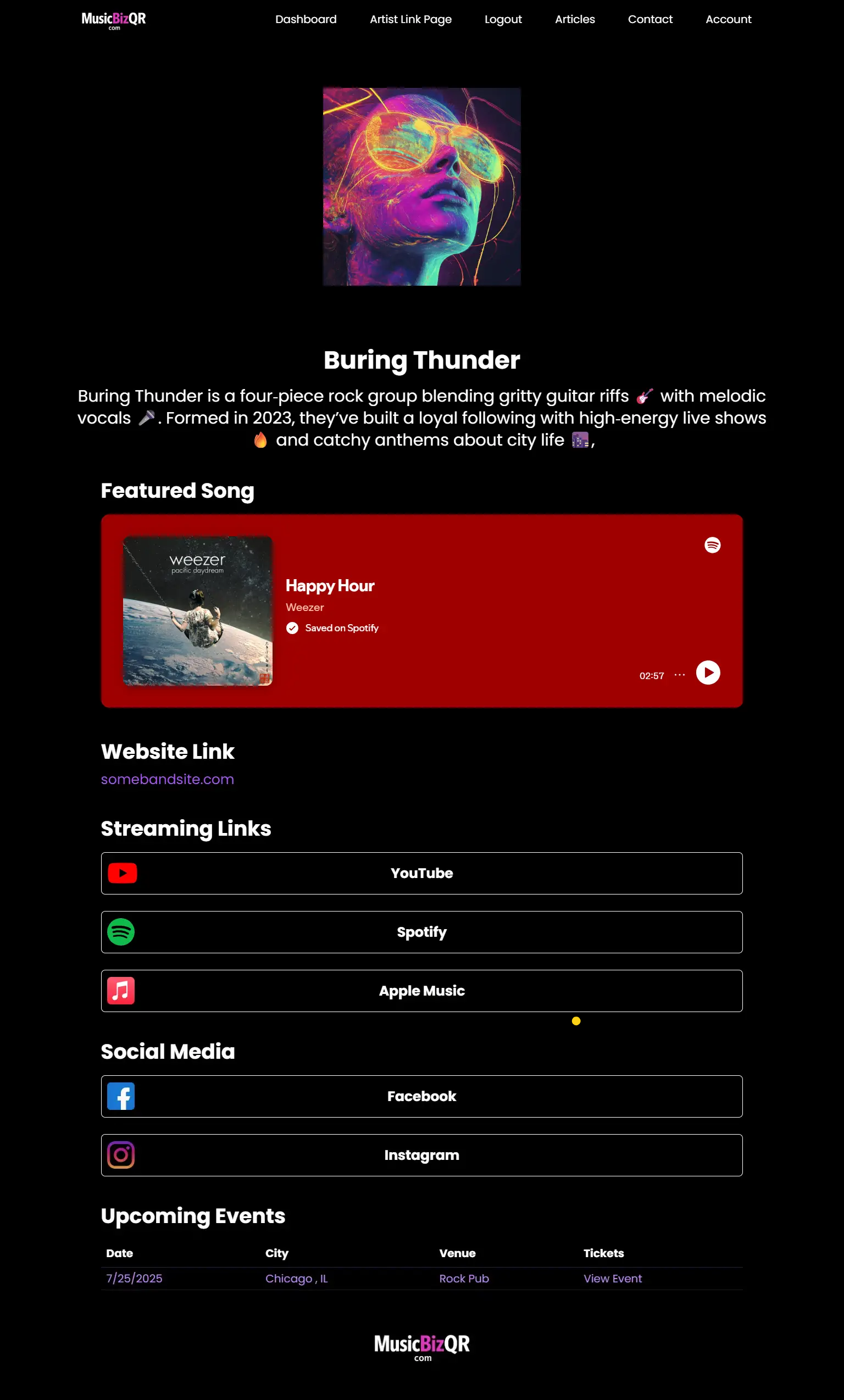
Related Posts
Most link-in-bio tools weren’t built for musicians. Discover why smart links create better fan journeys, stronger branding, and higher conversions for your music.
Smart links for musicians explained—how they work, why they matter in 2026, and how to build a fan-converting link that drives your music career.
Discover how music links can help artists guide fans across platforms effortlessly. Learn strategies to boost engagement, streams, and merch sales.
Most link-in-bio tools weren’t designed for musicians. Learn why smart links deliver better fan engagement, stronger branding, and real music-driven revenue.
Smart links aren’t just utility tools — they’re the new frontier in artist branding. Learn how visual design, consistency, and fan-centric smart links define a musician’s digital identity.
Discover how smart links can transform fleeting music streams into lasting fan connections. Learn the strategies indie artists use to grow their audience in the streaming era.
Discover how smart links empower indie artists to create deeper, lasting relationships with fans. Turn every click into meaningful engagement.
Discover 2026’s best smart link tools for artists. We compare top platforms, fan engagement features, and why MusicBizQR stands above the rest.
Learn how direct-to-fan video turns your smart link into a conversion machine. Build trust, drive streams, and make real fan connections with MusicBizQR.
Learn how to use music links to drive fan engagement, increase streams, and promote your music like a pro. Built for modern artists and bands. Shall I begin writing the Markdown content for this article now?
In 2026, discovery is chaotic — and smart links are how artists bring it all together. Explore how music smart links guide fans, boost streams, and create real momentum across every platform.
Tired of generic link tools? Discover the smart link platform built for music: video previews, analytics, and full artist control—all in one sleek page.
Every new release deserves more than a link in your bio. Learn how to use smart links to drive streams, collect fans, and turn a single drop into lasting momentum.
The layout of your smart link page can make or break your fan engagement. Learn the design psychology that turns clicks into superfans.
If you're still sending fans to scattered links, you're leaving money on the table. Here's why every indie artist needs a smart link strategy to grow, connect, and convert.",
Most smart links just sit there. This guide shows musicians how to build a smart link page that turns casual clicks into lifelong fans. Real strategies that work.
Discover the psychology behind smart link layout design and how it shapes fan engagement, conversions, and merch sales.
Master the art of launching music with smart links. This guide shows how to create hype, drive streams, and maximize impact every time you drop a new release.
Your smart link is your new homepage. Learn how to design a 2026-ready page that plays your music instantly, tells your story, and converts fans the moment they land.
Learn how musicians can use smart links to connect directly with fans, bypass algorithms, and drive engagement, streams, and merch sales.
Discover how embedded content like music, videos, and social posts can turn your smart link into a fan engagement engine. Boost streams, merch sales, and loyalty.
Discover why smart links are transforming music marketing in 2025. Learn how a centralized hub can grow your audience, boost streams, and drive real fan engagement.
From Spotify embeds to merch and tour links, MusicBizQR makes music promotion easy. Learn how to use smart links to streamline your entire fan funnel.
Learn five powerful ways smart links can revolutionize your band's music promotion, amplify fan engagement, and strengthen fan loyalty.
Discover how smart links are revolutionizing music promotion, increasing fan engagement, boosting streaming numbers, and enhancing concert attendance.