
Music Links for Artists: Build a Seamless Fan Journey Across Platforms
Executive Summary
Most artists think fan engagement happens on platforms. In reality, it happens between them. Attention doesn’t move in straight lines — it jumps from post to post, platform to platform, moment to moment. When those jumps don’t resolve to a consistent destination, momentum leaks away quietly.
A seamless fan journey isn’t about being everywhere. It’s about giving attention a place to land. Smart links serve this role by acting as stable destinations that absorb traffic from many sources without resetting context. Each visit builds familiarity instead of starting from zero.
When artists rely on fragmented links, fans experience discontinuity. Every click feels like a new decision. Trust has to be rebuilt. Orientation has to restart. Over time, this friction compounds and engagement decays — even when reach increases.
Smart links restore continuity by unifying platforms into a single behavioral system. They allow discovery to happen anywhere while keeping the journey coherent. When destination stays consistent, attention compounds, recognition builds, and engagement becomes cumulative rather than episodic.
Key Takeaways
Attention moves across posts, apps, and moments before it ever settles.
Every new link forces fans to re-orient and re-decide.
Familiar endpoints reduce friction and increase return engagement.
They absorb traffic without fragmenting experience.
Growth stalls when attention never accumulates in one place.
Fan Engagement Happens Between Platforms
Artists often assume engagement lives inside platforms — on Spotify, Instagram, YouTube, TikTok. But platforms don’t actually hold attention. They redirect it.
Real fan engagement happens in motion.
A fan hears a clip on TikTok, watches a longer video on Instagram, searches the song on Spotify, and later clicks a link from a bio, a story, or a QR code. None of these moments exist in isolation. Attention flows between them, carrying curiosity forward — or losing it along the way.
This is why platform-centric thinking breaks down. Platforms are entry points, not destinations. They spark interest, but they don’t resolve it. The moment a fan leaves one environment, the journey either continues smoothly or fractures completely.
When artists treat each platform as a separate engagement space, they unintentionally reset the fan’s experience over and over again. Every click becomes a fresh decision. Every transition requires re-orientation. Over time, this repetition exhausts curiosity — not because the fan isn’t interested, but because the journey never stabilizes.
The key insight is this: fans don’t experience platforms — they experience transitions.
Each transition asks silent questions:
- Where am I now?
- What am I supposed to do next?
- Is this still worth my attention?
If those questions aren’t answered quickly and consistently, momentum fades.
This is why engagement metrics can look healthy while growth stagnates. Posts perform. Videos get views. Links get clicks. But nothing accumulates, because attention never lands anywhere long enough to build familiarity or trust.
Understanding that engagement happens between platforms reframes everything that follows. It shifts the focus away from chasing reach and toward designing continuity. The goal is no longer to optimize each platform independently — it’s to give attention a reliable place to resolve, regardless of where it originates.
This idea forms the foundation of a seamless fan journey. Until this is understood, smart links look like convenience tools. Once it’s understood, they reveal themselves as infrastructure — the connective tissue that turns scattered moments into a coherent experience.
Why Fragmented Destinations Break Journeys
Fragmentation doesn’t feel dramatic when it happens. Nothing crashes. Nothing visibly fails. A fan clicks a link, lands somewhere new, looks around briefly, and moves on. The damage isn’t obvious — but it compounds.
Every time a fan is sent to a different destination, the journey resets.
A new layout.
A new visual language.
A new set of choices.
A new question: What am I supposed to do here?
That reset forces re-orientation. Re-orientation costs attention. And attention, once taxed too many times, quietly withdraws.
This is the hidden cost of fragmented destinations: trust never gets a chance to accumulate.
Even when each individual page is well designed, fragmentation breaks continuity. The fan never builds familiarity with a place. Nothing feels recognizable. Nothing feels stable. Each click becomes an isolated moment instead of part of a growing relationship.
Over time, this creates a subtle behavioral pattern. Fans engage briefly, then disengage just as quickly. They don’t feel rejected — they feel unanchored. Interest exists, but it has nowhere consistent to settle.
What makes this especially dangerous is that fragmentation often looks like reach. Artists spread links across platforms, campaigns, and tools, believing more destinations mean more opportunity. In reality, every additional endpoint increases cognitive friction and decreases the chance that attention will compound.
This is why growth stalls even as visibility increases.
As explored in How Smart Links Are Changing the Way Bands Build Their Fanbase, modern fan growth isn’t driven by scattering attention — it’s driven by resolving it. Fans don’t need more places to go. They need fewer places that feel familiar.
Fragmented destinations force fans to decide repeatedly whether to continue. Each decision weakens momentum. A seamless journey, by contrast, removes the need to decide at all. The destination becomes known. The environment becomes predictable. Attention stops bracing for effort and starts relaxing into recognition.
Until fragmentation is addressed, no amount of platform optimization fixes the problem. The issue isn’t where fans discover you — it’s whether the journey gives them a place to stay long enough for trust to form.
The Hidden Cost of Platform Switching
Platform switching feels harmless because it’s invisible. A fan taps a link, a new page loads, and the experience continues — at least on the surface. But beneath that smooth motion, the brain is doing work it never needed to do before.
Every switch introduces cognitive friction.
The environment changes. Visual language shifts. Interaction patterns reset. Even when the fan is still interested, their attention has to re-orient. This re-orientation isn’t dramatic, but it’s cumulative. Over time, repeated switches train the brain to expect effort — and effort shortens engagement.
This is why fans often appear active but never deepen. They listen briefly, watch partially, click occasionally, and disappear. Nothing feels wrong in isolation. The cost shows up only in aggregate, as attention thins out instead of stacking.
Platform switching creates three compounding effects:
Context loss
Each new destination strips away the emotional and informational context that brought the fan there.Trust reset
Familiarity has to be rebuilt from scratch on every page, even when the artist is the same.Decision fatigue
Fans must repeatedly answer “what now?” instead of being guided forward.
What makes this especially damaging is that cognitive load doesn’t reset cleanly. Fatigue carries forward. A fan who has already switched platforms several times is less willing to explore deeply on the next click, even if the content is strong.
This is the same psychological mechanism that operates within a single page when layout is noisy or unclear. As explained in Smart Link Design Psychology: How Layout Impacts Fan Behavior, increased cognitive load causes attention to withdraw before conscious decisions are made. Platform switching simply applies that same friction repeatedly, across environments.
The result is a journey that feels fragmented rather than progressive. Attention keeps moving, but nothing accumulates. Familiarity never settles. Momentum never stabilizes.
Understanding the hidden cost of platform switching reframes the problem. The issue isn’t that fans are unwilling to engage — it’s that the journey keeps asking them to restart. Until that restart cycle is broken, engagement remains episodic instead of cumulative.
How Consistent Destinations Build Momentum
Momentum forms when attention recognizes where it has landed.
A consistent destination changes the psychology of every click that follows. The first visit is about orientation. The second is about recognition. By the third, the fan no longer asks where they are — they begin asking what’s new. That shift is subtle, but it’s where engagement starts to compound.
Consistency reduces friction by eliminating re-orientation. The layout feels familiar. The structure is predictable. The environment doesn’t need to be relearned. As a result, attention relaxes instead of bracing for effort. Fans move more confidently because the destination feels known.
This is how momentum builds quietly:
Familiarity replaces evaluation
Fans stop assessing the page and start using it.Recognition shortens hesitation
The brain trusts what it has seen before.Return visits feel easier than first visits
Each interaction costs less effort than the last.
Consistent destinations also preserve context. When a fan arrives from different platforms at different times, the destination acts as a memory anchor. The emotional thread that brought them there doesn’t snap; it carries forward. Over time, that continuity creates a sense of relationship rather than a series of impressions.
This is why smart link pages outperform scattered links even when traffic volume is the same. Conversion improves not because fans are pushed harder, but because the journey stops restarting. As explored in How to Build a Smart Link Page That Actually Converts Fans, continuation depends on reducing the mental cost of moving forward. Consistency is one of the most effective ways to do that.
Importantly, consistency does not mean stagnation. The destination can evolve — new releases, new priorities, new emphasis — without losing its identity. Fans recognize the place even as the moment changes. That balance between stability and relevance is what allows attention to accumulate instead of disperse.
When destinations stay consistent, growth stops being episodic. Attention doesn’t spike and vanish; it layers. Momentum becomes durable. And durable momentum is what turns casual discovery into lasting engagement.
Smart Links as Journey Infrastructure
Once destination consistency is established, smart links stop looking like convenience tools and start revealing their real role: infrastructure.
Infrastructure isn’t flashy. It doesn’t compete for attention. It exists to support movement reliably, regardless of conditions. Roads don’t market themselves. Electrical grids don’t persuade. They quietly make everything else possible. Smart links function the same way in a fan journey.
Instead of treating each platform as a separate endpoint, smart links absorb traffic from anywhere and resolve it into one familiar environment. Discovery can happen on TikTok. Context can deepen on Instagram. Validation can occur on Spotify or YouTube. But the journey stabilizes because it always lands in the same place.
This is the critical distinction between disposable links and infrastructure.
Disposable links are campaign-specific. They exist for a moment, then vanish. Each new campaign introduces a new destination, resetting familiarity and trust. Infrastructure persists. It evolves without replacing itself. Fans don’t have to learn where to go again — they already know.
Smart links enable this persistence by separating where attention comes from from where attention settles.
That separation is what allows artists to scale without fragmentation. Platforms can change. Algorithms can shift. Formats can rise and fall. The destination remains stable. Attention doesn’t have to renegotiate the journey every time conditions change.
This is why smart links belong at the strategic layer, not the tactical one. As outlined in Why Every Indie Band Needs a Smart Link Strategy, strategy isn’t about using more tools — it’s about controlling where momentum accumulates. Infrastructure is how that control is maintained.
When smart links are treated as infrastructure, growth becomes additive instead of volatile. Each campaign strengthens the same destination. Each visit reinforces recognition. Each return costs less effort than the last. Over time, attention compounds not because it’s chased, but because it’s given somewhere reliable to land.
This is the shift most artists miss. They optimize platforms independently while neglecting the system that connects them. Smart links don’t replace platforms — they unify them. And unity is what turns scattered engagement into a coherent fan journey.
Smart Links as Journey Infrastructure
Once destination consistency is established, smart links stop looking like convenience tools and start revealing their real role: infrastructure.
Infrastructure isn’t flashy. It doesn’t compete for attention. It exists to support movement reliably, regardless of conditions. Roads don’t market themselves. Electrical grids don’t persuade. They quietly make everything else possible. Smart links function the same way in a fan journey.
Instead of treating each platform as a separate endpoint, smart links absorb traffic from anywhere and resolve it into one familiar environment. Discovery can happen on TikTok. Context can deepen on Instagram. Validation can occur on Spotify or YouTube. But the journey stabilizes because it always lands in the same place.
This is the critical distinction between disposable links and infrastructure.
Disposable links are campaign-specific. They exist for a moment, then vanish. Each new campaign introduces a new destination, resetting familiarity and trust. Infrastructure persists. It evolves without replacing itself. Fans don’t have to learn where to go again — they already know.
Smart links enable this persistence by separating where attention comes from from where attention settles.
That separation is what allows artists to scale without fragmentation. Platforms can change. Algorithms can shift. Formats can rise and fall. The destination remains stable. Attention doesn’t have to renegotiate the journey every time conditions change.
This is why smart links belong at the strategic layer, not the tactical one. As outlined in Why Every Indie Band Needs a Smart Link Strategy, strategy isn’t about using more tools — it’s about controlling where momentum accumulates. Infrastructure is how that control is maintained.
When smart links are treated as infrastructure, growth becomes additive instead of volatile. Each campaign strengthens the same destination. Each visit reinforces recognition. Each return costs less effort than the last. Over time, attention compounds not because it’s chased, but because it’s given somewhere reliable to land.
This is the shift most artists miss. They optimize platforms independently while neglecting the system that connects them. Smart links don’t replace platforms — they unify them. And unity is what turns scattered engagement into a coherent fan journey.
Designing a Seamless Cross-Platform Experience
A seamless fan journey doesn’t mean every platform looks the same. It means the experience feels coherent no matter where attention originates. Consistency lives at the destination, not at the source.
Platforms are optimized for discovery. Each has its own norms, formats, and rhythms. Trying to force uniformity across them usually backfires. The goal isn’t sameness — it’s continuity. Fans should feel that wherever they come from, they arrive somewhere recognizable.
This is where smart links do their most important work. They act as the stabilizing layer that platforms can’t provide. While posts, clips, and campaigns change constantly, the destination remains familiar. The fan doesn’t have to relearn who you are or what to do next.
Designing for seamlessness comes down to a few principles:
Consistent destination logic
The structure, hierarchy, and flow of the smart link page should feel the same regardless of entry point.Contextual emphasis, not reinvention
What leads can change — a new release, a tour date, a video — but the environment stays recognizable.Clear narrative handoff
The page should reflect why the fan arrived without requiring explanation.
When this balance is right, platforms stop competing with one another. They feed the same system. Each platform becomes a different doorway into the same place, rather than a separate journey that has to stand on its own.
This consistency has a branding effect that’s easy to underestimate. Over time, the destination becomes associated with the artist itself. Fans don’t just remember the song or the post — they remember where it led them. As explored in Beyond the Bio Link: How Smart Links Are Changing Artist Branding Forever, stable destinations function as brand surfaces, not just utilities.
Seamless cross-platform design doesn’t ask fans to adapt. It adapts to them. Attention can arrive from anywhere and still feel oriented. That orientation is what keeps the journey intact as it stretches across time, platforms, and moments.
When artists design for continuity instead of control, platforms become allies instead of silos — and the fan journey stops fragmenting under its own momentum.
Where Most Artists Break the Journey
Most artists don’t intentionally break the fan journey. It breaks quietly, through decisions that feel logical in isolation but destructive in sequence. Each choice solves a short-term problem while introducing long-term friction.
The most common break happens when links are treated as campaign artifacts instead of persistent destinations.
A new single gets a new link.
A tour gets a different page.
A video points somewhere else entirely.
Each moment feels justified. Together, they fragment the journey. Fans never build familiarity with a place because the place keeps changing. Recognition never forms, and without recognition, trust can’t accumulate.
Another break occurs when artists prioritize platform logic over journey logic. Each platform is optimized independently — different links, different destinations, different emphasis. The result is a fan experience that feels disjointed even when each individual piece performs well.
Journey breaks also emerge from over-accommodation:
- Too many links offered “just in case”
- Multiple destinations for the same intent
- Constant reorganization of priorities
What’s meant to be helpful becomes destabilizing. Fans don’t know what’s current, what matters, or where to return.
Perhaps the most damaging break comes from over-optimization. Analytics are consulted too frequently. Layouts are tweaked reactively. Destinations change based on short-term performance signals. The page never settles long enough to become familiar. Fans arrive to something that feels perpetually in flux.
These breaks don’t cause dramatic failure. They cause attention decay. Fans engage briefly, then drift away. Growth feels harder than it should. Momentum spikes but never holds.
The pattern is consistent: journeys break when destinations aren’t allowed to persist. Stability is sacrificed for immediacy. Control is mistaken for progress.
A seamless fan journey requires restraint. It requires letting a destination exist long enough to earn recognition. Without that patience, even the most creative output struggles to compound.
Understanding where journeys break is what allows them to be repaired. Once these patterns are visible, the solution isn’t more effort — it’s fewer resets.
How Journey Continuity Changes Growth Outcomes
When a fan journey stays intact, growth stops behaving like a series of spikes and starts behaving like a curve. Attention no longer resets with each campaign; it accumulates. Familiarity compounds. Trust carries forward.
This is the difference between episodic engagement and durable growth.
In fragmented systems, every campaign has to work hard. Each post, release, or video must reintroduce the artist, re-establish context, and re-earn attention. Performance lives and dies within short windows. When the moment passes, so does the momentum.
Journey continuity changes that dynamic.
When fans consistently land in the same destination, prior exposure matters. Recognition shortens hesitation. Return visits feel easier than first visits. Engagement deepens not because the content is louder, but because the environment is already known.
Over time, this produces measurable shifts:
Higher quality engagement
Fans explore more deeply because orientation costs less effort.Stronger return behavior
Repeat visits increase as the destination becomes familiar.More resilient performance
Campaigns reinforce one another instead of competing.Clearer signals
Engagement patterns become easier to interpret because behavior isn’t fragmented across destinations.
What’s important here is that none of this requires fans to consciously commit. Continuity works below awareness. Fans don’t think, “I trust this journey now.” They simply feel less friction returning. That ease is what turns casual discovery into sustained attention.
This is why smart links outperform scattered link strategies even when traffic volume is identical. As explored in Smart Links for Musicians: How to Turn One Link into a Marketing Powerhouse, leverage comes from giving attention somewhere stable to accumulate, not from pushing harder on each individual moment.
Journey continuity reframes success. Growth is no longer judged by single-click outcomes, but by how smoothly attention moves forward over time. When continuity is present, every campaign strengthens the next. When it’s absent, every campaign starts over.
This is the quiet advantage most artists never see — and the reason seamless journeys consistently outperform fragmented ones in the long run.
Connecting Fan Journey to Smart Link Strategy
Once journey continuity is understood, smart link strategy stops being about optimization and starts being about control — not control over fans, but control over where momentum accumulates.
Strategy exists to decide where effort compounds. Without that decision, growth energy disperses. Smart links become strategic when they serve as the fixed point that everything else resolves into. Platforms generate attention. Campaigns activate it. But strategy determines where it lands and whether it stays.
This is why smart link strategy cannot live at the execution layer. It sits above releases, posts, and promotions. As outlined in Why Every Indie Band Needs a Smart Link Strategy, the purpose of a strategy is to reduce fragmentation over time, not to maximize short-term clicks.
When journey logic is connected to strategy, decisions simplify:
- New platforms don’t require new destinations
- New campaigns don’t reset familiarity
- New content doesn’t fracture identity
Everything feeds the same system.
This connection also explains why smart link strategy feels subtle when it’s working. There are no dramatic spikes. No sudden breakthroughs. Instead, performance becomes steadier. Engagement signals grow clearer. Return behavior increases quietly. What looks like “slow growth” from the outside is often compounding momentum from the inside.
Crucially, strategy protects against volatility. Algorithms change. Formats rise and fall. Platforms lose favor. When the destination remains stable, those changes don’t break the journey — they simply change where it begins. Attention adapts without being lost.
This is the final shift most artists never make. They optimize moments without anchoring systems. They chase performance without designing continuity. Smart link strategy exists to reverse that pattern.
When fan journey continuity and smart link strategy are aligned, growth stops depending on constant effort. Each new moment strengthens the same destination. Each visit reinforces recognition. Over time, attention compounds not because it’s pushed harder — but because it’s allowed to settle somewhere reliable.
That is what turns smart links from tools into infrastructure — and infrastructure into long-term leverage.
Frequently Asked Questions
What is a fan journey in music marketing?
A fan journey is the sequence of moments where attention moves from discovery to deeper engagement over time. It doesn’t live on a single platform — it happens across posts, platforms, and repeated interactions.
Why do fragmented links hurt fan engagement?
Fragmented links reset orientation and trust on every click. Each new destination forces fans to re-learn where they are and what to do next, which increases cognitive friction and causes attention to fade.
How do smart links create a seamless fan journey?
Smart links provide a consistent destination that absorbs traffic from multiple platforms. Fans recognize the place they land, reducing hesitation and allowing engagement to compound instead of restarting.
Is it better to have one smart link or different links for different campaigns?
One consistent smart link performs better long-term. Campaign emphasis can change, but the destination should remain familiar so fans don’t have to re-orient with every interaction.
Do smart links replace artist websites?
Not necessarily. Smart links function as focused journey hubs, while websites often serve broader informational or archival roles. Many artists use both, with smart links acting as the primary engagement endpoint.
How does journey continuity affect growth metrics?
Continuity increases return visits, deepens engagement, and stabilizes performance over time. Growth becomes cumulative rather than dependent on short-lived campaign spikes.
Why does reach increase but engagement stay flat for many artists?
Because attention never accumulates in one place. Without a consistent destination, reach creates activity without momentum.
How often should a smart link page change?
Structure and destination should remain stable. Only emphasis should change to reflect current moments like releases, tours, or videos.
What’s the biggest mistake artists make with smart links?
Treating them as disposable campaign tools instead of persistent infrastructure. Stability is what allows trust and familiarity to form.
Can smart links work for offline promotion like QR codes?
Yes. In fact, offline discovery benefits even more from consistent destinations because fans need immediate orientation when they scan.
Suggested Reading: Build the Full Smart Links System
If this article clarified why journey continuity matters, the pieces below explain how the system works at every layer — from perception to conversion to long-term leverage. Reading them in this order will give you a complete, non-redundant understanding of Smart Links as infrastructure.
🧠 Psychology & Perception (Why Fans Behave the Way They Do)
Smart Link Design Psychology: How Layout Impacts Fan Behavior
https://musicbizqr.com/article/smart-links/smart-link-psychology
Explains how hierarchy, spacing, familiarity, and cognitive load shape fan behavior before conscious decisions are made.
🧩 Conversion Mechanics (How Attention Moves Forward)
How to Build a Smart Link Page That Actually Converts Fans
https://musicbizqr.com/article/smart-links/smart-link-page-that-converts-fans
Defines conversion as continuation and shows how structure, sequencing, and restraint remove hesitation.
🔁 Journey Systems (How Platforms Become One Experience)
How Smart Links Are Changing the Way Bands Build Their Fanbase
https://musicbizqr.com/article/smart-links/how-smart-links-are-changing-the-way-bands-build-their-fanbase
Reframes fan growth as a system problem, not a platform problem.
Music Links for Artists: Build a Better Fan Funnel
https://musicbizqr.com/article/smart-links/music-links-for-artists
Shows how smart links quietly shape progression without forcing commitment.
🧠 Strategy & Infrastructure (Why Smart Links Outperform Campaigns)
Why Every Indie Band Needs a Smart Link Strategy
https://musicbizqr.com/article/smart-links/why-every-indie-band-needs-a-smart-link-strategy
Explains why consistency of destination matters more than reach.
Smart Links for Musicians: How to Turn One Link into a Marketing Powerhouse
https://musicbizqr.com/article/smart-links/smart-links-for-musicians-how-to-turn-one-link-into-a-marketing-powerhouse
Connects journey continuity to long-term leverage and growth stability.
🎨 Branding & Identity (Why Destinations Become Trust Signals)
Beyond the Bio Link: How Smart Links Are Changing Artist Branding Forever
https://musicbizqr.com/article/smart-links/smart-links-artist-branding
Explores how stable destinations become part of an artist’s identity over time.
🔗 The Foundation
Smart Links Pillar: The Complete System
https://musicbizqr.com/article/smart-links
The central hub tying psychology, conversion, journey, and strategy into one coherent framework.
How to Use This Reading List
- Skimmers: Read the summaries + takeaways of each article
- Strategists: Read Psychology → Conversion → Journey → Strategy
- Builders: Use these articles as a reference system, not one-off posts
Together, these pieces form a closed knowledge loop. Each article strengthens the others. No repetition. No filler. Just a clear explanation of how attention moves — and how to design for it.
This is the difference between using smart links
and owning the system they operate in.
Code
Built for Musicians. Powered by Smart Links.
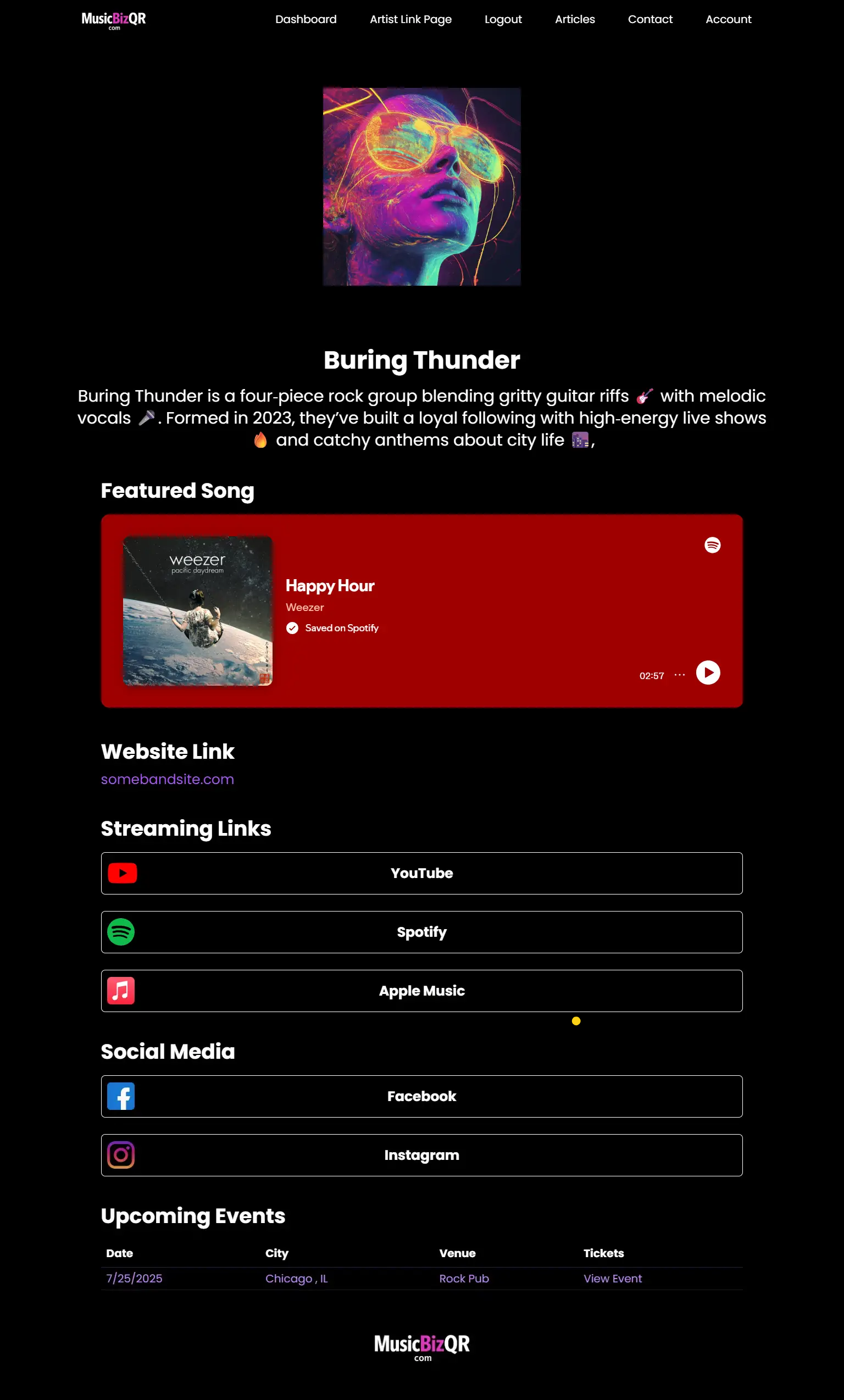
Faneqo gives you a powerful landing page with streaming links, videos, social buttons, and real-time fan analytics — all from a single QR code.
- 🎯 Unlimited link clicks & analytics
- 📈 Track Spotify streams, YouTube plays, and QR scans
- 📱 Mobile-optimized artist pages
- 🚀 Create your first Smart Link in seconds
Related Posts
Most link-in-bio tools weren’t built for musicians. Discover why smart links create better fan journeys, stronger branding, and higher conversions for your music.
Smart links for musicians explained—how they work, why they matter in 2026, and how to build a fan-converting link that drives your music career.
Discover how music links can help artists guide fans across platforms effortlessly. Learn strategies to boost engagement, streams, and merch sales.
Most link-in-bio tools weren’t designed for musicians. Learn why smart links deliver better fan engagement, stronger branding, and real music-driven revenue.
Smart links aren’t just utility tools — they’re the new frontier in artist branding. Learn how visual design, consistency, and fan-centric smart links define a musician’s digital identity.
Discover how smart links can transform fleeting music streams into lasting fan connections. Learn the strategies indie artists use to grow their audience in the streaming era.
Discover how smart links empower indie artists to create deeper, lasting relationships with fans. Turn every click into meaningful engagement.
Discover 2026’s best smart link tools for artists. We compare top platforms, fan engagement features, and why MusicBizQR stands above the rest.
Learn how direct-to-fan video turns your smart link into a conversion machine. Build trust, drive streams, and make real fan connections with MusicBizQR.
Learn how to use music links to drive fan engagement, increase streams, and promote your music like a pro. Built for modern artists and bands. Shall I begin writing the Markdown content for this article now?
In 2026, discovery is chaotic — and smart links are how artists bring it all together. Explore how music smart links guide fans, boost streams, and create real momentum across every platform.
Tired of generic link tools? Discover the smart link platform built for music: video previews, analytics, and full artist control—all in one sleek page.
Every new release deserves more than a link in your bio. Learn how to use smart links to drive streams, collect fans, and turn a single drop into lasting momentum.
The layout of your smart link page can make or break your fan engagement. Learn the design psychology that turns clicks into superfans.
If you're still sending fans to scattered links, you're leaving money on the table. Here's why every indie artist needs a smart link strategy to grow, connect, and convert.",
Most smart links just sit there. This guide shows musicians how to build a smart link page that turns casual clicks into lifelong fans. Real strategies that work.
Discover the psychology behind smart link layout design and how it shapes fan engagement, conversions, and merch sales.
Master the art of launching music with smart links. This guide shows how to create hype, drive streams, and maximize impact every time you drop a new release.
Your smart link is your new homepage. Learn how to design a 2026-ready page that plays your music instantly, tells your story, and converts fans the moment they land.
Learn how musicians can use smart links to connect directly with fans, bypass algorithms, and drive engagement, streams, and merch sales.
Discover how embedded content like music, videos, and social posts can turn your smart link into a fan engagement engine. Boost streams, merch sales, and loyalty.
Discover why smart links are transforming music marketing in 2025. Learn how a centralized hub can grow your audience, boost streams, and drive real fan engagement.
From Spotify embeds to merch and tour links, MusicBizQR makes music promotion easy. Learn how to use smart links to streamline your entire fan funnel.
Learn five powerful ways smart links can revolutionize your band's music promotion, amplify fan engagement, and strengthen fan loyalty.
Discover how smart links are revolutionizing music promotion, increasing fan engagement, boosting streaming numbers, and enhancing concert attendance.