
Why Every Indie Band Needs a Smart Link Strategy
Executive Summary
Most indie bands don’t lose fans because of bad music or weak promotion. They lose them because attention gets scattered. One link goes to Spotify, another to YouTube, another to a ticketing platform, and the fan is left to decide what to do next — or whether to do anything at all.
A smart link strategy fixes this by giving bands a single, intentional destination that guides fans forward instead of forcing choices. It centralizes music, video, tour activity, and identity into one adaptive system, allowing attention to flow instead of leak.
More importantly, smart links shift control back to the artist. Platforms are designed to optimize for their own retention and data capture, not for a band’s long-term growth. When bands rely solely on platform-native links, they rent attention and lose visibility into how fans actually behave.
A smart link strategy turns every release, post, and campaign into reusable infrastructure. Instead of starting from zero each time, indie bands build momentum that compounds — not because they post more, but because their links finally work together as a system.
Key Takeaways
When fans are forced to choose between scattered destinations, attention leaks and promotion stalls.
A single adaptive destination guides fan behavior instead of leaving outcomes to chance.
Without smart links, bands lose visibility into how fans engage after the click.
Platform-native links prioritize retention and data capture over artist growth.
Centralized destinations turn promotion into reusable infrastructure that strengthens over time.
The Hidden Cost of Fragmented Links
There’s a quiet moment where most indie band promotion actually fails, and it rarely looks dramatic. A fan hears a song, feels something, and decides to learn more. That moment is fragile. It’s where curiosity either turns into momentum — or disappears entirely.
Fragmented links break that moment.
When a band sends fans to Spotify for music, YouTube for video, a separate ticketing site for shows, and a social profile for identity, they’re not offering options — they’re offloading responsibility. The fan is forced to decide what matters next instead of being guided forward. Most don’t choose at all. They drift.
This isn’t a motivation problem. It’s a cognitive one.
Fans don’t arrive with a plan. They arrive with impulse. Every additional decision — Do I listen or watch? Should I follow or buy tickets? Where do I go next? — introduces friction. And friction is fatal at the top of the funnel. Attention doesn’t argue. It evaporates.
Fragmentation also fractures context. A song on a streaming platform exists without the story behind it. A video lives without tour dates nearby. A ticket link appears detached from the music that made the show matter in the first place. Each platform isolates a single dimension of the band, but none of them communicate the full picture.
What makes this especially costly is that bands rarely see the loss happen. There’s no alert when a fan gives up. No dashboard metric that shows almost followed or almost bought. The drop-off is silent, which makes it easy to misdiagnose the problem as weak content or bad timing instead of broken flow.
Over time, this creates a pattern indie bands recognize but can’t quite name: every release feels like starting over. New posts, new links, new pushes — but no accumulated momentum. Attention spikes briefly, then resets to zero.
Fragmented links don’t just scatter traffic. They prevent continuity. And without continuity, there is no compounding — only repetition.
Smart Links as Systems, Not Shortcuts
Most bands think about links tactically. A link is something you paste at the end of a post, drop into a bio, or throw into a story when there’s something new to promote. It’s treated like punctuation — useful, but forgettable.
That mindset is the problem.
A smart link isn’t a shortcut to content. It’s an infrastructure decision. It defines how attention moves once it arrives, what context survives the click, and whether a fan’s curiosity turns into momentum or fades out. When links are treated as systems instead of conveniences, promotion stops being reactive and starts becoming directional.
Static link lists fail because they assume fans behave rationally. They don’t. Faced with a grid of unrelated options, most visitors hesitate. Some click randomly. Many leave. Nothing in that experience suggests a path forward — only a menu of disconnected choices. The link technically “works,” but the journey doesn’t.
Smart links invert that logic. Instead of asking fans to decide what matters, they present a sequence that matches intent. Someone arriving from a new single is guided toward listening first, then context, then deeper engagement. Someone arriving from a tour post sees dates before streams. The destination adapts to why the fan showed up in the first place.
This is where smart links move beyond layout and into strategy. The link becomes the point where narrative, timing, and behavior converge. It’s the difference between dumping traffic and shaping flow.
If you want the deeper, category-level framework behind this idea, start with the pillar guide: The Ultimate Guide to Smart Links for Musicians.
When bands adopt this systems mindset, promotion stops feeling like constant reinvention. Each release doesn’t require a brand-new explanation of who you are and where fans should go. The link remembers. Context carries forward. Momentum has somewhere to land.
Smart links don’t make fans click more. They make clicks mean something.
Links Are Where Data Ownership Begins
Every time a fan clicks a platform-native link, something important disappears. The music might play. The video might load. But the band learns almost nothing about what happened next.
Streaming platforms and social networks are designed as closed systems. They track behavior extensively — just not for you. When a fan clicks through to Spotify or YouTube, the platform knows whether they listened, skipped, saved, or bounced. The artist sees a delayed aggregate, stripped of context and disconnected from the moment that triggered the click in the first place.
This is why so many bands feel blind between releases. They post, promote, and push, but when something underperforms, there’s no clear signal explaining why. Was the song wrong? The timing? The audience? Or did the link itself quietly fail to carry intent forward?
Smart links change this because they sit before the platform. They become the first place a fan lands, which means they become the first place behavior can be observed. Even simple insights — where fans come from, what they click first, how long they stay, what they ignore — create feedback loops most bands never get access to.
This shift matters more than most artists realize. Data ownership doesn’t start with email lists or CRM tools. It starts at the click. If you don’t control the link, you don’t control the insight.
This idea is explored more deeply in the context of long-term fan relationships in How Smart Links Help Indie Artists Build Fan Relationships, where links act as the bridge between anonymous attention and meaningful engagement.
Over time, link-level insight compounds. Bands stop guessing which posts work and start seeing patterns. They learn which songs pull fans deeper, which platforms send high-intent traffic, and which campaigns actually move people closer to shows, merch, or community.
Owning your links doesn’t just reveal data. It restores cause and effect — and with it, the ability to make decisions that build instead of reset.
Platforms vs. Artists: Who Controls the Journey?
Every major platform tells artists the same story: build here. Post here. Link here. Keep fans inside the ecosystem. On the surface, it sounds supportive. In reality, it creates a quiet dependency that most indie bands never fully escape.
Platforms are not neutral. They are optimized for retention, not artist growth. Their goal is to keep users scrolling, watching, and listening inside their walls. When a band relies on platform-native links, they aren’t guiding fans — they’re handing the journey over to systems designed to prevent exits.
This is why platform links feel productive but rarely compound. A fan watches a video, then gets served another artist. A listener finishes a song and is nudged toward a playlist. Engagement happens, but direction disappears. The platform wins either way. The band doesn’t lose outright — it just never accumulates leverage.
The deeper cost is narrative control. Inside platforms, a band exists as content, not context. Songs live without their stories. Tour dates float without the music that gives them meaning. Identity is flattened into thumbnails, metrics, and algorithmic suggestions. Even strong engagement becomes interchangeable.
Smart link strategies exist because of this imbalance. They don’t fight platforms — they sit above them. They allow artists to use Spotify, YouTube, and social media as discovery engines without surrendering what happens next. The platform becomes an entry point, not the end of the road.
This distinction determines whether growth stacks or resets. Renting attention feels easier because the infrastructure already exists. Owning the journey requires intention — but only ownership allows continuity. And without continuity, every audience is temporary.
Indie bands don’t need fewer platforms. They need a destination those platforms lead into — one they control.
The Compounding Advantage of a Smart Link Strategy
Most indie band promotion is built to spike, not to last. A post goes live, a link gets shared, attention surges briefly, and then everything collapses back to baseline. The next release starts from zero, even if the band has been active the entire time.
This happens because nothing is being carried forward.
A smart link strategy changes that by turning each campaign into infrastructure. Instead of scattering attention across disposable links, bands route traffic through a destination that persists. The same link evolves over time, but the learning accumulates.
Compounding doesn’t come from posting more. It comes from reuse.
When bands commit to a smart link strategy, several structural advantages begin to stack:
Repeat visitors arrive with context
Fans who return aren’t reintroducing themselves. They already know the band, the sound, and the story. Each visit starts deeper than the last.High-intent traffic becomes visible
Over time, bands see which platforms and campaigns send fans who actually engage — not just click. This allows promotion to become selective instead of noisy.Releases stop competing with each other
New singles don’t erase old ones. Videos don’t replace previous videos. Everything lives together, reinforcing the catalog instead of fragmenting it.Launch friction decreases with every cycle
There’s no need to reinvent where fans should go. The destination is familiar, trusted, and expected.
These effects don’t feel dramatic at first. They feel subtle. But subtle systems are the ones that compound. After a few release cycles, the difference becomes obvious: one band is constantly rebuilding attention, while another is stacking it.
This long-term leverage is explored further in The Anatomy of a Perfect Smart Link Page for Musicians, where structure, hierarchy, and flow determine whether a page simply exists or actually works.
The real advantage of a smart link strategy isn’t that it performs better today. It’s that it performs better because of yesterday. Each interaction leaves residue. Each campaign makes the next one easier.
That’s compounding. And it’s the difference between momentum and exhaustion.
When a Smart Link Strategy Becomes a Growth Flywheel
The real shift happens when a smart link stops being something you use and starts being something your growth depends on. At that point, promotion is no longer a series of disconnected pushes. It becomes a loop.
Every new release, video, or tour announcement sends attention to the same destination. Fans learn where to go without being told. The link becomes familiar, then trusted, then expected. What started as convenience turns into habit.
This is where momentum stops leaking and starts circulating.
A smart link strategy becomes a flywheel when it connects the moments that are usually treated in isolation. Music doesn’t live apart from video. Tour dates don’t float separately from the songs that made the show matter. Identity isn’t buried in a profile bio — it’s reinforced everywhere fans land. The destination becomes the place where context survives.
As this loop tightens, new layers become possible. Email signups no longer feel intrusive because they’re offered at the right moment. SMS updates make sense because fans already understand what they’re opting into. QR codes don’t feel gimmicky because they resolve to a destination that already works.
This is where fan funnels stop feeling like marketing theory and start feeling like experience design. Instead of pushing fans through steps, bands remove friction and let curiosity pull people forward. The link doesn’t demand action. It invites continuation.
For a deeper look at how this connective tissue works across discovery, engagement, and retention, see Fan Funnels for Musicians, where smart links act as the spine that holds the entire system together.
When a smart link strategy reaches this stage, growth stops feeling fragile. Attention doesn’t vanish after a post expires. It loops back. It reinforces itself. The system starts doing work in the background while the band focuses on making music.
That’s the difference between promotion that burns energy and infrastructure that returns it.
The Most Common Indie Band Objections (and Why They Fail)
Whenever smart link strategies come up, the resistance is predictable. Not because bands don’t understand the idea — but because the costs of not having a system are invisible. Fragmentation feels normal when everyone around you is doing it.
Still, a few objections surface over and over.
“We’re too small for this to matter.”
This is usually framed as humility, but it’s actually a misunderstanding of leverage. Smaller bands don’t have excess attention to waste. Every click matters more, not less. A smart link strategy isn’t something you earn later — it’s what prevents early momentum from evaporating before it has a chance to stack.
“Link-in-bio is enough.”
A link-in-bio is a location, not a strategy. It tells fans where to click, not why or what should happen next. Static lists don’t adapt, don’t guide, and don’t remember. They exist, but they don’t work together — which is exactly the problem smart links are designed to solve.
“Fans will find us anyway.”
Some will. Most won’t. Discovery is already rare; follow-through is rarer. Assuming fans will navigate a fragmented presence on their own is like assuming someone will finish a conversation after you walk away mid-sentence. Intent needs continuity, not hope.
“This feels too marketing-focused.”
Smart link strategies aren’t about pushing harder. They’re about removing friction. When done well, they reduce marketing noise rather than amplify it. The experience feels cleaner, calmer, and more respectful of the fan’s attention — which is why it works.
What all of these objections share is a short time horizon. They evaluate links based on immediate effort instead of long-term effect. But links aren’t campaigns. They’re infrastructure.
And infrastructure only looks optional until you notice what keeps breaking without it.
Frequently Asked Questions
What exactly is a smart link for musicians?
A smart link is a centralized destination that adapts to fan intent. Instead of sending people to isolated platforms, it guides them through music, video, shows, and identity in a way that preserves context and momentum.
How is a smart link different from a basic link-in-bio page?
Link-in-bio pages list options. Smart links create flow. They prioritize actions, adapt to where fans come from, and are designed to guide behavior rather than simply present choices.
Do smart links really matter for small or early-stage bands?
Yes — especially for smaller bands. When attention is scarce, losing fans to fragmented journeys is far more costly. Smart links prevent early momentum from leaking before it can compound.
Can’t I just link directly to Spotify or YouTube instead?
You can, but you give up control of what happens next. Platform-native links optimize for platform retention, not your growth. Smart links let platforms act as discovery engines without owning the entire journey.
Will a smart link strategy feel too promotional to fans?
When done correctly, it feels less promotional, not more. Smart links reduce friction, clarify intent, and respect attention by making the next step obvious instead of overwhelming.
How do smart links help with fan data and insights?
Smart links sit before platforms, which means bands can see how fans arrive, what they engage with, and where momentum drops off. That visibility enables better decisions over time.
Is a smart link strategy only useful during releases?
No. The real value appears between releases. Smart links create continuity so attention doesn’t reset to zero every time something new comes out.
Do smart links replace websites?
Not necessarily. For many indie bands, smart links function as a lightweight, purpose-built alternative — a focused destination optimized for fan journeys rather than general browsing.
Built for Musicians. Powered by Smart Links.
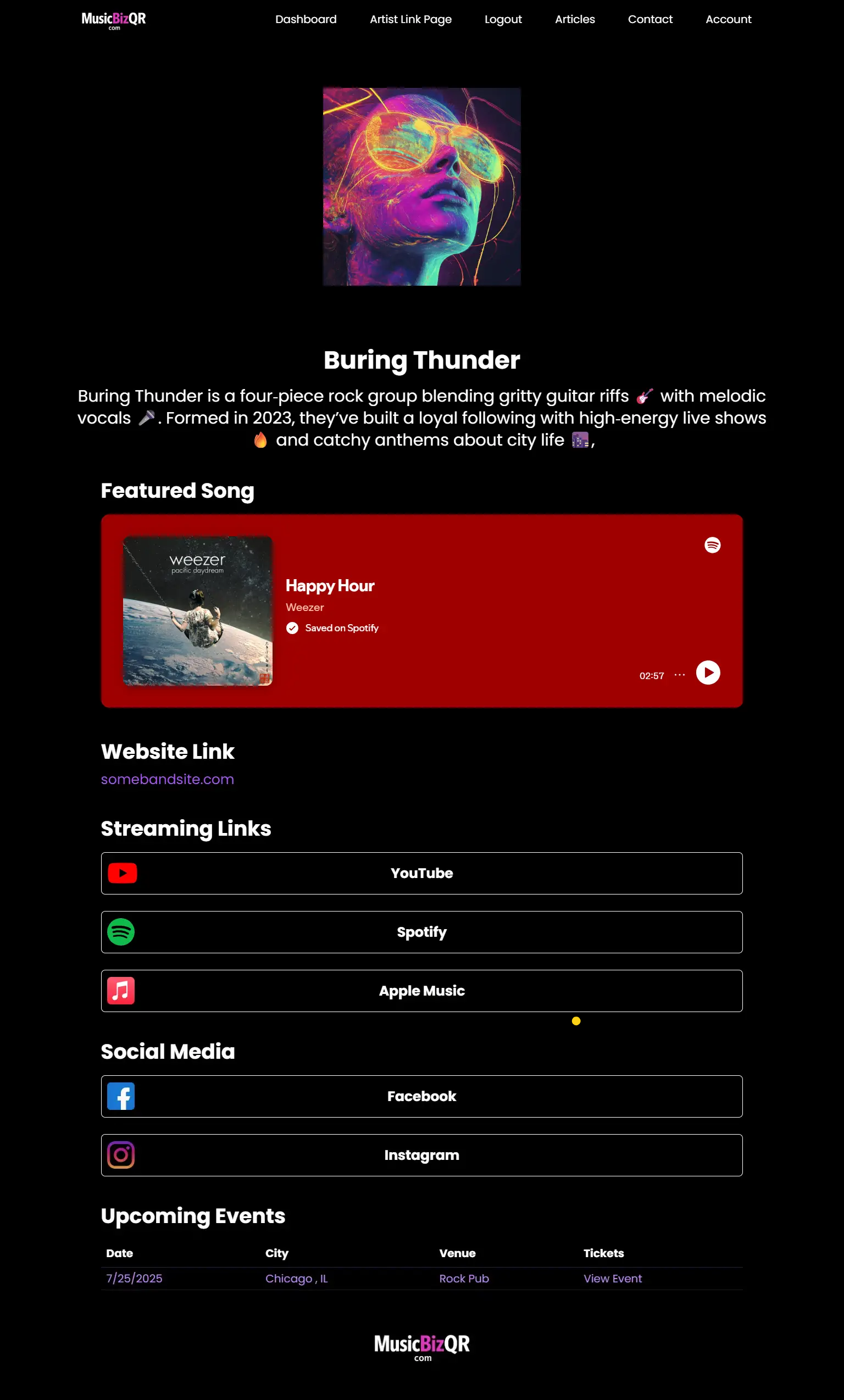
Faneqo gives you a powerful landing page with streaming links, videos, social buttons, and real-time fan analytics — all from a single QR code.
- 🎯 Unlimited link clicks & analytics
- 📈 Track Spotify streams, YouTube plays, and QR scans
- 📱 Mobile-optimized artist pages
- 🚀 Create your first Smart Link in seconds
Related Posts
Most link-in-bio tools weren’t built for musicians. Discover why smart links create better fan journeys, stronger branding, and higher conversions for your music.
Smart links for musicians explained—how they work, why they matter in 2026, and how to build a fan-converting link that drives your music career.
Discover how music links can help artists guide fans across platforms effortlessly. Learn strategies to boost engagement, streams, and merch sales.
Most link-in-bio tools weren’t designed for musicians. Learn why smart links deliver better fan engagement, stronger branding, and real music-driven revenue.
Smart links aren’t just utility tools — they’re the new frontier in artist branding. Learn how visual design, consistency, and fan-centric smart links define a musician’s digital identity.
Discover how smart links can transform fleeting music streams into lasting fan connections. Learn the strategies indie artists use to grow their audience in the streaming era.
Discover how smart links empower indie artists to create deeper, lasting relationships with fans. Turn every click into meaningful engagement.
Discover 2026’s best smart link tools for artists. We compare top platforms, fan engagement features, and why MusicBizQR stands above the rest.
Learn how direct-to-fan video turns your smart link into a conversion machine. Build trust, drive streams, and make real fan connections with MusicBizQR.
Learn how to use music links to drive fan engagement, increase streams, and promote your music like a pro. Built for modern artists and bands. Shall I begin writing the Markdown content for this article now?
In 2026, discovery is chaotic — and smart links are how artists bring it all together. Explore how music smart links guide fans, boost streams, and create real momentum across every platform.
Tired of generic link tools? Discover the smart link platform built for music: video previews, analytics, and full artist control—all in one sleek page.
Every new release deserves more than a link in your bio. Learn how to use smart links to drive streams, collect fans, and turn a single drop into lasting momentum.
The layout of your smart link page can make or break your fan engagement. Learn the design psychology that turns clicks into superfans.
If you're still sending fans to scattered links, you're leaving money on the table. Here's why every indie artist needs a smart link strategy to grow, connect, and convert.",
Most smart links just sit there. This guide shows musicians how to build a smart link page that turns casual clicks into lifelong fans. Real strategies that work.
Discover the psychology behind smart link layout design and how it shapes fan engagement, conversions, and merch sales.
Master the art of launching music with smart links. This guide shows how to create hype, drive streams, and maximize impact every time you drop a new release.
Your smart link is your new homepage. Learn how to design a 2026-ready page that plays your music instantly, tells your story, and converts fans the moment they land.
Learn how musicians can use smart links to connect directly with fans, bypass algorithms, and drive engagement, streams, and merch sales.
Discover how embedded content like music, videos, and social posts can turn your smart link into a fan engagement engine. Boost streams, merch sales, and loyalty.
Discover why smart links are transforming music marketing in 2025. Learn how a centralized hub can grow your audience, boost streams, and drive real fan engagement.
From Spotify embeds to merch and tour links, MusicBizQR makes music promotion easy. Learn how to use smart links to streamline your entire fan funnel.
Learn five powerful ways smart links can revolutionize your band's music promotion, amplify fan engagement, and strengthen fan loyalty.
Discover how smart links are revolutionizing music promotion, increasing fan engagement, boosting streaming numbers, and enhancing concert attendance.