
Smart Links in the Streaming Age: Convert Casual Listeners into Lifelong Fans
Executive Summary
Streaming platforms are incredibly good at surfacing music — and remarkably bad at helping artists build memory. Songs are discovered, played, and enjoyed, but the experience is designed to move forward, not return. For most artists, this results in a familiar frustration: streams go up, but fans never seem to form.
The problem isn’t quality or effort. It’s structural. Streaming environments strip context, collapse identity, and provide no stable destination for listeners to come back to intentionally. Each play happens in isolation, disconnected from the last and invisible to the next.
Smart links change this dynamic by giving streaming discovery somewhere to resolve. Instead of vanishing into algorithmic flow, listeners land in a consistent, artist-controlled place that can be revisited after the moment passes. Recognition replaces reintroduction. Familiarity replaces friction.
This article explains how smart links act as the missing bridge between streaming and ownership — not by competing with platforms, but by completing what they were never designed to do: turn attention into lasting connection.
Key Takeaways
Algorithms are designed to surface music continuously, not to help listeners remember or revisit artists intentionally.
Metrics increase while listener relationships fail to accumulate or persist between releases.
Listeners experience songs in fragmented environments that discourage recognition and exploration.
Without a stable destination, even positive listening experiences fade without compounding.
They transform fleeting platform exposure into a repeatable, artist-controlled experience.
Repeat visits signal recognition, familiarity, and the beginning of a real relationship.
Consistency shifts power away from platforms and toward the artist over time.
Streaming Optimizes for Discovery, Not Memory
Streaming platforms are built to answer one question exceptionally well: what should the listener hear next?
They are not built to answer a second, far more important one for artists: who should the listener remember?
This difference is subtle, but it shapes everything.
When a song appears in a playlist, an autoplay queue, or an algorithmic radio, the system’s job is to keep the listener moving forward. Momentum matters more than reflection. The experience is designed to feel frictionless, endless, and disposable in the best possible way — from the platform’s perspective.
For artists, that design creates a quiet problem. Discovery happens constantly, but it rarely settles into memory.
Why Algorithms Move Listeners Forward, Not Back
Streaming algorithms are rewarded for continuation. A successful recommendation is one that leads seamlessly into the next track, not one that causes a pause. Pauses introduce choice. Choice introduces exit.
So the system avoids them.
Artist pages are secondary. Context is minimized. The interface gently discourages lingering on who made the music and encourages staying inside what comes next. Even when listeners enjoy a song, the environment nudges them away from dwelling on it.
This dynamic sits at the foundation of the smart-link ecosystem described in The Ultimate Guide to Smart Links for Bands.
The Incentive Mismatch Between Platforms and Artists
For platforms, success looks like time spent listening. For artists, success looks like fans who return intentionally.
These goals overlap only briefly.
A streaming platform can succeed even if a listener never remembers the artist they just enjoyed. The artist, however, depends on that memory to exist at all. Without recognition, there is no return. Without return, there is no relationship.
Understanding this mismatch reframes the problem. The question is no longer “How do I get more streams?” but “Where does discovery go after the stream ends?”
The Illusion of Progress: Plays Without Permanence
For most artists, streaming metrics feel like proof that something is working. The numbers move. The graphs trend upward. A release lands and the audience appears, even if only briefly.
It feels like momentum.
But progress that doesn’t accumulate is an illusion.
Streaming platforms are excellent at creating activity. They are far less effective at creating continuity. A spike in plays can look identical to growth on the surface while masking a deeper problem underneath: nothing is being retained.
This is why so many artists experience the same cycle. Each release brings attention. Each campaign creates listeners. And then everything resets.
Why Rising Numbers Feel Like Growth
Numbers feel objective. They’re visible, measurable, and easy to compare. When streams go up, it’s natural to assume progress is being made.
But most streaming metrics measure momentary engagement, not relationship formation. A play means the song was heard. It does not mean the artist was remembered. Monthly listener counts can increase even if the same person never listens twice.
This leads artists to optimize for exposure because exposure appears to work — while the underlying problem goes unaddressed.
Where That Growth Quietly Collapses
The collapse happens between releases.
When the algorithm stops pushing, listeners don’t return on their own. There is no familiar destination to revisit, no context to re-enter. The artist exists only as long as the platform surfaces them again.
Until listeners have a reason and a place to come back intentionally, growth will always be temporary. Plays rise. Audiences vanish. Nothing compounds.
Isolated Listening Moments
Most streaming listens don’t happen in moments of intention. They happen in moments of interruption.
A song plays between tasks. A track surfaces while someone is driving, working, scrolling, or cleaning. The listener may enjoy it — even love it — but the experience is brief and compartmentalized. When the song ends, the moment dissolves.
This is the default state of streaming: isolated encounters, detached from everything that came before and everything that follows.
How Streaming Removes Context
In a traditional fan relationship, context accumulates. An artist is encountered in a specific place, tied to a memory, a story, or a shared experience. Streaming platforms intentionally flatten that context in favor of speed.
Album art flashes by. Artist names are visible but not emphasized. Bios, visuals, and narratives are buried behind taps most listeners never make. The system prioritizes continuation, not curiosity.
This structural issue — discovery without resolution — is explored at the system level in The Ultimate Guide to Smart Links for Bands.
Without a place for context to land, every listen exists in isolation.
Why Listeners Experience Songs, Not Artists
This isn’t a failure of attention. It’s a result of environment.
Streaming platforms train listeners to respond emotionally in the moment and then move on. The interface rarely encourages exploration unless the listener already knows they want more. For casual listeners — the majority of streams — that motivation never forms.
As a result, listeners remember how a song made them feel, but not who made it.
This gap between enjoyment and recognition is exactly where many artists struggle to build real audiences, a dynamic explored further in How Smart Links Help Indie Artists Build Fan Relationships.
Until listening moments stop being isolated and start resolving into something familiar, even genuine enjoyment fails to compound.
Why Streaming Can’t Create Fan Memory
Memory isn’t formed by exposure alone. It’s formed by repetition, recognition, and context — three things streaming platforms are structurally unable to provide on their own.
A listener can genuinely enjoy a song, even replay it multiple times, and still fail to remember the artist behind it. This isn’t a contradiction. It’s the result of an environment that treats each listen as a self-contained event rather than part of an accumulating relationship.
Streaming excels at delivering music in the moment. It fails at giving that moment a place to live afterward.
No Stable Destination
Fan memory requires a fixed point — a place that feels the same each time a listener encounters it. Streaming platforms do not offer this.
Artist profiles are secondary surfaces, reached only if the listener actively chooses to leave the listening flow. Most never do. The platform’s design assumes the listener’s destination is always the next song, not the artist’s world.
Without a stable destination, recognition can’t form. Even if a listener enjoys multiple tracks from the same artist across weeks or months, those experiences remain scattered. There is no single location that gathers them together into something coherent.
Memory needs a place to attach itself. Streaming refuses to provide one.
No Narrative Continuity
Memory also depends on narrative — not a story told explicitly, but a sense of ongoing presence. Who is this artist? Why do they matter? What connects this song to the last one?
Streaming removes nearly all narrative continuity by design. Songs surface independently of each other. Releases appear without historical context. Visual identity is minimized. The artist’s broader arc is invisible unless the listener deliberately seeks it out.
As a result, each listen feels new, even when it shouldn’t. There is no sense of progression, no feeling of familiarity, no recognition that compounds over time.
This is why artists often feel stuck repeating themselves. From the listener’s perspective, they aren’t repeating — they’re encountering the artist as if for the first time, every time.
Until there is continuity, there can be no memory. And without memory, there can be no intentional return.
Smart Links as the Bridge From Streaming
Streaming platforms were never meant to be destinations. They were meant to be engines — systems that surface music efficiently and move listeners forward. Expecting them to build memory or ownership is a category error.
Smart links exist to resolve that gap.
They don’t replace streaming platforms, and they don’t compete with them. They complete the system by giving discovery somewhere consistent to land once the moment passes.
Giving Discovery Somewhere to Resolve
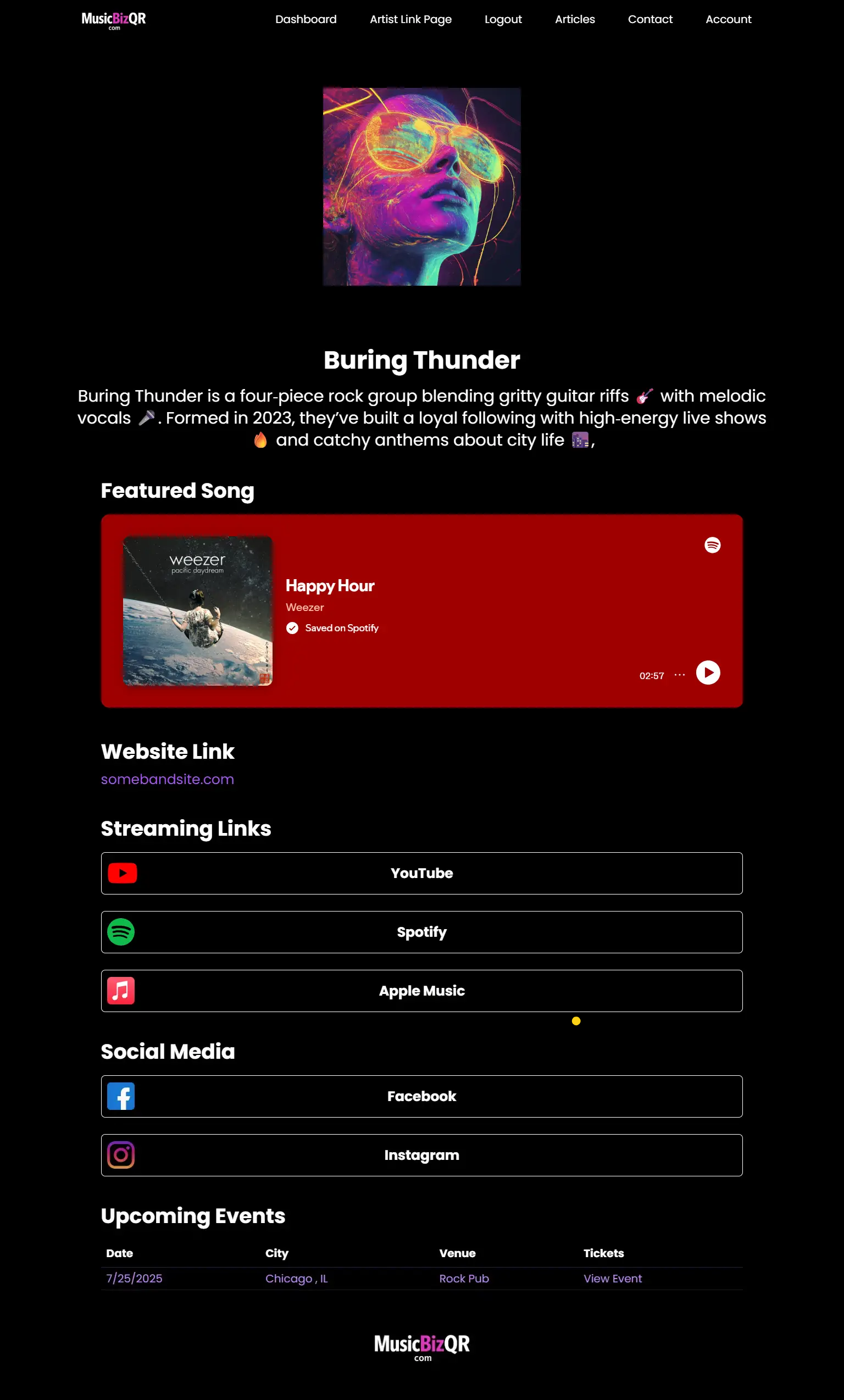
When a listener taps a smart link, they exit the algorithmic flow and arrive in a place that doesn’t change depending on mood, platform, or feed. The layout is familiar. The artist identity is clear. The experience feels intentional rather than accidental.
This shift matters more than it appears to on the surface.
Instead of encountering an artist only inside fragmented listening moments, the listener now experiences them in a stable environment. Music, visuals, context, and next actions coexist in one place. The artist is no longer a passing sound — they are a presence.
This is the structural role smart links play within the broader ecosystem described in
The Ultimate Guide to Smart Links for Bands.
Discovery doesn’t disappear. It resolves.
Completing What Platforms Were Never Designed to Do
Streaming platforms are optimized for scale. Smart links are optimized for continuity.
That distinction is critical.
A smart link doesn’t ask the listener to make a decision they aren’t ready for. It doesn’t demand a follow, a purchase, or a commitment. It simply gives the listener a place that feels recognizable the next time they arrive — whether that’s minutes later or months later.
This is why smart links outperform generic link-in-bio pages. They aren’t just collections of buttons. They are environments designed to reduce friction, reinforce identity, and support return behavior — principles rooted in fan psychology rather than feature checklists.
Those psychological mechanics are explored in depth in
The Psychology of Fan Conversion: Why Smart Links Outperform Link-in-Bio Tools.
By introducing a familiar destination into the streaming loop, smart links make something new possible: recognition. And recognition is the first step toward memory.
What Happens When Streaming Resolves to a Familiar Place
The moment streaming discovery resolves to a familiar destination, listener behavior changes — quietly, but decisively.
Nothing dramatic happens on the surface. There’s no sudden declaration of fandom, no explicit commitment. What changes instead is orientation. The listener is no longer drifting through an endless feed. They have arrived somewhere that feels stable, intentional, and repeatable.
That shift alters how attention behaves.
Recognition Lowers Resistance
The second time a listener lands on the same smart link, something subtle occurs: recognition replaces uncertainty.
They don’t need to re-learn who the artist is. The layout feels familiar. The visuals are consistent. The environment signals continuity. This reduces cognitive friction — the small hesitation that normally precedes action.
In streaming environments, every interaction feels like a first encounter. In a familiar destination, the listener feels oriented immediately. Orientation creates comfort. Comfort creates openness.
This is why fans are more likely to explore, listen longer, and engage more deeply once discovery resolves somewhere consistent.
Engagement Deepens Without Pressure
A familiar place doesn’t demand action. It invites exploration.
Embedded media plays a crucial role here. Instead of sending listeners back out into platforms where attention is fragmented, smart links allow music and video to exist inside the destination itself. Listening continues, but context is preserved.
This keeps the listener present rather than redirecting them away at the moment of peak interest — a behavioral advantage explored in
How Embedded Content Turns Smart Links Into Fan-Converting Machines.
The result isn’t immediate conversion. It’s duration. More time spent. More signals of interest. More familiarity forming naturally.
Early Signals of Relationship Formation
Return visits are the first quiet indicators that something has shifted.
When a listener chooses to come back — even briefly — they’ve crossed an invisible threshold. They are no longer responding solely to algorithmic prompts. They are acting with intention.
This is the moment where listeners stop being anonymous. Recognition has begun. Memory is forming.
And once return behavior exists, everything else becomes possible.
Return Behavior Creates Fans
Fans are not created in moments of discovery. They are created in moments of return.
The first time a listener comes back intentionally — not because a platform suggested it, but because they chose to — something fundamental changes. The artist is no longer just a sound that passed through their day. They have become a reference point.
Return behavior is the behavioral line between exposure and relationship.
The Difference Between Listeners and Fans
Listeners are reactive. Fans are intentional.
A listener hears a song when it appears. A fan seeks the artist out when nothing is prompting them to do so. That distinction has nothing to do with enthusiasm and everything to do with familiarity.
Streaming platforms are excellent at generating listeners. They are structurally incapable of creating fans on their own because they rarely encourage intentional return. The system always supplies the next option, removing the need for choice.
When a smart link becomes the place listeners return to, that dynamic reverses. The artist is no longer dependent on being surfaced again. They have become findable.
This transition — from passive listening to active return — is where real fan relationships begin, a process examined more deeply in
How Smart Links Help Indie Artists Build Fan Relationships.
How Familiarity Compounds Over Time
Familiarity doesn’t arrive all at once. It accumulates through repetition.
Each return reinforces recognition. Each visit lowers friction further. Over time, the artist becomes mentally “available” — someone the listener thinks of unprompted. This is the foundation of loyalty, support, and long-term engagement.
Importantly, this compounding effect does not require constant novelty. It requires consistency. The destination feels the same. The identity is clear. The experience is reliable.
Once return behavior exists, fans don’t need to be chased. They already know where to go.
Ownership Through Familiar Destinations
Ownership doesn’t begin with data, emails, or platforms. It begins with orientation.
An artist owns a relationship when fans know exactly where to go — without being told, reminded, or redirected by an algorithm. That familiarity is the earliest and most important form of ownership, and it exists long before any formal conversion takes place.
Streaming platforms cannot provide this. Their destinations are interchangeable by design. One artist page feels like the next. One listening session dissolves into another. The listener never needs to remember where they were, because the system always decides what comes next.
A familiar destination changes that dynamic.
Ownership Is About Predictability, Not Control
Ownership is often misunderstood as control over platforms or audiences. In reality, it’s about predictability.
When fans know where to find you — and expect that place to feel the same each time — you’ve established a durable connection. They don’t need to search. They don’t need to guess. They don’t need to wait for permission from a feed or an algorithm.
That predictability creates trust.
Over time, this trust shifts power away from platforms and back toward the artist. Not abruptly, not dramatically, but steadily. Each intentional return reinforces the idea that the artist exists independently of any single service or surface.
Consistency Beats Scale in the Streaming Age
Scale without consistency produces noise. Consistency without scale produces growth.
Streaming platforms excel at scale. They surface music to massive audiences quickly. But without a consistent destination, that scale evaporates as fast as it arrives. Listeners scatter because there is nothing anchoring them.
A familiar destination — revisited again and again — allows even modest discovery to compound. Fewer listeners can become more valuable than thousands of fleeting plays. Recognition deepens. Relationships stabilize.
This is how ownership forms in practice. Not through forcing actions, but through creating a place that fans return to naturally — until it becomes theirs as much as it is yours.
How This Fits Into the Smart Links System
This article doesn’t argue that streaming is broken. It explains why streaming is incomplete.
Discovery, on its own, is not a strategy. It’s a trigger. Streaming platforms are extraordinarily good at triggering attention, but they are structurally incapable of carrying that attention forward into memory, return, and ownership. Expecting them to do so leads to the cycle most artists know too well: releases spike, numbers fade, and nothing compounds.
Smart links are the missing connective tissue.
Within the broader smart links ecosystem, streaming sits at the top of the funnel — the place where listeners first encounter music. Smart links operate beneath that layer, where recognition, familiarity, and return behavior are formed. They don’t replace platforms; they resolve what platforms initiate.
This distinction matters for clarity and for scale. When artists understand that streaming is the entry point — not the destination — their strategy changes. Effort shifts from chasing every new surface to strengthening a single, consistent place fans can return to intentionally.
That system-level view is explored in depth in
The Ultimate Guide to Smart Links for Bands,
while the emotional and relational outcomes of return behavior are expanded in
How Smart Links Help Indie Artists Build Fan Relationships.
Taken together, these pieces form a hierarchy:
- Streaming creates discovery
- Smart links create continuity
- Continuity creates return
- Return creates ownership
Once that hierarchy is clear, the frustration lifts. Growth stops feeling random. Strategy stops feeling reactive. And fans stop disappearing between releases.
The problem was never that people weren’t listening.
It was that they had nowhere to come back to.
Frequently Asked Questions
Why don’t streaming platforms turn listeners into fans?
Streaming platforms are designed to maximize listening time, not memory or return behavior. They surface music efficiently but provide no stable destination for listeners to revisit intentionally, which prevents recognition and relationship-building from compounding.
What’s the difference between a listener and a fan?
A listener reacts to what appears in their feed. A fan returns intentionally. The shift happens when someone knows who the artist is, remembers them, and chooses to come back without being prompted by an algorithm.
Can’t artist profiles on streaming platforms solve this problem?
Artist profiles exist, but they are secondary surfaces. Most listeners never visit them because the platform experience is designed to keep them in continuous playback rather than encourage exploration or return.
How do smart links actually change listener behavior?
Smart links give discovery a consistent place to resolve. When listeners encounter the same destination repeatedly, recognition forms, friction drops, and return behavior becomes more likely.
Do smart links replace streaming platforms?
No. Smart links don’t compete with streaming platforms — they complete them. Streaming drives discovery; smart links handle continuity, memory, and ownership.
How many times does a listener need to return before they become a fan?
There’s no fixed number. What matters is that return becomes intentional. Even one unprompted revisit signals that recognition and familiarity have begun to form.
Is this strategy only for large or established artists?
No. In fact, smaller artists benefit the most. When discovery is limited, consistency matters more than scale. A small number of returning listeners is more valuable than a large number of fleeting streams.
What’s the first sign that this approach is working?
The earliest signal is repeat visits. When listeners come back on their own — even briefly — it indicates that memory has formed and the relationship is beginning to solidify.
Built for Musicians. Powered by Smart Links.
Faneqo gives you a powerful landing page with streaming links, videos, social buttons, and real-time fan analytics — all from a single QR code.
- 🎯 Unlimited link clicks & analytics
- 📈 Track Spotify streams, YouTube plays, and QR scans
- 📱 Mobile-optimized artist pages
- 🚀 Create your first Smart Link in seconds
Related Posts
Most link-in-bio tools weren’t built for musicians. Discover why smart links create better fan journeys, stronger branding, and higher conversions for your music.
Smart links for musicians explained—how they work, why they matter in 2026, and how to build a fan-converting link that drives your music career.
Discover how music links can help artists guide fans across platforms effortlessly. Learn strategies to boost engagement, streams, and merch sales.
Most link-in-bio tools weren’t designed for musicians. Learn why smart links deliver better fan engagement, stronger branding, and real music-driven revenue.
Smart links aren’t just utility tools — they’re the new frontier in artist branding. Learn how visual design, consistency, and fan-centric smart links define a musician’s digital identity.
Discover how smart links can transform fleeting music streams into lasting fan connections. Learn the strategies indie artists use to grow their audience in the streaming era.
Discover how smart links empower indie artists to create deeper, lasting relationships with fans. Turn every click into meaningful engagement.
Discover 2026’s best smart link tools for artists. We compare top platforms, fan engagement features, and why MusicBizQR stands above the rest.
Learn how direct-to-fan video turns your smart link into a conversion machine. Build trust, drive streams, and make real fan connections with MusicBizQR.
Learn how to use music links to drive fan engagement, increase streams, and promote your music like a pro. Built for modern artists and bands. Shall I begin writing the Markdown content for this article now?
In 2026, discovery is chaotic — and smart links are how artists bring it all together. Explore how music smart links guide fans, boost streams, and create real momentum across every platform.
Tired of generic link tools? Discover the smart link platform built for music: video previews, analytics, and full artist control—all in one sleek page.
Every new release deserves more than a link in your bio. Learn how to use smart links to drive streams, collect fans, and turn a single drop into lasting momentum.
The layout of your smart link page can make or break your fan engagement. Learn the design psychology that turns clicks into superfans.
If you're still sending fans to scattered links, you're leaving money on the table. Here's why every indie artist needs a smart link strategy to grow, connect, and convert.",
Most smart links just sit there. This guide shows musicians how to build a smart link page that turns casual clicks into lifelong fans. Real strategies that work.
Discover the psychology behind smart link layout design and how it shapes fan engagement, conversions, and merch sales.
Master the art of launching music with smart links. This guide shows how to create hype, drive streams, and maximize impact every time you drop a new release.
Your smart link is your new homepage. Learn how to design a 2026-ready page that plays your music instantly, tells your story, and converts fans the moment they land.
Learn how musicians can use smart links to connect directly with fans, bypass algorithms, and drive engagement, streams, and merch sales.
Discover how embedded content like music, videos, and social posts can turn your smart link into a fan engagement engine. Boost streams, merch sales, and loyalty.
Discover why smart links are transforming music marketing in 2025. Learn how a centralized hub can grow your audience, boost streams, and drive real fan engagement.
From Spotify embeds to merch and tour links, MusicBizQR makes music promotion easy. Learn how to use smart links to streamline your entire fan funnel.
Learn five powerful ways smart links can revolutionize your band's music promotion, amplify fan engagement, and strengthen fan loyalty.
Discover how smart links are revolutionizing music promotion, increasing fan engagement, boosting streaming numbers, and enhancing concert attendance.