
The Ultimate Guide to Smart Links for Bands
Executive Summary
Bands don’t lose fans because the music isn’t good. They lose fans because attention arrives fragmented — across platforms, moments, and contexts — and nothing exists to hold it together. For years, link-in-bio tools promised simplicity, but for bands, they quietly created a deeper problem: fractured fan journeys with no memory, no continuity, and no system behind them.
Smart links emerged not as a marketing trick, but as infrastructure — a centralized surface where discovery, listening, watching, following, and returning all converge. For bands especially, this shift matters more than it does for solo creators. Bands operate across releases, tours, rotating members, multiple platforms, and long timelines. Without a system that understands this complexity, every new fan interaction resets to zero.
This guide explains smart links at the system level: what problem they actually solve, why bands are uniquely affected by broken link strategies, and how modern smart links replace scattered promotion with a durable fan-growth foundation. The goal is not more clicks — it’s continuity, clarity, and compounding attention.
If you understand smart links only as “one link with buttons,” you are already behind. For bands building sustainable careers, smart links are not optional tools. They are the connective tissue that turns moments into momentum.
Key Takeaways
Disjointed discovery across platforms causes fan momentum to reset instead of compound.
Generic link tools organize links but do not preserve context, behavior, or continuity.
Their value comes from centralization, memory, and system-level continuity.
Multiple members, releases, tours, and timelines require a more durable fan surface.
When attention is centralized, fan relationships compound instead of evaporate.
Why Bands Lose Fans at the Link Level
Bands don’t lose fans because interest disappears. They lose fans because interest has nowhere to land.
Discovery today is chaotic by default. A clip surfaces on TikTok. A song gets shared in a group chat. A live video appears in an Instagram Story. A friend texts a Spotify link after a show. Each moment arrives charged with curiosity, emotion, momentum — and then immediately sends the fan somewhere else. Another app. Another tab. Another context switch.
For bands, this fragmentation is lethal.
Unlike solo creators, bands don’t operate on a single narrative thread. They exist across releases, tours, rotating content, multiple members, and long arcs of attention. Every discovery moment is only a fragment of a much larger story. When those fragments scatter across platforms with no shared center, the fan experience resets every time.
The fan isn’t deciding not to follow the band.
The system is simply failing to remember them.
Discovery Happens Everywhere — Retention Happens Nowhere
Most bands assume the problem is visibility. More posts. More ads. More content. But visibility without continuity creates an illusion of growth while quietly eroding retention.
A fan clicks a link, listens to a track, watches a clip, maybe follows — and then disappears. Not because the experience was bad, but because nothing connected that moment to the next one. No shared surface. No memory. No return path.
Each platform optimizes for its outcome, not the band’s. Spotify wants streams. Instagram wants engagement. TikTok wants watch time. None of them are designed to preserve the relationship across contexts. When a band relies on platform-native links alone, every fan interaction becomes a dead end.
The result is a familiar pattern: strong discovery, weak follow-through, and a fanbase that feels perpetually smaller than the audience being reached.
The Hidden Cost of Broken Fan Journeys
What breaks isn’t interest — it’s momentum.
Every time a fan encounters a band in a new place and has to re-orient themselves, friction increases. They have to decide again who the band is, where to listen, what matters, and whether it’s worth continuing. Most don’t consciously opt out. They simply drift.
Over time, this creates a silent tax on growth. Bands work harder for every release, every tour, every campaign — yet nothing compounds. Attention flares up and fades out, again and again, without ever accumulating into something durable.
This is the link-level problem most bands never see. Not a lack of traffic, but a lack of continuity. Not a content issue, but an infrastructure failure.
Until attention has a place to gather and persist, fan growth will always feel fragile — no matter how good the music is.
Why Link-in-Bio Tools Break Down for Bands
Link-in-bio tools didn’t fail because they were poorly built. They failed because they were built to organize links, not to support how bands actually grow.
At first glance, they seem like the solution to fragmentation. One link. Multiple destinations. Everything in one place. But for bands, this approach only rearranges the problem instead of solving it. The underlying assumption is that fans arrive with context, patience, and intent — and that once given options, they’ll navigate correctly.
That assumption is wrong.
Bands don’t attract fans in clean, linear journeys. They attract fans in moments — a song clip mid-scroll, a live video after midnight, a shared track days later, a QR code at a show. These moments are emotional, brief, and fragile. When a fan taps a generic link-in-bio page, they aren’t looking to browse. They’re looking for continuity.
Link-in-bio tools offer choice, but not direction. They present destinations without preserving why the fan arrived in the first place.
Organization Without Continuity
Most link-in-bio pages are static menus. They list platforms, profiles, and links as if fans are calmly deciding where to go next. But real fan behavior doesn’t look like that. Fans don’t want to choose between five buttons — they want the next meaningful step to be obvious.
For bands, this matters more than it does for solo creators. A band’s story isn’t singular. There are multiple releases, rotating priorities, tour cycles, and evolving narratives. When all of that collapses into a flat list of links, nothing is contextualized and nothing compounds.
The page may technically be “central,” but it doesn’t behave like a system. It doesn’t remember what the fan engaged with. It doesn’t adapt to where they came from. It doesn’t guide them forward. Every visit starts from zero.
This is why bands often feel like they’re rebuilding their audience every time they release something new.
Why “One Link” Is Not the Same as One System
A single URL does not automatically create continuity.
A system does.
A system understands that a fan who arrived from a live clip is in a different state than someone who clicked after a studio release. It recognizes that bands need to support listening, watching, following, and returning — not as separate actions, but as connected behaviors.
Generic link-in-bio tools stop at aggregation. They collect links, but they don’t connect experiences. They don’t preserve momentum across platforms. They don’t create a surface where fan behavior can accumulate and evolve.
This is why so many bands eventually outgrow them — even if they can’t immediately articulate why.
For a deeper breakdown of how this limitation plays out in real-world comparisons, see
Smart Link vs Linktree: What Every Musician Should Know in 2026.
That comparison makes the distinction clear: organization solves clutter. Infrastructure solves continuity.
Until bands recognize that difference, they’ll keep mistaking neat pages for growth systems — and wondering why their fanbase never seems to stick.
Smart Links as Fan Infrastructure
Most people still think of smart links as improved link pages — better layouts, richer embeds, nicer buttons. That framing misses what actually changed.
Smart links didn’t evolve to organize destinations.
They evolved to hold fan attention in one place long enough for it to compound.
That shift — from navigation to infrastructure — is the difference between something that looks useful and something that quietly reshapes how bands grow.
Infrastructure is invisible when it works. You don’t notice it because it removes friction instead of creating features. In the context of fan growth, infrastructure provides a stable surface where discovery, engagement, and return visits connect instead of scattering.
That is what smart links do when they are built correctly.
Centralization vs. Aggregation
Aggregation collects links. Centralization collects experience.
Most tools stop at aggregation. They gather external destinations and present them as options, assuming the fan will self-direct. But centralization does something more subtle and far more powerful: it creates a single surface where listening, watching, following, and returning all happen without forcing context switches.
For bands, this distinction matters more than it does for almost anyone else.
A band’s presence is inherently distributed. Music lives on streaming platforms. Video lives elsewhere. Announcements live on social. Touring lives in calendars and venues. When each interaction pushes the fan away from the band’s center, attention leaks out instead of building.
A smart link acts as a gravitational point. Not by trapping fans, but by giving every interaction a shared reference point. No matter where discovery happens, the experience resolves to the same surface. Over time, that surface becomes familiar. Predictable. Trustworthy.
That familiarity is what allows momentum to accumulate.
Memory, Behavior, and Compounding Attention
The real power of infrastructure is memory.
Not memory in the technical sense alone, but behavioral continuity. When a fan returns to the same surface — even weeks later, even from a different platform — they are not starting from scratch. They recognize the environment. They understand what to do next. Their attention flows instead of hesitating.
This is where most band promotion quietly fails. Each campaign assumes a fresh audience, even though it’s often the same people encountering the band again in a new place. Without a central surface, those repeat encounters don’t reinforce each other. They compete.
Smart links change that dynamic by giving attention somewhere to land repeatedly.
This is also why embedded media matters so much inside smart links. When listening and watching happen without sending fans away, engagement deepens instead of fragmenting. The link stops being a hallway and starts becoming a room.
For a deeper look at this mechanism, see
How Embedded Content Turns Smart Links Into Fan-Converting Machines.
When attention stays centralized, behavior compounds. Fans don’t just click — they return. They explore. They remember. Over time, the band stops reintroducing itself and starts building a relationship.
That is infrastructure at work.
Smart links aren’t better menus.
They are the foundation that allows everything else — releases, tours, videos, analytics — to finally connect.
Why Bands Need a Different Smart Link Approach
Most smart link advice is written as if every artist operates the same way. One voice. One release cycle. One narrative thread. That assumption quietly breaks down the moment a band enters the picture.
Bands are not just larger versions of solo creators. They are structurally different entities, with different rhythms, different pressures, and different failure points. When bands use tools designed for individuals, the cracks don’t show immediately — but they widen over time.
This is where many bands feel like they’re doing everything “right” while nothing sticks.
Multiple Members, Multiple Timelines
A band is never telling one story at a time.
There are multiple members with their own visibility. There are releases that overlap instead of replacing each other. There are tours layered on top of singles, merch drops, videos, collaborations, and local scenes. Attention arrives in fragments — and often out of order.
A fan might discover the band through a live clip from six months ago, then encounter a new single weeks later, then finally see a tour announcement after that. None of those moments exist in isolation. But most link strategies treat them as if they do.
Generic link pages flatten everything into a single moment: here’s what we’re promoting right now. Anything that doesn’t fit that frame becomes invisible, even though it may be exactly what a returning fan is looking for.
For bands, this creates a constant tension between the past and the present. Older content still matters. Live footage still converts. Songs released months ago still resonate. Without a system that supports layered timelines, bands are forced to choose what to surface — and what to bury.
A band-grade smart link doesn’t erase history. It accommodates it.
Releases, Tours, and Long Arcs of Attention
Solo creators often optimize for immediacy. Bands have to optimize for endurance.
A tour doesn’t behave like a post. A release doesn’t peak and vanish. Fan relationships form over months and years, not days. When link strategies reset with every campaign, bands lose the ability to build on prior momentum.
This is why bands often feel trapped in a cycle of constant reintroduction. Every release feels like starting over. Every tour feels disconnected from the last. Fans who already care are treated the same as fans who just arrived.
A different approach is required — one that assumes return visits, recognizes long arcs of attention, and allows fans to re-enter the band’s world without friction.
This is also where band-centric smart links begin to intersect with analytics and behavioral insight. When attention is centralized, bands can finally see patterns instead of isolated clicks. They can understand what fans return to, not just what they click once.
For a deeper look at how this distinction affects long-term fan relationships, see
How Smart Links Help Indie Artists Build Fan Relationships.
The key shift is subtle but profound: bands don’t need smarter links because they have more links. They need smarter links because they have longer stories.
Without infrastructure that respects those stories, even the most passionate fans eventually lose their way back.
From Moments to Momentum
Most bands experience fan attention as a series of spikes. A release bumps numbers for a week. A tour announcement flares engagement for a few days. A clip goes semi-viral and then fades. Each moment feels promising — and then strangely disposable.
The problem isn’t that moments don’t work.
It’s that they don’t connect.
Momentum only exists when one moment makes the next moment easier. When recognition replaces introduction. When familiarity replaces friction. Without that continuity, attention behaves like static electricity — brief, bright, and gone as soon as contact breaks.
This is where infrastructure quietly determines outcomes.
Turning Discovery into Return Visits
A fan who returns is fundamentally different from a fan who clicks once.
They don’t need convincing. They don’t need context. They already know who the band is and why they care. The only question is whether the system makes it easy for them to re-enter the band’s world — or whether it forces them to start over.
When discovery resolves to a consistent smart link surface, return visits become natural instead of accidental. The fan remembers where to go. The band becomes associated with a place, not just a song or a post. Over time, that place becomes the default reference point for everything the band does.
This is how isolated moments begin to stack.
A clip leads to a song.
A song leads to a follow.
A follow leads to a return.
Not because the fan was pushed harder, but because the path was already there.
What Sustainable Fan Growth Actually Requires
Sustainable growth isn’t about maximizing any single action. It’s about reducing the effort required to stay connected over time.
When attention is centralized, bands stop chasing fans across platforms and start meeting them where they already are. Each new campaign doesn’t compete with the last one — it reinforces it. Each interaction adds context instead of erasing it.
This is also where clarity replaces guesswork. When fan behavior flows through a single surface, patterns emerge. Bands can see what people come back for, not just what they clicked once. They can distinguish curiosity from commitment. Noise from signal.
That distinction matters. It’s the difference between feeling busy and actually building something.
For a deeper exploration of how centralized smart links change fan behavior in the streaming era, see
Smart Links in the Streaming Age: Convert Casual Listeners into Lifelong Fans.
Momentum isn’t created by louder promotion.
It’s created when fans don’t have to think about where to go next.
Smart links, when treated as infrastructure, give attention somewhere to return to. And once attention starts returning, growth stops resetting — and starts compounding.
What a Band-Grade Smart Link System Must Support
Once smart links are understood as infrastructure, the question stops being what buttons should we add? and becomes what behaviors must this system reliably support over time?
A band-grade smart link system doesn’t try to do everything. It does a few structural things exceptionally well — the kinds of things that allow attention to accumulate instead of disperse.
These are not features.
They are capabilities.
Listening, Watching, and Following in One Surface
Bands don’t convert fans through a single action. Listening leads to watching. Watching leads to following. Following leads to returning. When these behaviors are split across platforms with no shared surface, each step becomes a decision point — and decisions are where momentum dies.
A band-grade system allows fans to move between these states without being pushed away or reset. Music can be heard where discovery happens. Video can be watched without forcing a platform jump. Following doesn’t feel like an exit — it feels like continuation.
This is why embedded media isn’t cosmetic. It’s structural. When fans can engage deeply without leaving the band’s central surface, attention thickens instead of thinning.
For a focused breakdown of how this works in practice, see
How Embedded Content Turns Smart Links Into Fan-Converting Machines.
The goal isn’t to trap fans. It’s to give them fewer reasons to drift.
Analytics and Behavioral Insight
Infrastructure that can’t be observed can’t be improved.
Bands don’t just need to know how many people clicked. They need to understand how fans move, return, hesitate, and commit over time. When interactions are scattered across platforms, that story is invisible. Each platform reports success in isolation, while the band is left guessing what actually worked.
A centralized smart link system creates a single behavioral lens. It allows bands to see patterns: what content pulls people deeper, what moments trigger return visits, what paths consistently lead to real engagement.
This isn’t about dashboards for their own sake. It’s about replacing intuition with clarity — and allowing strategy to evolve based on reality instead of assumptions.
Evolution Over Time, Not Static Pages
Bands don’t stand still. Their links shouldn’t either.
Releases stack. Tours come and go. Videos age differently than songs. What mattered last month may still matter next year — just in a different way. Static link pages force bands to constantly overwrite themselves, erasing history to make room for the present.
A band-grade system supports evolution without deletion. It allows the surface to change while preserving continuity. New fans see what matters now. Returning fans recognize what they’ve seen before. Nothing feels abandoned, and nothing feels frozen.
This is where design psychology quietly reinforces infrastructure. Familiar layouts reduce friction. Predictable structure increases trust. When fans know what to expect, they move with confidence instead of hesitation.
For a deeper look at how layout and hierarchy influence behavior, see
Smart Link Design Psychology: How Layout Impacts Fan Behavior.
When these capabilities work together, the smart link stops behaving like a page and starts behaving like a place — one that grows alongside the band instead of resetting with every campaign.
That is what separates tools that organize links from systems that sustain careers.
How This Guide Fits the Smart Links Ecosystem
This guide exists to define the system — not to exhaust every dimension of it.
Smart links touch design, psychology, analytics, media, promotion, and comparison. Each of those areas deserves focused treatment. Trying to collapse them all into one place would blur responsibility instead of clarifying it. That’s how overlap happens. That’s how authority weakens.
Instead, this guide acts as the reference point everything else builds from.
If you are looking for a system-level understanding of how smart links function for bands — why they matter, what problem they solve, and how they replace fragmented promotion — you are in the right place. If you want depth in a specific dimension, the ecosystem below is where that depth lives.
Where to Go Deeper
Each of the following articles assumes the foundation established here and explores one dimension in isolation:
Design & behavior:
How layout, hierarchy, and visual structure influence fan decisions →
Smart Link Design Psychology: How Layout Impacts Fan BehaviorEmbedded engagement:
Why listening and watching inside the link surface changes conversion dynamics →
How Embedded Content Turns Smart Links Into Fan-Converting MachinesDirect-to-fan video:
How video changes the emotional weight of a smart link experience →
Direct-to-Fan Video: The Smart Link Strategy Musicians OverlookFan psychology & conversion:
Why smart links outperform generic link tools at turning interest into commitment →
The Psychology of Fan Conversion: Why Smart Links Outperform Link-in-Bio Tools Every TimeTool comparisons:
Where traditional link-in-bio tools fall short for musicians →
Smart Link vs Linktree: What Every Musician Should Know in 2026
Each article above deepens one layer of the system described here. None of them attempt to redefine it.
How to Use This Guide
Think of this guide as the map, not the destination.
Return to it when:
- You need to explain smart links clearly to bandmates or collaborators
- You want to sanity-check a strategy before diving into tactics
- You feel like promotion is working, but growth isn’t sticking
The other articles in the smart-links category exist to help you apply the system. This one exists to help you understand it.
When the system is clear, everything else becomes easier — decisions simplify, tools make sense, and momentum stops resetting.
That clarity is the real advantage smart links provide.
Frequently Asked Questions
What is a smart link for bands?
A smart link is a centralized fan surface that connects listening, watching, following, and returning in one place. For bands, it functions as infrastructure — not just a list of links — allowing attention from different platforms to accumulate instead of reset.
How is a smart link different from a link-in-bio tool?
Link-in-bio tools organize destinations. Smart links preserve continuity. The difference isn’t the number of links, but whether fan behavior connects across visits, platforms, and moments instead of fragmenting each time.
Why do bands need smart links more than solo artists?
Bands operate across longer timelines, multiple releases, tours, members, and narratives. Without a centralized surface, fans encounter the band out of context and are forced to reorient every time, which weakens retention and momentum.
Do smart links replace websites for bands?
Smart links don’t replace websites — they replace friction. For many bands, a smart link becomes the primary fan touchpoint because it’s faster, more focused, and better aligned with how fans actually discover and return.
Can smart links help bands grow their fanbase, not just manage links?
Yes. When smart links are treated as infrastructure, they turn isolated discovery moments into repeat engagement. Growth comes from fans returning, not just clicking once.
What kind of content works best inside a smart link?
Content that reduces context switching performs best — embedded music, video, tour info, and follow actions that keep fans engaged without sending them away before interest settles.
How do smart links support long-term fan relationships?
By giving fans a familiar place to return to. Over time, recognition replaces reintroduction, and the band’s presence feels stable rather than scattered across platforms.
Is a smart link only useful during releases or tours?
No. Smart links are most valuable between campaigns. They provide continuity when nothing “new” is happening, allowing fans to reconnect without waiting for the next promotional spike.
Built for Musicians. Powered by Smart Links.
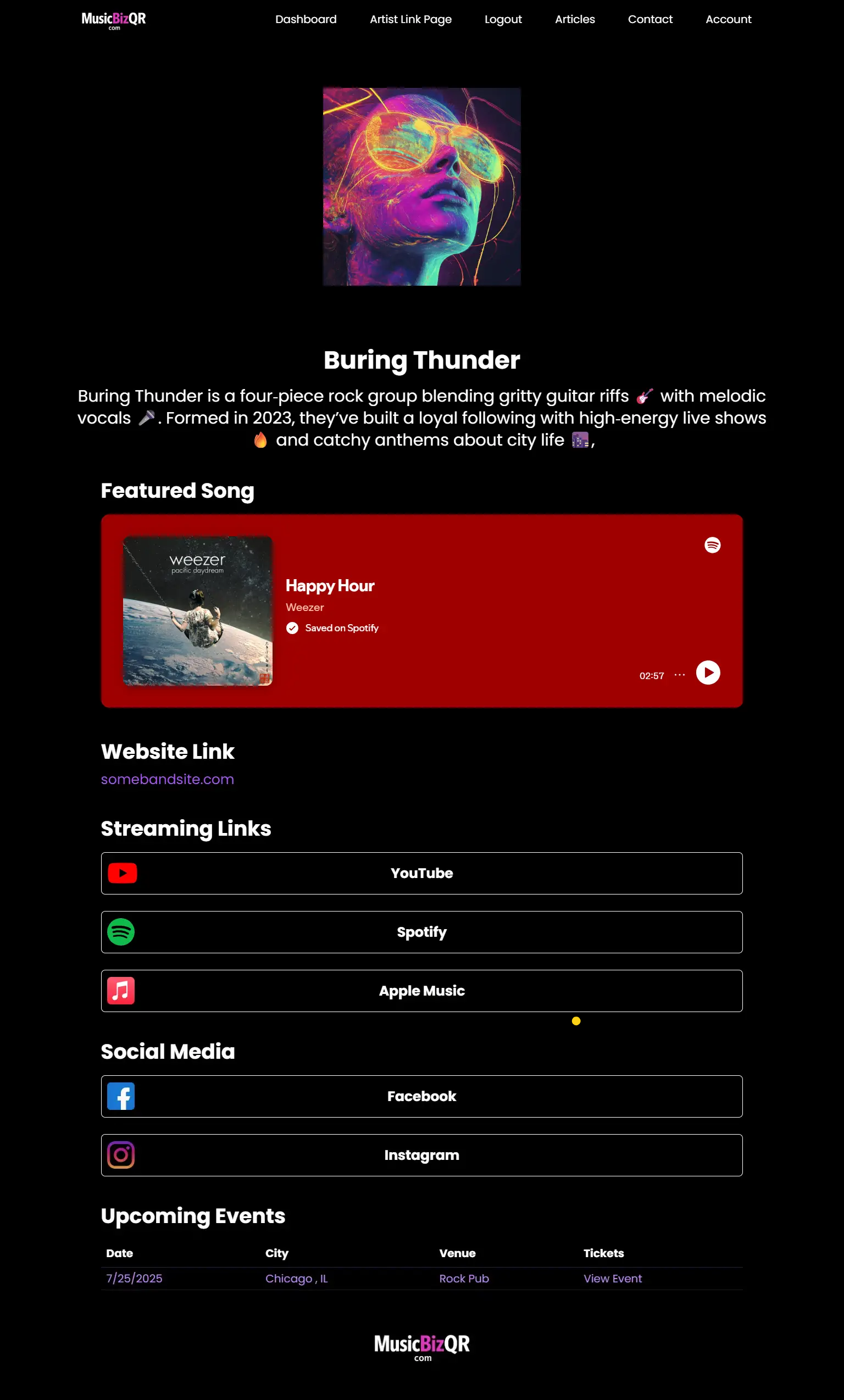
Faneqo gives you a powerful landing page with streaming links, videos, social buttons, and real-time fan analytics — all from a single QR code.
- 🎯 Unlimited link clicks & analytics
- 📈 Track Spotify streams, YouTube plays, and QR scans
- 📱 Mobile-optimized artist pages
- 🚀 Create your first Smart Link in seconds
Related Posts
Most link-in-bio tools weren’t built for musicians. Discover why smart links create better fan journeys, stronger branding, and higher conversions for your music.
Smart links for musicians explained—how they work, why they matter in 2026, and how to build a fan-converting link that drives your music career.
Discover how music links can help artists guide fans across platforms effortlessly. Learn strategies to boost engagement, streams, and merch sales.
Most link-in-bio tools weren’t designed for musicians. Learn why smart links deliver better fan engagement, stronger branding, and real music-driven revenue.
Smart links aren’t just utility tools — they’re the new frontier in artist branding. Learn how visual design, consistency, and fan-centric smart links define a musician’s digital identity.
Discover how smart links can transform fleeting music streams into lasting fan connections. Learn the strategies indie artists use to grow their audience in the streaming era.
Discover how smart links empower indie artists to create deeper, lasting relationships with fans. Turn every click into meaningful engagement.
Discover 2026’s best smart link tools for artists. We compare top platforms, fan engagement features, and why MusicBizQR stands above the rest.
Learn how direct-to-fan video turns your smart link into a conversion machine. Build trust, drive streams, and make real fan connections with MusicBizQR.
Learn how to use music links to drive fan engagement, increase streams, and promote your music like a pro. Built for modern artists and bands. Shall I begin writing the Markdown content for this article now?
In 2026, discovery is chaotic — and smart links are how artists bring it all together. Explore how music smart links guide fans, boost streams, and create real momentum across every platform.
Tired of generic link tools? Discover the smart link platform built for music: video previews, analytics, and full artist control—all in one sleek page.
Every new release deserves more than a link in your bio. Learn how to use smart links to drive streams, collect fans, and turn a single drop into lasting momentum.
The layout of your smart link page can make or break your fan engagement. Learn the design psychology that turns clicks into superfans.
If you're still sending fans to scattered links, you're leaving money on the table. Here's why every indie artist needs a smart link strategy to grow, connect, and convert.",
Most smart links just sit there. This guide shows musicians how to build a smart link page that turns casual clicks into lifelong fans. Real strategies that work.
Discover the psychology behind smart link layout design and how it shapes fan engagement, conversions, and merch sales.
Master the art of launching music with smart links. This guide shows how to create hype, drive streams, and maximize impact every time you drop a new release.
Your smart link is your new homepage. Learn how to design a 2026-ready page that plays your music instantly, tells your story, and converts fans the moment they land.
Learn how musicians can use smart links to connect directly with fans, bypass algorithms, and drive engagement, streams, and merch sales.
Discover how embedded content like music, videos, and social posts can turn your smart link into a fan engagement engine. Boost streams, merch sales, and loyalty.
Discover why smart links are transforming music marketing in 2025. Learn how a centralized hub can grow your audience, boost streams, and drive real fan engagement.
From Spotify embeds to merch and tour links, MusicBizQR makes music promotion easy. Learn how to use smart links to streamline your entire fan funnel.
Learn five powerful ways smart links can revolutionize your band's music promotion, amplify fan engagement, and strengthen fan loyalty.
Discover how smart links are revolutionizing music promotion, increasing fan engagement, boosting streaming numbers, and enhancing concert attendance.