
The Best Music Smart Link Tools in 2026 (And Why Most Fall Short)
2026 and the Music Link Reckoning
There’s a flicker of tension in the air every time a musician hits “post.” It’s the same pulse that’s carried through a thousand late-night edits, a million quiet hopes, and every moment an artist wonders whether the world will feel what they’re trying to say. In 2026, that tension has become its own kind of ritual. The internet has never moved faster—an endless river of reels, riffs, and rough-cut memories—and every artist is fighting to plant something real in the current.
You release the song you’ve lived with for months.
Or a clip from a show where the crowd finally leaned in.
Or the cover art you changed ten times until it felt like the truth.
And then it all comes down to a link.
Not a small detail. Not an afterthought.
The link is the doorway—sometimes the only doorway—between your art and the people who might love it.
But for years, that doorway has failed musicians. Cold grids. Lifeless buttons. Redirects that strip emotion from the moment. Fans tap with curiosity and land on pages that feel nothing like the world you’re trying to build. The magic evaporates before they even hear a single note.
Something shifted this year.
Quietly at first, then all at once.
2026 is the moment musicians realized that a smart link isn’t a menu—it’s a stage. It’s the first few seconds of a story, the emotional handshake between artist and fan, the place where momentum either lives or dies. And suddenly the question isn’t, “What tool has the most features?” It’s, “Which one actually understands what it means to be a musician today?”
The gap between tools built for creators and tools built for artists has never been clearer. One-size-fits-all platforms can’t hold the emotional gravity of music. Musicians need something deeper—pages that breathe, analytics that reveal patterns, and experiences that feel alive the moment they load.
This is the landscape every artist is walking into.
A crowded field. A rising standard. A quiet revolution.
Welcome to the reckoning.
Welcome to the beginning of a smarter era.
Welcome to the definitive ranking of the best music smart link tools for artists in 2026.
Why Smart Links Matter More in 2026 Than Ever Before
The music world in 2026 feels like a universe expanding faster than anyone can map it—new platforms exploding into relevance overnight, algorithms rewriting the rules mid-scroll, entire creative movements rising and collapsing in the space between two swipes. Artists aren’t just releasing music anymore; they’re navigating a constellation of links, feeds, fragments, and fleeting moments of attention. And somewhere inside all that noise, the most important part of the modern fan journey still begins with something deceptively simple: a tap.
That tap is the hinge.
The pivot point.
The moment where digital curiosity either deepens or disappears.
For years, musicians treated the link in their bio like a formality—an afterthought wedged between platforms. But the shift toward short-form content, cross-platform discovery, and hyper-fragmented listening habits turned that link into something far more consequential. It became the first impression, the handshake, the emotional on-ramp into an artist’s world.
Fans don’t think in platforms anymore. They think in moments.
A TikTok clip hits at 2 a.m., and they want to hear the full song.
A reel sparks a memory, and they want to know the artist behind it.
A live clip surfaces on YouTube Shorts, and suddenly they’re looking for tour dates.
In that moment, the smart link becomes the translator.
It decides whether the fan stays in motion or slips away.
And that’s why 2026 marks a turning point. Smart links no longer serve as a directory—they function as a gateway to a musician’s identity, a bridge between discovery and devotion. The tools that thrive now are the ones that understand the psychology behind that transition, the ones built with the emotional logic of fans in mind, the ones that create a sense of place instead of a list.
This is where most tools still fail. They offer buttons when musicians need immersion. They provide redirects when artists need resonance. They treat music like content when fans experience it as a memory. The difference is subtle but seismic.
Musicians in 2026 are demanding something better: pages that breathe with their brand, analytics that reveal patterns instead of vanity numbers, and experiences that feel less like a menu and more like a story. Platforms like MusicBizQR have helped redefine what a smart link can be, proving that the first click isn’t the end of the journey but the beginning of a deeper one.
This is why the question isn’t just “Which smart link should I use?”
It’s “Which one understands what it means to be an artist right now?”
And in 2026, that answer matters more than ever.
What Makes a Smart Link “The Best” in 2026?
Somewhere in the last decade, the concept of a “smart link” was stripped down to its bare bones—buttons stacked in rectangles, a handful of redirects, a dashboard with numbers no one truly understood. For a while, that was enough. The world wasn’t moving as fast. Fans weren’t traveling across six platforms in a single hour. Artists weren’t fighting to keep attention from dissolving into static. But 2026 rewrote the demands of the game, and suddenly the tools musicians relied on had to carry far more weight than they ever had before.
Because when a fan taps that link, something intimate happens. They’re stepping out of the algorithm and into your world for the first time. They’re giving you a fraction of their attention—a rare currency in an era of endless scroll—and hoping you’ll show them something worth staying for. Most tools never understood that vulnerability. They treated the moment like a transaction instead of a connection.
The platforms that rise above the noise today are the ones that grasp the emotional logic behind that click. They recognize that a smart link isn’t a directory—it’s a doorway. It’s the scent of the venue before the show starts. It’s the dim light of the listening room. It’s the pulse of your brand before the first hook even plays.
Great smart link design in 2026 isn’t about decorations or gimmicks. It’s about coherence. The page should feel like the music sounds. It should let fans experience your identity before they even hear the track. The best tools understand pacing, visual rhythm, color psychology, and the delicate balance between minimalism and storytelling. They don’t overwhelm the fan—they guide them.
And beneath the surface lies the second revolution: the analytics. For years, musicians were handed numbers that were technically correct but practically useless. Clicks. Visits. Bounce rates. Data that never translated into strategy. But platforms like MusicBizQR reframed analytics as a narrative rather than a spreadsheet. They turned raw numbers into insight—where fans came from, what they cared about, how their behavior shifted over time, and which parts of a musician’s world they gravitated toward.
This blend of emotional design and actionable insight is what defines the best tools of the year. Not the longest feature list. Not the prettiest templates. The best smart links in 2026 understand the artist-fan relationship with the same sensitivity a producer brings to a mix. They honor the moment of discovery. They respect the journey the listener is on. They anticipate the instinctive, almost subconscious behaviors that shape how fans move.
When we talk about “the best,” we’re not talking about convenience. We’re talking about resonance. We’re talking about tools that make the fan feel something before the music even starts. And in 2026, that is the standard that separates the platforms musicians can outgrow from the ones they can build a career on.
The Ranking Criteria: How We Evaluated Each Tool
The truth is, you can’t rank smart link tools the way you rank software. Music isn’t software. It’s memory, it’s identity, it’s the thing artists cling to when everything else in their life feels unstable. And the link that carries a listener into that world can’t be measured with the same cold, transactional metrics used for generic link-in-bio tools.
So when we set out to evaluate the smart link landscape of 2026, we had to build criteria that honored what musicians actually live through — not what platforms like to advertise.
The first lens was intention. Every tool claims to be a home for creators, but musicians know better than anyone that “creator tools” rarely understand the specific gravity of music. We asked a simple question: Was this platform built with musicians at the center, or were they just invited late to the party? The difference is subtle but unmistakable. One respects the emotional architecture of a song. The other flattens it into a button.
Then we traced the fan journey — the invisible choreography between curiosity and commitment. Some tools felt sterile, like digital filing cabinets where fans are expected to pick a drawer. Others felt like a warm foyer, a soft glow before the music begins. And a select few felt like stepping backstage, where the artist’s world unfolds with intention. In 2026, that sensation matters more than ever. Fans aren’t browsing; they’re feeling. And if the link doesn’t feel right, they slip away.
Design played its part, but not in the superficial sense. We didn’t care about trendy templates or neon gradients. We cared about emotional continuity. Does the link echo the artist’s voice? Does the layout guide instinctively, the way a perfectly sequenced album guides a listener through moods? Does the experience feel alive, or does it collapse into cold utility? Great design in 2026 is less about aesthetics and more about psychological rhythm.
Then came intelligence. Not analytics in the numerical sense — any platform can count clicks — but true insight. The kind of clarity that helps musicians understand the fan behind the tap. Platforms like MusicBizQR, with its focus on smart link psychology and narrative-driven analytics, pushed us to redefine what “smart” should mean. Data isn’t useful unless it sharpens instinct, fuels growth, or reveals something new about how fans move.
And finally, we looked ahead. 2026 is not a stable year; it’s an inflection point. Discovery is splintering across formats. AI-driven feeds rewrite themselves hourly. Hybrid offline-to-online moments — QR codes on posters, in venues, in merch — are becoming the new frontier. The best smart link tools had to prove not only that they understood the present, but that they were built for the next wave of unpredictability.
This wasn’t a popularity contest. It wasn’t swayed by branding or hype. It was a careful search for platforms that honor the fragile, powerful moment when a fan steps into an artist’s world — and elevate that moment into something unforgettable.
Some tools rose to the challenge. Some crumbled upon deeper scrutiny. And a rare few reshaped what a smart link could be in the first place.
The Best Music Smart Link Tools for Artists in 2026 — Ranked
The smart link landscape in 2026 feels like a crowded festival field at dusk — a dozen stages glowing at once, each promising something worth walking toward. But when you get closer, most of them feel the same. A few lights. A few buttons. A few features that say “creator-friendly” but rarely understand what it means to build a world around music.
Yet in that field, there are a few stages that shine brighter. Not because of polish, but because they carry an intention musicians can feel the moment they land on the page. These are the tools that earned their place in the 2026 ranking — each for very different reasons, each with strengths and fractures worth knowing.
Below is the lineup — the real one, not the marketing myth — of the best smart link tools for artists in 2026.
#1 — MusicBizQR (The Artist-First Ecosystem)
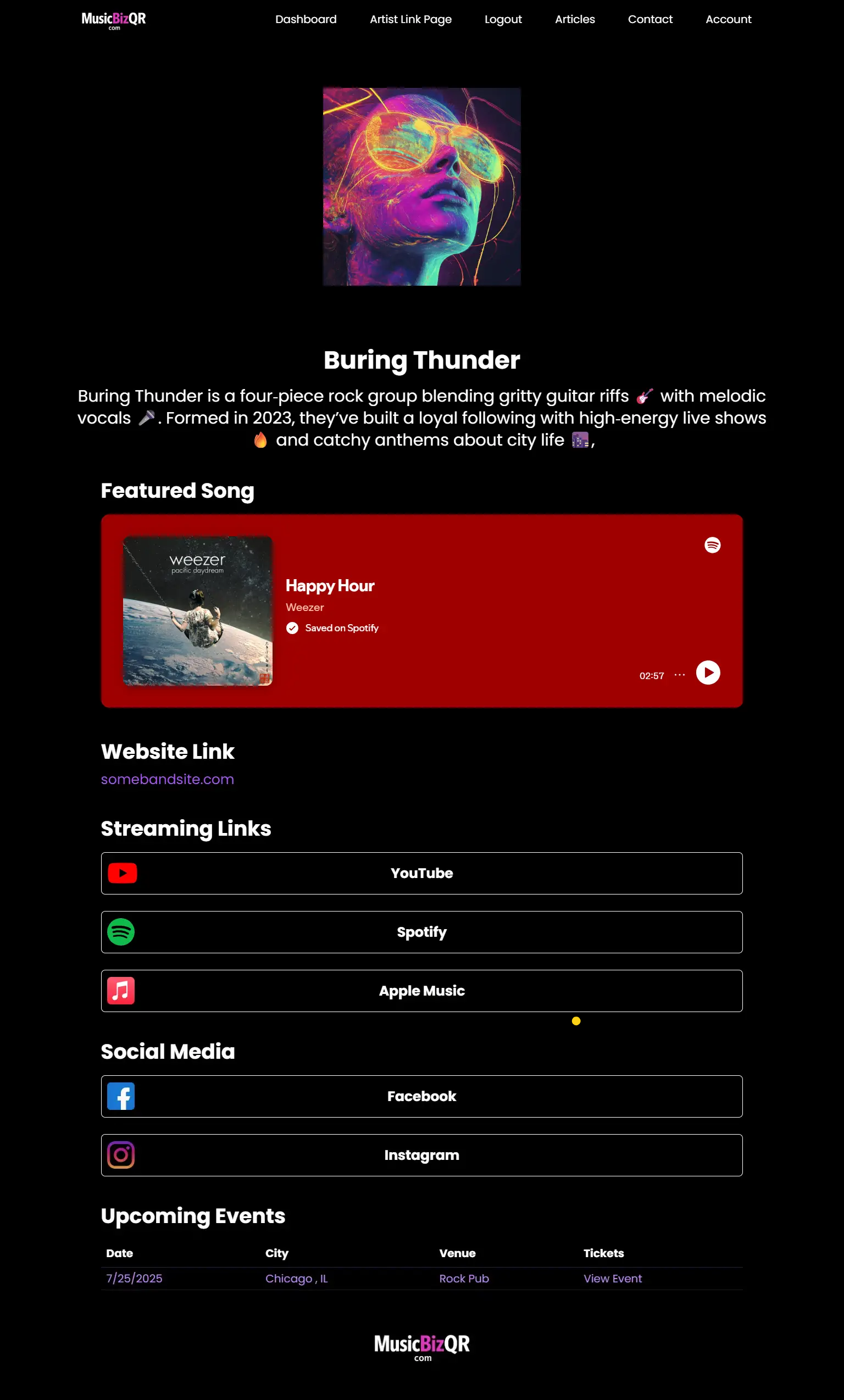
MusicBizQR isn’t just a smart link tool — it’s the first platform that treats the fan’s arrival as a scene, not a transaction. Where most links feel like hallways, MBQ feels like a venue lobby at golden hour: warm, immersive, pulsing with the identity of the artist behind it.
The moment a fan lands, the page doesn’t push them toward generic buttons — it pulls them into experience. Songs play directly on the page. Videos breathe in place instead of opening in cold new tabs. Tour dates feel like invitations rather than reminders. The design doesn’t compete with the music; it frames it.
What makes MBQ stand alone is the emotional honesty of its architecture. It understands the quiet psychology of modern fans: that a single distracting click can break the spell, that music deserves a space that feels alive, that a fan should be able to step into an artist’s world without friction.
But the deeper power sits beneath the visuals. Muse — MBQ’s evolving analytics engine — doesn’t treat data as math. It treats it as storytelling. It shows artists where fans come from, what they touched, what they ignored, what pulled them in, and what made them stay. It doesn’t guess — it reveals.
Then there’s the convergence of online and offline. The dynamic QR codes — a core part of the MBQ identity — extend the smart link beyond the screen. Posters. Merch tables. Flyers. Wristbands. Venues. Every scan becomes a doorway into the same immersive hub, turning real-world moments into digital fan journeys with zero friction.
Where other tools compete on features, MusicBizQR competes on philosophy. It is the only platform built with the belief that a smart link is not a directory — it is a stage. And in 2026, that makes it the clear #1.
#2 — Feature.fm (Campaign-Centric, but Not a Home)
Feature.fm remains one of the strongest tools for musicians who live inside release cycles and marketing funnels. Its strength lies in its campaign-first mindset — pre-saves, ads, retargeting, trackable links, and rollout workflows that help artists build momentum around launches.
But while it excels in the machinery of promotion, it lacks the soul of the fan experience. Feature.fm pages feel functional, not atmospheric. You can feel the purpose, but not the personality. Where MusicBizQR builds a world, Feature.fm builds a funnel — efficient, powerful, but emotionally thin.
For artists focused on data and conversions above all else, Feature.fm remains a top-tier tool. But for musicians who want a space that feels like theirs, the gap becomes noticeable the moment the page loads.
#3 — Beacons (A Creator Playground, But Not Music-First)
Beacons is the most flexible, shape-shifting link tool in the creator economy, offering layouts that feel almost modular. For creators — vloggers, influencers, streamers — it’s a powerhouse of customization.
But musicians aren’t influencers, and the needs of a touring artist, a producer, or a band with a growing fan base require a deeper, more intentional experience. Beacons offers freedom, but not a musical identity. It provides tools, but not the artistry behind them.
It’s a brilliant platform for visual experimentation — but one that stops just short of honoring the emotional architecture of music.
#4 — Koji (Innovative, Visual, but Scattered)
Koji feels like a marketplace disguised as a link tool — creative, adventurous, full of apps and mini-features that spark curiosity. For a while, it was the most exciting place to experiment with interactive elements.
But as the smart link space matured, Koji’s greatest strength became its limitation. The experience can feel scattered, more like a sandbox than a destination. Fans land with interest but often leave without a clear sense of the artist’s identity.
Koji is brilliant for tinkering, but the emotional continuity musicians need isn’t always present.
#5 — Hypeddit (Conversion-Driven, But Dated)
Hypeddit built its name on one core promise: conversion. Follow-for-download, SoundCloud growth, gated content. It carved out a lane early in the streaming era and still holds power for certain strategies.
But in 2026, where music discovery is visual, emotional, and multi-platform, Hypeddit’s pages feel like remnants of an older internet. Functional, but stiff. Effective, but impersonal.
It’s a tool that still works — but not one that shapes a fan’s first impression in a way that moves them.
#6 — ToneDen / BeatLink (Campaign Tools, Not Artist Homes)
ToneDen and BeatLink operate like the marketing department behind the scenes — automation, ads, targeting, audience segmentation. They are exceptional for paid promotion and cold funnels.
But when it comes to giving fans a sense of place, these tools fade. They feel like marketing software, not a digital home. Artists looking for emotional continuity, embedded content, or a space that feels personal will find themselves wanting.
Powerful for marketers. Limited for musicians seeking connection.
#7 — Linktree (Popular, Familiar, But Never Built for Music)
Linktree is the skyscraper in every city skyline — recognizable, omnipresent, a default choice for millions of users. But its greatest strength is also its limitation: it was never designed for musicians.
Its pages feel like lists. Its design feels like a catalog. It offers familiarity, not immersion. And though Linktree added features over the years, the core experience still carries the emotional flatness of a tool built for everyone, and therefore for no one in particular.
In 2026, musicians need depth. Linktree offers convenience. And that’s why it lands here.
The Real Differentiator: Fan Journey Architecture
Every tool in this ranking offers buttons. Every platform promises convenience. But the reason some of them rise above the noise has almost nothing to do with features at all. It comes down to something far more delicate and far more important: the shape of the fan journey.
Most platforms think of a smart link as a menu — a place where fans choose where to go next. But musicians don’t live in menus, and fans don’t remember menus. What they remember is the feeling of landing somewhere that reflects the artist they’re chasing. The space between the tap and the song is emotional terrain, and in 2026 it may be the most competitive space in the entire industry.
Because the truth is simple: the fan journey begins before the music plays.
A listener doesn’t tap your link because they’re bored. They tap because something in your world sparked a pulse of curiosity — a lyric that hit them sideways, a fifteen-second clip that felt like a memory, a live moment that carried the electricity of truth. When they land on your page, they’re not asking for information. They’re asking for connection. They’re asking, quietly, “Is there more here for me?”
Most tools answer that question with cold geometry. Rectangles. Gradients. Redirects. But the platforms that understand fan journey architecture answer with atmosphere. They create a sense of arrival. They let the page breathe with the same rhythm as the music. They let the fan feel invited, not processed.
This is where musicians start to notice the difference between tools built for creators in general and tools built for artists specifically. A creator needs utility; a musician needs continuity — something that bridges the emotional space between discovery and belonging. It’s the same psychology explored in the deeper conversations around fan relationship design: fans need to feel the world before they understand it.
And that’s what separates the great smart link tools of 2026 from the ones simply trying to keep up. The best platforms guide instinct. They anticipate where the fan’s curiosity wants to go. They remove friction without removing magic. They understand that attention is not a statistic — it’s a fragile resource that must be treated with the respect an artist gives a hook, a verse, a chorus, a stage.
This is the part most tools still miss. They give the fan options but never give them momentum. They provide direction but never a story. They allow a journey but never shape one.
The smartest platforms — the ones rising to the top of this ranking — understand that the link in your bio isn’t a list. It’s a moment. And the tools that honor that moment with intention are the ones capable of carrying a listener all the way from curiosity to connection, from arrival to resonance, from the first tap to the feeling that they’ve stepped into something worth staying for.
Why MusicBizQR Ranks #1 for Musicians in 2026
There’s a reason MusicBizQR sits at the top of this list, and it has nothing to do with marketing claims or feature sheets. It has to do with something quieter, something more personal — the way the platform understands the emotional physics of being a musician in 2026.
Other tools offer links. MusicBizQR offers a world.
Most smart links greet fans with choices. MBQ greets them with atmosphere. The moment a listener arrives, there’s a sense of presence, a feeling that the page is not an accessory to the music but an extension of it. Nothing is rushed. Nothing is cold. The design breathes the way a great intro breathes — steady, intentional, almost cinematic.
You can feel the difference instantly. Songs don’t hide behind extra taps. Videos don’t break immersion by opening in barren new tabs. Tour dates don’t sit like administrative announcements — they feel like open doors. The entire page moves with a rhythm that feels closer to stage lighting than web layout. It’s subtle, but artists notice it immediately: the space feels alive.
That’s the word musicians keep coming back to when they talk about MBQ — alive. It’s rare for a landing page to feel like it’s holding a pulse, but that’s what happens when a platform is built by people who pay attention to the emotional weight of a fan’s arrival. The MBQ experience understands that curiosity is fragile, that a fan’s first few seconds matter, and that connection is something you earn, not demand.
But what truly sets MusicBizQR apart is the way it interprets data. Most tools toss numbers at you — impressions, clicks, button taps — hoping you’ll figure out what to do with them. MBQ treats data as narrative. Muse, the platform’s evolving analytics engine, reads fan behavior the way a producer reads a multitrack session: for patterns, for energy shifts, for the moments that matter.
It tells musicians not just what happened, but why it happened. It gives them the architecture of their fan relationships. It shows the emotional trail listeners follow through a page and reveals the parts of an artist’s world they gravitate toward. That kind of clarity doesn’t just improve marketing — it strengthens instinct.
Then there’s the hybrid frontier: QR codes. In 2026, the line between online and offline has blurred into a single continuous fan journey. A poster in a venue should lead to the same emotional world as a link in a biography. A flyer at a show should carry the same weight as a viral clip. MusicBizQR is the only platform that treats QR codes not as novelties, but as anchors. Every scan becomes part of the story. Every real-world encounter becomes an entry point into the same immersive hub.
There’s no gimmick to why MusicBizQR ranks #1. No hype cycle. No trick of comparison.
It’s the philosophy.
The belief that a smart link shouldn’t feel like a portal — it should feel like a moment.
The belief that fan behavior isn’t math — it’s emotion.
The belief that artists don’t need a list — they need a stage.
And the belief, proven again and again, that when a platform honors the relationship between musician and fan with this level of care, musicians will feel it, fans will feel it, and the link becomes more than a tool. It becomes part of the art.
That’s why MusicBizQR sits at the top of this ranking.
Not because it does the most, but because it understands the most — about artists, about fans, and about the fragile, electric space where the two first meet.
2026 Smart Link Trends Every Artist Should Watch
If 2025 was the year musicians realized how much their smart link mattered, 2026 is the year the entire landscape started shifting beneath their feet. Discovery is no longer linear. Fans don’t move in straight lines anymore — they blur across platforms, across mediums, across moments. And the smart link has evolved from a landing page into a kind of gravitational field, pulling all those fragments into a single emotional center.
To understand the future, you have to understand the patterns emerging inside the noise. The biggest shifts aren’t happening on the surface — they’re happening in the subtle ways fans behave, in the corners where attention lingers, in the small unconscious choices that shape how a listener becomes a supporter.
MusicBizQR sits at the center of these shifts, not because of features, but because it understands the direction the river is flowing.
1. The Rise of Media-First Smart Links
Fans no longer accept pages that tell them where to go — they want pages that begin the experience immediately. The biggest trend of 2026 is the move toward media-first design:
- music that plays without friction
- visuals that introduce the artist’s aesthetic before a fan even scrolls
- embedded videos that feel like scenes rather than widgets
This isn’t about decoration — it’s about emotional momentum. When a fan taps a link after a viral clip, they expect the world they land in to continue the story seamlessly.
2. The Emotional Design Era
2026 marks the death of the template-driven link grid. Musicians want pages that breathe. Pages that move like the music moves. Pages that feel like identity, not inventory.
This trend isn’t aesthetic — it’s psychological. Fans connect with artists through atmosphere, not architecture. And the smart link has quietly become the first moment where that atmosphere has to be believable.
3. Hybrid Journeys: Offline → Online → Back Again
QR codes aren’t a novelty anymore — they’re part of the ritual of discovery.
Posters. Merch tables. Flyers. Wristbands. Venue doors. Bus stops.
Every scan becomes another entry point into an artist’s digital home. But the real trend is the loop:
A fan sees you in the real world → scans → lands on your MBQ link → experiences your world → returns to your music in the real world with deeper recognition.
Smart links are no longer the end of the journey.
They’re the center of it.
4. Data as Narrative, Not Numbers
For years, analytics dashboards felt like math homework — a set of numbers artists were expected to interpret like statisticians. But 2026 marks a different direction:
- less obsession with clicks
- more insight into behavior
- less noise
- more narrative
- less counting
- more clarity
Musicians want to understand the story their fans are telling with their behavior — not drown in spreadsheets.
This is where platforms focusing on emotional analytics, like MusicBizQR’s evolving Muse engine, pull ahead of everyone else.
5. Personalized Fan Pathways
The smartest tools of 2026 are quietly moving toward adaptive design — pages that adjust based on fan behavior over time. Not algorithmic trickery. Not personalization in the corporate sense. Something gentler:
- a returning fan sees deeper content
- a new fan sees the essentials
- a fan who pauses on a video gets more visuals
- a fan who scrolls for tour dates is shown upcoming shows sooner
This is the future of smart links:
experiences that feel like they’re listening back.
6. The Collapse of “Creator Tools” Into Something More Specific
Influencers, vloggers, streamers, podcasters — they all have different needs.
2026 is the year musicians stopped settling for tools built for everyone else.
Artists are finally demanding platforms shaped around:
- the way music flows
- the way fans discover
- the way identity builds
- the way relationships evolve
Generic link-in-bio tools can’t keep up. The future belongs to platforms built for the emotional logic of music.
The trends aren’t subtle anymore. They’re tectonic.
And the platforms paying attention are the ones shaping the next generation of fan experiences — where a smart link isn’t just a link, but a stage, a story, and sometimes the very first moment a fan realizes they’ve found an artist worth staying for.
How to Choose the Right Smart Link for Your Music Career
Choosing a smart link in 2026 isn’t the same as choosing a piece of software. It’s choosing the frame for your identity, the doorway into your world, the place where strangers decide whether they're curious enough to stay. This decision lives closer to instinct than logic, but that instinct is shaped by something real — the emotional landscape of your music and the kind of connection you’re trying to build.
Most musicians try to choose their smart link the way people choose tech: by comparing features, scanning templates, counting integrations. But that’s the wrong lens. Music doesn’t live in features. Music lives in feeling. And the best smart link for your career is the one that extends that feeling into the digital space fans land on after they’ve found you.
A good place to begin is with your identity. What does your world feel like? Is it dark and cinematic? Bright and energetic? Minimal and soft-spoken? Chaotic in a way that feels intentional? The smart link should echo that energy the moment it loads — the same way the opening seconds of a track signal the emotional terrain of the song.
After identity comes intention. What do you want the fan to do once they arrive? Listen? Watch? Explore? Buy tickets? Follow you? The right smart link won’t try to offer everything at once. It will guide the fan toward the path that makes the most sense for your stage of growth. This is where musicians often get overwhelmed — not because they don’t know what they want, but because no one ever taught them that clarity is a creative choice.
Then there’s the complexity of your ecosystem. Are you active across multiple platforms? Are you building a touring base? Are you nurturing a small but devoted core of listeners? Musicians at different moments in their career need different digital architectures. A new artist needs simplicity and an emotional landing space. A growing artist needs storytelling and cohesion. A touring artist needs a page that acts like a map.
To avoid getting lost in the noise, musicians can ask themselves three deceptively simple questions:
- Does this smart link feel like me?
- Does it guide my fans toward the place where my art shines most?
- Do I feel more understood by this platform than I do overwhelmed by it?
If the answer isn’t yes to all three, it’s not the right fit — not because it’s a bad tool, but because it’s not your tool.
This is why musicians often find themselves gravitating toward platforms like MusicBizQR as they grow: not because it has the longest feature list, but because it understands the emotional weight of these questions. It respects the shape of a fan’s curiosity. It honors the fragility of the first impression. It treats the smart link as part of the art itself.
At its core, choosing the right smart link is about choosing the right narrative for your music career. It’s about choosing a space that can evolve with you, one that feels alive every time a fan lands on it, one that doesn’t just show people where to go — but reminds them why they came.
Because in the end, the smart link you choose becomes part of the story you tell about yourself. And 2026 is the year musicians stopped treating that story like a formality and started treating it like an extension of the music itself.
Final Verdict
In a landscape as loud and as fast-moving as music in 2026, it’s easy to assume that the tools artists use don’t matter as much as the art itself. But every musician who has lived through a release, a rollout, a viral flicker of attention knows the quiet truth: the smallest moments carry the biggest consequences. And there is no moment smaller — or more decisive — than the instant a fan taps your link.
A smart link doesn’t make your music better. It doesn’t write your songs or sharpen your voice or shape the stories you’re brave enough to tell. But it does something just as important: it creates the emotional conditions for a listener to hear you. It creates the environment where attention turns into connection. It gives the curiosity of a stranger a place to land.
That’s why the difference between the tools on this list is so stark. Some offer functionality. Some offer convenience. Some offer clever features that solve surface-level problems. But only a few understand the deeper reality that musicians live inside — that fans need more than direction; they need a doorway into a world that feels worth entering.
Platforms like MusicBizQR rise to the top not because they out-feature the competition, but because they understand what this moment in music actually demands. They treat the smart link as a stage, not a shortcut — a place where music, identity, design, and storytelling converge into a single, living experience. It’s a philosophy, not a template. A presence, not a page.
And that’s what artists need now more than ever.
When everything is moving this quickly…
When discovery feels accidental and unpredictable…
When fans drift across platforms faster than a chorus can finish…
Musicians need digital spaces that can hold attention long enough for the art to speak.
So here’s the verdict, simple and honest:
The best smart link for an artist in 2026 is the one that understands the emotional gravity of that first tap. The one that respects the fragility of curiosity. The one that turns a small moment into a meaningful connection.
Because in the end, the smartest tool isn’t the one with the most features — it’s the one that helps fans feel something the moment they arrive.
FAQ
What is the best smart link for musicians in 2026?
The best smart link for musicians in 2026 is the one that treats the fan’s arrival as an experience, not a list of options. Platforms built specifically for artists — especially MusicBizQR — rise above generic tools because they create emotional continuity, offer embedded media, and provide narrative-driven analytics that actually help musicians understand their fans.
Why do musicians need a smart link at all?
Because fans move quickly. A smart link creates a single home for your world: music, videos, shows, merch, and everything that tells your story. Without one, you force listeners to hunt for you across platforms — and every second of friction makes it easier for them to drift away.
How do smart links affect fan engagement?
A smart link shapes the first impression fans get after discovering your music. When the page feels alive — with visuals, media, and a sense of identity — engagement rises naturally. Fans stay longer, explore more deeply, and move toward the parts of your world that resonate most.
What features matter most in a smart link tool?
The most important features aren’t technical — they’re emotional:
- embedded music and video
- fast load times
- clean, identity-driven design
- cohesive storytelling
- meaningful analytics
The platform you choose should feel like an extension of your sound, not a collection of buttons.
Are smart links better than link in bio tools?
For musicians, yes. Generic link in bio tools were never built around the emotional weight of music. Smart links designed for artists offer atmosphere, media-first layouts, and deeper fan understanding. For example, the concept of a centralized hub explored here:
Smart Link Revolution: The Centralized Hub
Do quality smart links improve streams and traffic?
They don’t force streams — but they absolutely increase them. When fans land on a page that feels intentional and immediate, they’re far more likely to stay, listen, and follow the path toward your music. Emotional continuity becomes conversion.
How do QR codes fit into smart link strategy in 2026?
QR codes turned into the perfect bridge between real-world moments and digital discovery. Posters, flyers, venue signage, and merch table displays all drive fans straight into the same immersive hub — making the smart link the center of both the offline and online journey.
What’s the biggest mistake musicians make with smart links?
They treat the page like a résumé instead of a story. Too many links. Too many options. Too little emotion. The smartest approach is simplicity paired with identity: let the page breathe, let the visuals speak, and guide fans toward one clear next step.
How do I know if a smart link platform is right for my music?
Ask yourself:
- Does this page feel like my sound?
- Does it guide fans toward the parts of my world that matter most?
- Does it feel alive — or does it feel like a template?
If the answer isn’t clear, keep searching.
Will smart links evolve further in the next few years?
Absolutely. 2026 is a turning point, not a destination. Expect more personalized fan pathways, deeper analytics, and richer hybrid experiences that merge offline and online discovery. The smartest tools are already building toward that future.
Built for Musicians. Powered by Smart Links.
Faneqo gives you a powerful landing page with streaming links, videos, social buttons, and real-time fan analytics — all from a single QR code.
- 🎯 Unlimited link clicks & analytics
- 📈 Track Spotify streams, YouTube plays, and QR scans
- 📱 Mobile-optimized artist pages
- 🚀 Create your first Smart Link in seconds
Related Posts
Most link-in-bio tools weren’t built for musicians. Discover why smart links create better fan journeys, stronger branding, and higher conversions for your music.
Smart links for musicians explained—how they work, why they matter in 2026, and how to build a fan-converting link that drives your music career.
Discover how music links can help artists guide fans across platforms effortlessly. Learn strategies to boost engagement, streams, and merch sales.
Most link-in-bio tools weren’t designed for musicians. Learn why smart links deliver better fan engagement, stronger branding, and real music-driven revenue.
Smart links aren’t just utility tools — they’re the new frontier in artist branding. Learn how visual design, consistency, and fan-centric smart links define a musician’s digital identity.
Discover how smart links can transform fleeting music streams into lasting fan connections. Learn the strategies indie artists use to grow their audience in the streaming era.
Discover how smart links empower indie artists to create deeper, lasting relationships with fans. Turn every click into meaningful engagement.
Discover 2026’s best smart link tools for artists. We compare top platforms, fan engagement features, and why MusicBizQR stands above the rest.
Learn how direct-to-fan video turns your smart link into a conversion machine. Build trust, drive streams, and make real fan connections with MusicBizQR.
Learn how to use music links to drive fan engagement, increase streams, and promote your music like a pro. Built for modern artists and bands. Shall I begin writing the Markdown content for this article now?
In 2026, discovery is chaotic — and smart links are how artists bring it all together. Explore how music smart links guide fans, boost streams, and create real momentum across every platform.
Tired of generic link tools? Discover the smart link platform built for music: video previews, analytics, and full artist control—all in one sleek page.
Every new release deserves more than a link in your bio. Learn how to use smart links to drive streams, collect fans, and turn a single drop into lasting momentum.
The layout of your smart link page can make or break your fan engagement. Learn the design psychology that turns clicks into superfans.
If you're still sending fans to scattered links, you're leaving money on the table. Here's why every indie artist needs a smart link strategy to grow, connect, and convert.",
Most smart links just sit there. This guide shows musicians how to build a smart link page that turns casual clicks into lifelong fans. Real strategies that work.
Discover the psychology behind smart link layout design and how it shapes fan engagement, conversions, and merch sales.
Master the art of launching music with smart links. This guide shows how to create hype, drive streams, and maximize impact every time you drop a new release.
Your smart link is your new homepage. Learn how to design a 2026-ready page that plays your music instantly, tells your story, and converts fans the moment they land.
Learn how musicians can use smart links to connect directly with fans, bypass algorithms, and drive engagement, streams, and merch sales.
Discover how embedded content like music, videos, and social posts can turn your smart link into a fan engagement engine. Boost streams, merch sales, and loyalty.
Discover why smart links are transforming music marketing in 2025. Learn how a centralized hub can grow your audience, boost streams, and drive real fan engagement.
From Spotify embeds to merch and tour links, MusicBizQR makes music promotion easy. Learn how to use smart links to streamline your entire fan funnel.
Learn five powerful ways smart links can revolutionize your band's music promotion, amplify fan engagement, and strengthen fan loyalty.
Discover how smart links are revolutionizing music promotion, increasing fan engagement, boosting streaming numbers, and enhancing concert attendance.