
How Smart Links Are Changing the Way Bands Build Their Fanbase
Executive Summary
Executive Summary
For years, bands have been told the same story: build your fanbase on social platforms, grow your streams, post consistently, chase engagement. And for a while, it worked — or at least it felt like it did. But beneath the surface, something fundamental was breaking. Fans were fragmented across platforms. Momentum reset with every algorithm change. Growth looked healthy on paper, yet real connection remained thin, unstable, and disposable.
Smart links didn’t emerge as a trend. They emerged as a response to this breakdown.
At their core, smart links represent a shift in how bands think about fan relationships. Instead of scattering listeners across platforms they don’t control, smart links pull fans into a single, artist-owned destination. One place where music, video, shows, merch, and story live together — and where the band controls the experience, not an algorithm.
This changes what “building a fanbase” actually means.
A fanbase is no longer something rented from social networks. It becomes something structured, intentional, and portable. Smart links turn the first click into a moment of choice — not just where a fan listens, but whether they stay connected at all. Over time, this transforms casual listeners into repeat supporters, and scattered attention into a relationship that compounds.
This article explores how that shift happened, why it matters now more than ever, and what smart links reveal about the future of fan ownership for bands. Not as a tool. Not as a shortcut. But as infrastructure. Because in an industry built on volatility, the bands that last are the ones that build something they actually own.
Key Takeaways
Streams, followers, and views can rise while real fan relationships fail to form, creating momentum that looks healthy but never compounds.
Algorithm-driven platforms reset attention constantly, forcing artists to rebuild engagement instead of deepening existing relationships.
Sustainable growth comes from artist-controlled infrastructure that persists beyond any single social or streaming platform.
The first click determines whether a listener stays trapped inside platform noise or enters an artist-owned experience.
A clear, centralized hub reduces friction, builds trust, and makes repeat engagement feel natural rather than forced.
Instead of isolated interactions, smart links guide fans through a cohesive journey that encourages return and long-term connection.
Treating smart links as long-term infrastructure allows momentum to compound across releases, tours, and campaigns.
The Fanbase Illusion: Why “Followers” Stopped Meaning Loyalty
There was a time when building a fanbase felt straightforward. Get people to follow you. Get them to stream your music. Watch the numbers go up. On paper, it looked like progress. In reality, something quieter was happening underneath — something most bands didn’t notice until it started hurting.
The illusion is simple: visibility feels like loyalty.
A post gets likes. A song gets plays. A video gets shared. Each signal feels like confirmation that a fanbase is growing. But when the next release drops, the room goes quiet again. Engagement resets. Momentum vanishes. The same fans who “supported” you last month seem to disappear overnight.
Nothing went wrong — except the assumption that attention equals connection.
Followers are not fans in the traditional sense. They are temporary witnesses, passing through feeds designed to keep them moving. Platforms optimize for novelty, not memory. They reward what’s new, not what’s meaningful. This is why so many bands struggle with conversion — a dynamic explored more deeply in the psychology of fan conversion.
The result is a subtle psychological trap. When numbers rise, artists feel validated. When they fall, artists blame themselves — posting more, releasing faster, trying harder. But the problem isn’t effort. It’s structure. A fanbase built entirely inside platforms will always be fragile, because the relationship never belongs to the band.
A real fanbase has continuity. It remembers you. It follows your story across releases, not just individual posts. When that continuity is missing, growth never compounds — it resets. This is why developing a coherent smart link strategy becomes so critical once bands move beyond surface-level reach.
How Bands Lost Control of Their Own Audience
Bands didn’t lose control of their audience overnight. It happened slowly, almost invisibly — wrapped in convenience and opportunity. Each new platform promised reach. Each new feature promised discovery. And every step made sense at the time.
Social platforms offered free distribution. Streaming services offered global access. Link-in-bio tools offered simplicity. Together, they formed the modern music stack — and quietly shifted ownership away from the artist.
The trade was subtle: visibility in exchange for control.
As bands embraced platform-first growth, fan relationships became fragmented by design. One fan followed on Instagram. Another listened on Spotify. Someone else watched a video on YouTube. Each interaction lived in isolation, governed by a different algorithm, a different interface, a different set of rules. No single place held the whole relationship together — a fragmentation that also reshaped artist branding itself.
Over time, this fragmentation produced a predictable set of failures:
- Attention reset instead of compounding, forcing bands to re-earn interest with every release
- Trust eroded through constant redirection, as fans were sent to new destinations again and again
- Momentum became platform-dependent, rising and falling with algorithm changes
- No persistent home base, where fans could reconnect on their own terms
Platforms reinforced this pattern. Algorithms rewarded spikes, not consistency. They prioritized what was new, not what was familiar. A post performed well for a day, then vanished. A song got playlisted, then rotated out — a cycle that defines the modern streaming age.
Even when bands “won” on a platform, the relationship remained conditional. The connection wasn’t broken by neglect. It was never owned in the first place.
What Changed: From Platform-Centered Growth to Artist-Centered Infrastructure
For years, bands were taught that growth lived inside platforms. Build your Instagram. Feed the algorithm. Optimize for playlists. The assumption was simple: if you performed well within those systems, everything else would follow.
But over time, cracks appeared.
Artists could do everything “right” and still feel stuck. A song could spike without changing anything long-term. Growth existed — but it didn’t accumulate.
The question shifted from “How do I get more reach?” to “Where does my audience actually land?”
This is the difference between platform-centered growth and artist-centered infrastructure. Platforms circulate attention. Infrastructure holds it. One optimizes discovery; the other builds continuity.
Artist-centered infrastructure introduces a stable center — a concept explored more deeply in The Ultimate Guide to Smart Links for Bands. Instead of fans bouncing endlessly between platforms, there is now a consistent destination where context is preserved.
This reframes growth entirely. Attention stops being the goal and becomes the raw material. What matters is what happens after the click — whether the experience invites recognition, trust, and return.
Smart Links Explained (Without the Hype)
At a glance, a smart link looks simple. One URL. One destination. A place to send fans.
That simplicity is exactly why smart links are underestimated.
Most people assume smart links exist to solve a convenience problem. But their real value lies elsewhere. A normal link hands control over immediately — to a platform, a feed, an algorithm. The artist disappears as soon as the click happens.
A smart link introduces a pause.
Instead of dropping fans directly into platform noise, it creates an artist-shaped experience first. Music, video, tour dates, and context appear together, in a space the band controls. This distinction is subtle but foundational — and it’s why understanding what music smart links actually are matters so much.
Smart links don’t replace platforms. They organize them. Streaming services, social channels, merch stores — all still exist, but they now live inside a system instead of operating as isolated endpoints.
When bands treat smart links as utilities, they miss this entirely. The power isn’t in the link itself. It’s in what the link controls: sequencing, context, and continuity.
Why One Central Hub Changes Fan Behavior
When fans arrive at a single, consistent destination, their behavior changes — not because they were told to do anything differently, but because the experience feels different.
Fragmentation creates hesitation. Every new destination introduces friction. A central hub removes it.
When the destination is familiar, fans arrive with confidence. They recognize the space. They understand the structure. Over time, this consistency creates a psychological anchor — a phenomenon rooted in design psychology.
A central hub also reduces decision fatigue. Instead of overwhelming fans with scattered options, it establishes hierarchy and flow — principles explored further in guides on building conversion-focused smart link pages.
Clarity trains behavior. Fans return without prompting. Engagement becomes habitual rather than reactive. The hub becomes a place fans visit, not just pass through.
From Casual Listener to Real Fan: The New Fan Path
Real fanbases don’t form in moments. They form in sequences.
In the old model, those sequences were broken. Discovery happened on one platform. Engagement happened somewhere else — if it happened at all. Each interaction stood alone.
A smart link creates a path.
Instead of asking fans to jump blindly between platforms, it connects moments into a coherent journey — what many artists now think of as a true fan journey. Music leads to video. Video leads to story. Story leads to connection.
Casual listeners consume and move on. Real fans recognize context. They remember where they are. Over time, that recognition deepens into relationship — the dynamic explored in how smart links help artists build lasting fan relationships.
This is how fanbases actually grow. Not by endlessly expanding reach, but by deepening the path from first encounter to long-term connection.
Smart Links as Long-Term Band Infrastructure
Most bands think in campaigns. A single release. A tour run. A merch drop. Each push has a beginning and an end, and when it’s over, attention fades until the next cycle begins.
Infrastructure thinks differently.
Infrastructure assumes continuity. It’s designed to outlast any one moment and quietly support everything that follows. When smart links are treated this way — not as promotional tools but as permanent foundations — they change how momentum behaves over time.
Instead of creating a new destination for every release or announcement, the same central hub evolves. New music replaces old highlights. Tour dates update. Videos rotate. But the destination itself stays familiar. Fans don’t need to be re-taught where to go — they already know. This is the core of a long-term smart link strategy.
That familiarity compounds.
Each interaction reinforces memory. Each return visit strengthens recognition. Over months and years, the smart link becomes an asset — a place fans associate with the band’s identity, not just a specific release. Momentum no longer spikes and disappears; it layers.
This is where many bands miss the opportunity. They rebuild their online presence repeatedly, fragmenting attention across temporary pages, platform-specific links, and short-lived campaigns. Infrastructure removes that churn by giving everything a stable center.
Tools matter here — but only insofar as they support the infrastructure mindset. Platforms designed specifically for bands understand this distinction, which is why many artists begin moving toward band-first smart link alternatives that prioritize longevity over novelty.
Over time, this stability changes how bands plan. Releases stop feeling like isolated bets. Tours plug into an existing system. Content feeds a destination that already holds context. Even periods of silence no longer break the relationship, because the connection has a home.
This is the quiet advantage of infrastructure. It doesn’t demand constant attention. It simply holds space — and lets everything else build on top of it.
Why Many Bands Still Underuse Smart Links
By now, the value of smart links should feel obvious. And yet, many bands still treat them as an afterthought — something to set up once, paste into a bio, and forget. The gap isn’t awareness. It’s interpretation.
Most underuse comes from seeing smart links as tools instead of systems.
When a smart link is approached like a checklist item, it inherits all the limitations of that mindset. Bands drop in every possible destination, overload the page with options, and call it done. What looks thorough on the surface quietly undermines the experience. Fans hesitate. Choices blur together. The path disappears.
This is the same mistake bands make with generic link-in-bio tools. They solve the problem of space, not the problem of structure — a distinction explored more clearly in comparisons between smart links and link-in-bio tools.
Another common issue is static thinking. Bands build a smart link page as if it were permanent, when its real power comes from evolution. New releases should reshape the page. Tours should re-order priorities. Context should shift with the moment. Without that movement, the link becomes stale — just another dead end in the chain.
There’s also a deeper resistance at play: fear of narrowing focus. Many artists worry that guiding fans too clearly means limiting choice. In reality, the opposite is true. Clear structure increases confidence. Fans don’t want endless options — they want to know what matters now. This principle becomes obvious when bands see how clarity improves engagement across modern smart link alternatives built specifically for musicians.
Underuse isn’t a technology problem. It’s a mindset problem.
When bands stop treating smart links as placeholders and start treating them as living systems, everything shifts. The link becomes a destination, not a directory. A guide, not a dump. And once that perspective changes, smart links stop feeling optional — they start feeling essential.
The Future of Fan Ownership for Bands
The direction of the music industry is clear, even if the path isn’t always comfortable. Platforms will continue to change. Algorithms will continue to shift. New formats will emerge, and old ones will quietly fade. What won’t change is the volatility that bands are asked to build their careers inside.
This is why fan ownership is becoming the defining advantage.
Ownership doesn’t mean abandoning platforms. It means refusing to let them define the relationship. As discovery becomes more fragmented and attention more fleeting, bands who control where fans land gain stability that others don’t. They aren’t chasing every algorithmic adjustment — they’re anchoring around something that persists.
In this future, the most valuable asset a band has isn’t reach. It’s access.
Access to fans who know where to go. Access to relationships that don’t disappear when a feed changes. Access to a destination that holds context between releases. This is the foundation behind why many artists are already thinking beyond tools and toward systems — a shift reflected in discussions about the future of fan ownership.
As this mindset spreads, the gap between bands will widen. Those who continue to rely solely on platform reach will experience the same cycle they always have: spikes followed by silence. Those who build ownership into their strategy will compound. Their fans will return without being chased. Their releases will plug into an existing relationship instead of restarting one.
What emerges is a quieter kind of momentum.
Fan connections deepen not because bands are louder, but because they are easier to stay connected to. The relationship feels intentional. Familiar. Grounded. This is why so much emphasis is now placed on building direct fan connections that last rather than maximizing surface-level engagement.
In the end, the future doesn’t belong to the bands with the biggest numbers. It belongs to the bands with the strongest connections. The ones who built a place fans could return to — regardless of where discovery happened first.
That’s the real promise behind smart links. Not optimization. Not growth hacks. But a future where the relationship finally belongs to the artist.
Building a Fanbase You Don’t Have to Rebuild
For a long time, bands were taught to accept instability as part of the job. Algorithms change. Platforms rise and fall. Attention comes in bursts and disappears just as quickly. Starting over felt inevitable — even normal.
It isn’t.
What’s changing now isn’t just the tools bands use, but the assumptions they build on. A fanbase no longer has to live inside systems that weren’t designed to serve artists. It doesn’t have to reset with every release, every post, every shift in a feed. It can exist somewhere stable. Somewhere familiar. Somewhere owned.
Smart links are one expression of that shift, but the deeper idea is larger than any single link. It’s the decision to give fans a place to return to. A place that holds context between moments. A place that remembers them, even when platforms don’t.
When bands build around that idea, everything starts to feel different. Growth stops feeling frantic. Engagement feels earned instead of chased. Momentum carries forward instead of evaporating. The relationship becomes something you build on — not something you keep trying to recover.
This is what it means to build a real fanbase in the modern music landscape. Not one defined by reach, but by continuity. Not one borrowed from platforms, but grounded in something you control.
And once that foundation is in place, the future stops feeling so fragile. Because no matter where discovery happens next, your fans already know where to go.
Frequently Asked Questions
Do smart links replace social media platforms?
No. Smart links don’t replace social platforms — they organize them. Social media is still where discovery happens, but smart links provide a stable destination where the relationship can continue without being reset by algorithms.
Is a smart link different from a regular link-in-bio tool?
Yes. Most link-in-bio tools act as simple directories, listing destinations without context or flow. Smart links are designed as intentional hubs, guiding fans through a structured experience rather than dropping them into disconnected endpoints.
Will fans actually click a single link instead of going directly to streaming platforms?
Yes — when the link provides clarity. Fans don’t resist smart links; they resist confusion. When a destination feels familiar, useful, and clearly organized, fans are more likely to engage and return.
Do smart links work for small or early-stage bands?
Absolutely. In many ways, smart links matter more for smaller bands. When attention is limited, every interaction counts. A smart link helps early fans stay connected instead of disappearing after a single stream or follow.
How often should a band update their smart link page?
As often as the band’s priorities change. New releases, tours, videos, or campaigns should reshape what fans see first. A smart link works best when it’s treated as a living hub, not a static page.
Can smart links be used for more than music promotion?
Yes. Smart links can support tours, merch, mailing lists, video content, and storytelling. Anywhere a band needs fans to land with context, a smart link can serve as the entry point.
Built for Musicians. Powered by Smart Links.
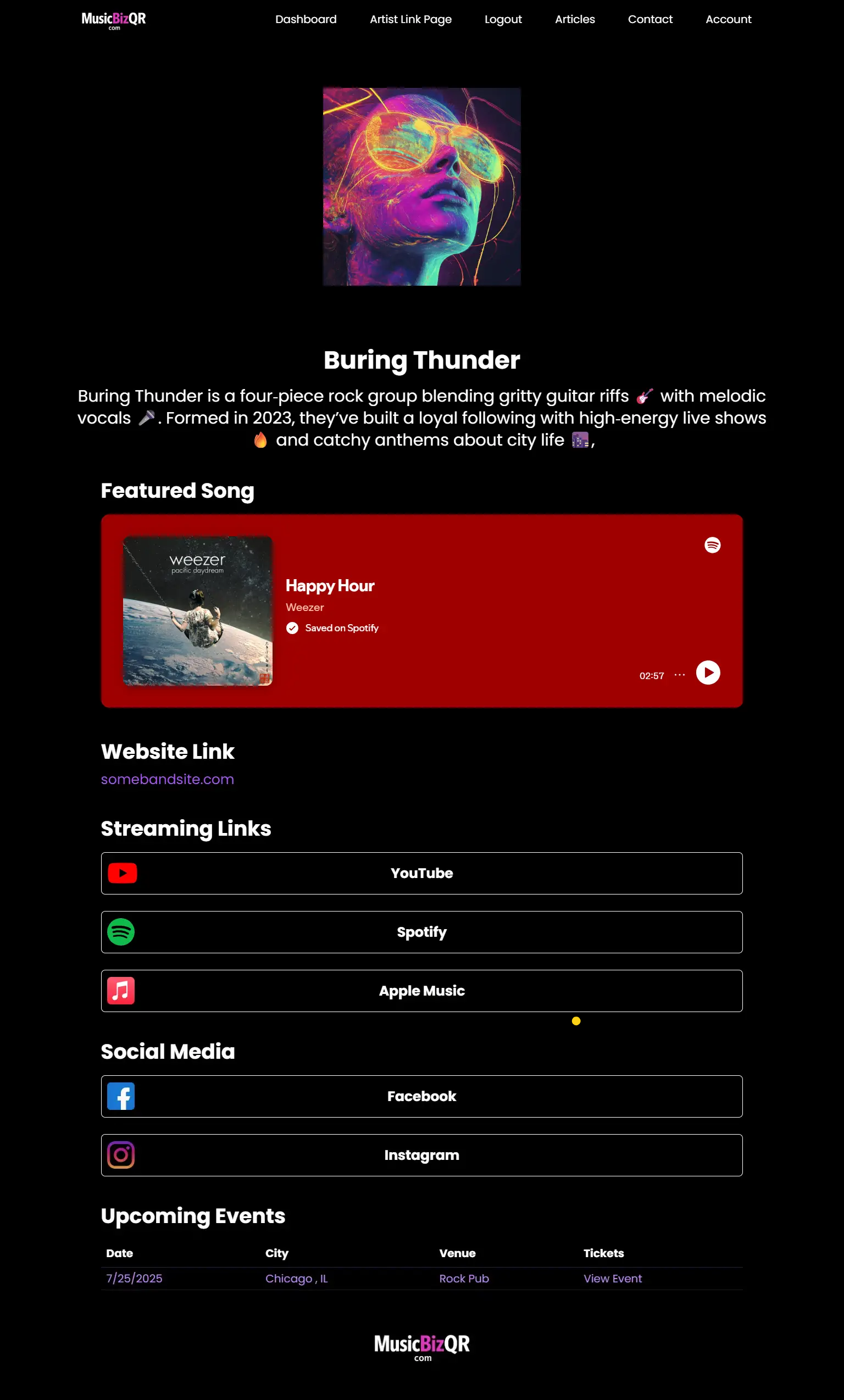
Faneqo gives you a powerful landing page with streaming links, videos, social buttons, and real-time fan analytics — all from a single QR code.
- 🎯 Unlimited link clicks & analytics
- 📈 Track Spotify streams, YouTube plays, and QR scans
- 📱 Mobile-optimized artist pages
- 🚀 Create your first Smart Link in seconds
Related Posts
Most link-in-bio tools weren’t built for musicians. Discover why smart links create better fan journeys, stronger branding, and higher conversions for your music.
Smart links for musicians explained—how they work, why they matter in 2026, and how to build a fan-converting link that drives your music career.
Discover how music links can help artists guide fans across platforms effortlessly. Learn strategies to boost engagement, streams, and merch sales.
Most link-in-bio tools weren’t designed for musicians. Learn why smart links deliver better fan engagement, stronger branding, and real music-driven revenue.
Smart links aren’t just utility tools — they’re the new frontier in artist branding. Learn how visual design, consistency, and fan-centric smart links define a musician’s digital identity.
Discover how smart links can transform fleeting music streams into lasting fan connections. Learn the strategies indie artists use to grow their audience in the streaming era.
Discover how smart links empower indie artists to create deeper, lasting relationships with fans. Turn every click into meaningful engagement.
Discover 2026’s best smart link tools for artists. We compare top platforms, fan engagement features, and why MusicBizQR stands above the rest.
Learn how direct-to-fan video turns your smart link into a conversion machine. Build trust, drive streams, and make real fan connections with MusicBizQR.
Learn how to use music links to drive fan engagement, increase streams, and promote your music like a pro. Built for modern artists and bands. Shall I begin writing the Markdown content for this article now?
In 2026, discovery is chaotic — and smart links are how artists bring it all together. Explore how music smart links guide fans, boost streams, and create real momentum across every platform.
Tired of generic link tools? Discover the smart link platform built for music: video previews, analytics, and full artist control—all in one sleek page.
Every new release deserves more than a link in your bio. Learn how to use smart links to drive streams, collect fans, and turn a single drop into lasting momentum.
The layout of your smart link page can make or break your fan engagement. Learn the design psychology that turns clicks into superfans.
If you're still sending fans to scattered links, you're leaving money on the table. Here's why every indie artist needs a smart link strategy to grow, connect, and convert.",
Most smart links just sit there. This guide shows musicians how to build a smart link page that turns casual clicks into lifelong fans. Real strategies that work.
Discover the psychology behind smart link layout design and how it shapes fan engagement, conversions, and merch sales.
Master the art of launching music with smart links. This guide shows how to create hype, drive streams, and maximize impact every time you drop a new release.
Your smart link is your new homepage. Learn how to design a 2026-ready page that plays your music instantly, tells your story, and converts fans the moment they land.
Learn how musicians can use smart links to connect directly with fans, bypass algorithms, and drive engagement, streams, and merch sales.
Discover how embedded content like music, videos, and social posts can turn your smart link into a fan engagement engine. Boost streams, merch sales, and loyalty.
Discover why smart links are transforming music marketing in 2025. Learn how a centralized hub can grow your audience, boost streams, and drive real fan engagement.
From Spotify embeds to merch and tour links, MusicBizQR makes music promotion easy. Learn how to use smart links to streamline your entire fan funnel.
Learn five powerful ways smart links can revolutionize your band's music promotion, amplify fan engagement, and strengthen fan loyalty.
Discover how smart links are revolutionizing music promotion, increasing fan engagement, boosting streaming numbers, and enhancing concert attendance.