
The Best Linktree Alternative for Musicians: QR Codes, Music Embeds & Fan Analytics
🎸 The Moment Every Musician Knows
There’s a specific kind of adrenaline musicians feel — a vibration in the ribs, a pulse in the throat — when you finally release something that matters.
A new single.
A live session.
A music video you spent weeks perfecting.
You post the teaser.
You pin the new clip.
You update the link in your bio.
For a few seconds, the world feels like it’s leaning in.
Fans tap your link with the same curiosity and excitement you feel rushing through your chest.
And then it happens.
The momentum… evaporates.
They land on a cold, generic, influencer-style menu of buttons.
No music.
No video.
No atmosphere.
No artistry.
Just a flat page that doesn’t sound like you, look like you, or feel like the world you’re trying to build.
It’s like walking out of a packed venue and straight into fluorescent supermarket lighting.
The vibe dies instantly.
The magic slips away.
And you know it — because you feel it in your stomach:
Linktree was never built for musicians. It was built for creators who don’t need their art to be experienced immediately.
Musicians do.
Your fans should hear your song within one second of clicking your link.
They should see your newest video without scrolling.
They should feel the same energy online that you create onstage.
But Linktree forces your audience into friction, confusion, and hesitation.
It breaks the emotional arc.
It interrupts the fan journey.
It wastes the exact moment where someone wants to become a fan.
And deep down, every artist knows this. That’s why you’re here.
Because you’re done losing listeners to a lifeless list of buttons.
Because you’re ready for a link that actually carries the momentum forward instead of smothering it.
A link that:
- plays your music instantly
- showcases your video
- drives ticket sales
- grows your Spotify
- captures fan data
- powers your strategy
- and makes your audience feel like they’re stepping into your world
Not someone else’s template.
Musicians don’t need a “link tool.”
They need a fan funnel, a landing page, a digital stage, and a music-specific engine designed to amplify the moment they create.
If you want to see how real artist-first smart links work in practice, here’s the full guide:
👉 Smart Links for Musicians
And now, let’s talk about why Linktree fails musicians — and what the best alternatives actually do right.
❌ Why Linktree Fails Musicians in 2025–2026
It’s not that Linktree is “bad.”
It’s that Linktree was never engineered for the realities of a modern music career.
Influencers can get away with a list of buttons.
Musicians can’t.
Your entire livelihood depends on capturing momentum in the exact moment a fan shows interest — and Linktree breaks that moment every single time.
Here’s the uncomfortable truth most artists already feel but rarely say out loud:
1. Linktree Stops the Music Instead of Starting It
Fans click your link at the peak of their excitement — right after hearing your teaser, seeing your live clip, or discovering you on a playlist.
And Linktree greets them with:
- no autoplay
- no embedded player
- no visual energy
- no emotional continuation
A dead page means a dead fan journey.
If you want to understand how musicians use smart links to keep fan momentum alive, check out the full guide:
👉 Smart Links for Musicians
2. Linktree Is Designed for Influencers — Not Artists
Influencers need:
- a link to YouTube
- a link to their shop
- a link to their promo code
Musicians need:
- a music-first landing page
- instant audio or video playback
- tour dates
- ticket links
- merch integration
- pre-save funnels
- analytics that connect to their creative strategy
Linktree treats you like every other creator — even though your needs are completely different.
3. It Wastes the Most Critical Moment in the Fan Funnel
In music marketing, there’s something called the “first-touch conversion window.”
It’s the 3–8 seconds where someone is most likely to become a real fan.
Linktree forces that person to stop, read a list, and choose something.
The momentum breaks, the excitement fades, and many never come back.
If you want to see the fan funnel logic behind this, this guide breaks it down:
👉 Fan Funnels for Musicians
4. Zero Music Embeds = Zero Immediate Emotion
Music is emotional.
It needs to hit the ears before someone starts thinking logically.
But Linktree = no embedded:
- Spotify
- Apple Music
- YouTube
- SoundCloud
- Bandcamp
Without instant playback, you’re asking fans to do extra work — and fans rarely do extra work.
A smart link fixes this instantly.
5. No Analytics That Actually Matter to Musicians
Musicians don’t just need “link clicks.”
They need:
- plays
- skips
- device + city data
- traffic sources
- QR code scans
- conversion depth
- fan journey maps
This is exactly why MBQ’s analytics system (Muse) exists — because musicians need music intelligence, not “influencer analytics.”
If you want to learn the QR strategy that powers offline-to-online analytics:
👉 QR Code Strategy
6. No Offline Funnel Support (Tours, Shows, Festivals)
Linktree isn’t built for:
- posters
- flyers
- merch tables
- wristbands
- tour visuals
- stage displays
But modern artists absolutely rely on QR codes to drive:
- ticket sales
- merch sales
- fan email capture
- Spotify growth
Linktree simply doesn’t integrate offline engagement with your online fan journey.
7. Linktree Makes You Look Like Every Other Artist
Every artist using Linktree has the same layout, same buttons, same look.
There’s no:
- aesthetic identity
- personalization
- branding
- stage presence
- emotional signature
It flattens your art into a template.
Musicians need a link page that feels like a stage — not a spreadsheet.
Linktree didn’t fail because it’s bad.
It failed because the music world evolved — and musicians now need links that move energy, not lose it.
🎯 What Musicians Actually Need in a Modern Bio Link
If Linktree stumbled by treating musicians like influencers, the real question becomes:
What does a modern artist actually need the moment a fan taps their link?
The answer isn’t a mystery. It’s written in every backstage hallway, every late-night studio session, every half-asleep DM from a fan who finally discovered your music. What musicians need is a link that carries the emotion of their art — the momentum, the atmosphere, the identity — straight into the digital world without dropping the energy.
And that begins with something most creators never have to think about:
Music has to be experienced instantly.
For artists, sound isn’t optional. It’s the doorway into your universe.
If a fan clicks your link and doesn’t hear you within a beat or two, the moment fades.
Attention shifts.
The emotional thread breaks.
That’s why artists no longer have the luxury of sending fans into a maze of buttons. They need a landing page that plays, one that greets listeners with a pulse — a Spotify embed ready to go, a YouTube visual already waiting, a vibe strong enough to hold someone for more than three seconds.
Smart links were born from that reality.
They weren’t created to look pretty; they were created to capture momentum, the same kind you feel when someone shazams your track during a show or watches your TikTok loop one more time than you expected. If you want to see how modern smart links do this, the full guide breaks it down:
👉 https://musicbizqr.com/article/smart-links
But playback alone isn’t enough anymore.
Today’s artists operate across a dozen platforms — Spotify, Apple Music, Instagram, TikTok, YouTube — each feeding a different part of their growth. A modern bio link has to act like a funnel, guiding fans from discovery → listening → following → buying tickets without making them think. Most fans don’t even know they’re moving through a funnel; they just follow the emotional cues that a well-designed page gives them.
And then there’s the physical world — the shows, the tours, the festivals.
In 2025–2026, more fan conversions happen offline than anywhere else. A good night on stage can turn 20 casual listeners into 200 real fans, but only if there’s a frictionless way to capture that energy. That’s why dynamic QR codes have become one of the most powerful tools in a musician’s career. Not because QR codes are trendy — but because they bridge the gap between the room you’re performing in and the digital world that sustains you after the lights go down.
If you want to understand how artists are turning stages, flyers, posters, and even merch tags into fan funnels, this guide explains the strategy:
👉 https://musicbizqr.com/article/qr-code-strategy
But the biggest shift shaping modern bio-link needs is something deeper:
Musicians no longer want to guess what’s working. They want truth — the real data behind their fanbase. Where people discover them. When people listen. What city is reacting the hardest. Whether their tour visuals are converting. Whether their TikTok spike actually led to streams.
They need analytics that reflect a fan journey, not influencer charts.
That’s the backbone of Muse, MBQ’s analytics engine — a system designed to track not just clicks, but impact. Plays, skips, conversions, device types, time-of-day patterns, scan hotspots — the kind of intelligence that shapes real music careers.
And above all, musicians need something that looks and feels like their world, not a template.
A page that carries their colors, their atmosphere, their aesthetic.
A page that doesn’t flatten their art into a list — but expands it.
Because at the end of the day, musicians don’t need a “bio link.”
They need a digital stage that greets every fan with the same energy they felt when they discovered your music.
That’s the difference.
And it’s the reason smart links have quietly become the heart of modern music marketing.
🔀 Smart Links vs Linktree: The Real Difference
Most blogs talk about Linktree vs smart links like it’s a feature checklist.
More buttons here, cleaner design there, maybe a few color options if you’re lucky.
That’s not the real difference.
Not for musicians.
Not for anyone whose art depends on how fans experience the first ten seconds after clicking a link.
The real difference is emotional.
It’s psychological.
It’s the difference between momentum and interruption.
Let’s start with the part no one says out loud:
Linktree creates distance. Smart links create immersion.
Linktree takes the energy you build — the spark from a TikTok clip, the rush of a live show, the intimacy of a new release — and forces it to wait its turn behind a wall of buttons. It’s a hallway with too many doors, and every door feels like the wrong one.
A smart link does the opposite.
It opens directly into your world.
The moment someone taps, they should feel the atmosphere: your artwork, your sound, your identity. They should hear your voice through a Spotify embed, see your visual aesthetic through a YouTube frame, feel your tone before they even scroll. Smart links don’t ask fans to choose a direction; they pull them into the center of your universe and let them stay there.
If you want the complete breakdown of this concept, this guide goes deeper:
👉 https://musicbizqr.com/article/smart-links/smart-link-vs-linktree-musicians
Linktree organizes links. Smart links guide behavior.
A lot of creators don’t realize this, but design plays a massive role in fan movement.
Not colors — architecture.
Linktree is an index.
Smart links are a funnel.
A smart link guides a listener through the hierarchy of what matters:
- hear the new single
- see the new video
- follow on the platforms that shape your career
- buy a ticket
- join the community
It’s not a list. It’s a path.
This is why modern artists who understand funnels are outperforming artists who rely on “link in bio” templates. They design moments, not menus. If you want to see how those funnels actually work, here’s the strategic foundation:
👉 https://musicbizqr.com/article/fan-funnels
Linktree shows information. Smart links trigger action.
This is the difference between a Twitter account showing a list of links and a real music hub that pulls a casual listener into commitment.
Smart links don’t just describe your world.
They generate movement.
A smart link turns discovery into a listen, a listen into a follow, a follow into a fan, a fan into someone who shows up at your next gig shouting the lyrics. Linktree leaves that chain to chance. Smart links design it.
Linktree lives online. Smart links connect the physical world.
In 2025–2026, more fans convert offline than anywhere else — at shows, bars, festivals, coffee shops, flyers, crosswalks, bathroom doors, and places your music unexpectedly hits someone in real life.
Smart links plug directly into dynamic QR codes, letting a fan in a crowd jump straight into your world without ever typing your name again. Linktree was never built for that kind of momentum.
To understand why QR funnels are becoming essential, here’s the full breakdown:
👉 https://musicbizqr.com/article/qr-code-strategy
Linktree treats you like an influencer. Smart links treat you like an artist.
Influencers need:
- a coupon code
- a YouTube link
- an Amazon storefront
Musicians need:
- playback
- aesthetics
- ticketing
- analytics
- platform-aware strategy
- fan journey mapping
- live-show funnels
Smart links understand that music isn’t “content.”
It’s identity, culture, emotion, craft.
And the tools built for musicians have to reflect that.
This is why smart link platforms continue to evolve into full-scale marketing hubs — and why creators using Linktree are starting to feel like they’re falling behind.
The gap isn't small.
It’s an entire difference in philosophy.
One is a list.
The other is a launchpad.
Smart links don’t organize your links.
They amplify your career.
🚀 The MusicBizQR Advantage
Every so often, a tool arrives that doesn’t just replace what came before — it redefines the category.
MusicBizQR isn’t a “better Linktree.”
It’s what Linktree would have become if it were built by musicians, for musicians, in a world where fan attention shifts in milliseconds and careers are built on moments of momentum.
To understand why, you have to look at how MBQ was shaped: not by influencer trends, but by the real stories artists live every day — backstage adrenaline, shaky-handed Spotify refreshes, empty rooms that become packed rooms, the quiet hope that the next song will connect with someone who actually listens.
MBQ is built for those moments.
It starts with sound — because music should play instantly.
When a fan taps your MBQ page, they’re not met with decisions or distractions.
They’re met with you — your artwork, your newest release, your video, your vibe. Music plays immediately through Spotify, Apple Music, YouTube, or SoundCloud embeds. Your world is the first thing they experience.
No hesitation.
No hallway of buttons.
No energy drop.
This is why smart links matter — and if you want the full breakdown, here’s the complete guide:
👉 https://musicbizqr.com/article/smart-links
MBQ isn’t a landing page. It’s a fan engine.
Most bio-link tools ask:
“How can we organize links neatly?”
MBQ asks:
“Where is the fan in their journey — and what should happen next?”
That shift changes everything.
A first-time listener should hear your single.
A warmed-up fan should see your upcoming show.
A returning fan should find your merch or pre-save easily.
A live-show attendee should scan a QR code and get pulled into your world instantly.
MBQ adapts to all of it — because it’s built on fan funnel architecture, not menus. If you want to see how these funnels actually work, this guide explains the psychology:
👉 https://musicbizqr.com/article/fan-funnels
Your offline world becomes part of your online strategy.
This is where MBQ leaves every competitor behind — including Linktree.
Artists don’t grow in apps.
Artists grow in:
- clubs
- bars
- house shows
- festivals
- open mics
- parking lots
- college campuses
- backstage hallways
- merch tables
- afterparties
The real conversions happen when someone hears you in person, feels something, and wants to go deeper right now.
MBQ’s dynamic QR codes exist for that exact moment.
Fans scan → land on your music instantly → follow → buy → connect.
And every scan is tracked through Muse analytics, giving you a map of your offline impact — something Linktree could never dream of.
For the full QR strategy that powers this, here’s the breakdown:
👉 https://musicbizqr.com/article/qr-code-strategy
Analytics that understand musicians, not influencers.
Influencers care about traffic.
Musicians care about behavior.
MBQ’s Muse analytics show you:
- where fans come from
- which platforms convert
- which songs get the most plays
- which videos hold attention
- which cities are reacting
- which QR codes are performing
- what time of day fans engage
It doesn’t just tell you “how many clicks you got.”
It tells you why you got them — and what to do next.
This is the part of MBQ that feels like magic:
data that actually makes musicians smarter, not overwhelmed.
A design that feels like you — not a template.
Linktree gives everyone the same box.
MBQ gives artists a canvas.
Your colors.
Your artwork.
Your aesthetic.
Your world.
Fans don’t just see your links.
They see your identity.
This is why more artists describe MBQ as “a digital stage” rather than a link tool. It feels like walking into your visual universe — not someone else’s branding.
Built to grow with you — from your first 1,000 fans to your first 1,000,000.
MBQ isn’t a temporary tool.
It’s an infrastructure.
Features build on each other:
- smart links
- dynamic QR
- music embeds
- show & tour modules
- conversion-focused design
- platform integrations
- Muse analytics
- upcoming AI-powered insights
This isn’t a trend.
It’s the evolution of how musicians grow online and offline — through momentum, context, and intentional design.
MBQ is the first platform that actually understands that.
And that’s why it’s not just the best Linktree alternative.
It’s the tool replacing Linktree entirely for the next generation of artists.
🎤 Real-World Scenario: Luna Grey’s Release Day
Every artist has a moment they remember — the night before a release, when the world goes quiet and the only sound is the soft hum of a mix you’ve already heard a thousand times. That’s where our fictional artist, Luna Grey, finds herself. It’s midnight. Her new single drops in less than twelve hours. Her stomach is tight with that familiar cocktail of fear and hope.
This song matters.
She needs people to hear it.
Luna with Linktree (The Momentum Killer)
The next morning, Luna posts a teaser on TikTok — a dreamy chorus, a slow camera pan, soft blue lighting. It’s her best-performing clip in months. Comments flood in. People want to hear the full song.
She updates her Linktree. She adds “Spotify,” “Apple Music,” “YouTube,” “Pre-save,” “Merch,” “Tour Dates.” It feels responsible — organized, clean, tidy.
But when fans tap her link, something breaks.
The energy from the TikTok clip evaporates.
Her momentum runs into a wall of buttons.
There’s nothing to hear, nothing to see, nothing that feels like the world she just created in her video.
A few people click Spotify.
Fewer click Apple.
Most leave.
By the end of the day, Luna refreshes her Spotify for Artists dashboard and sees the truth every musician knows but never says:
the traffic leak.
The clip went viral.
The song didn’t.
Luna with MusicBizQR (The Fan Funnel Awakening)
Now let’s rewind.
Same clip. Same engagement. Same buzz.
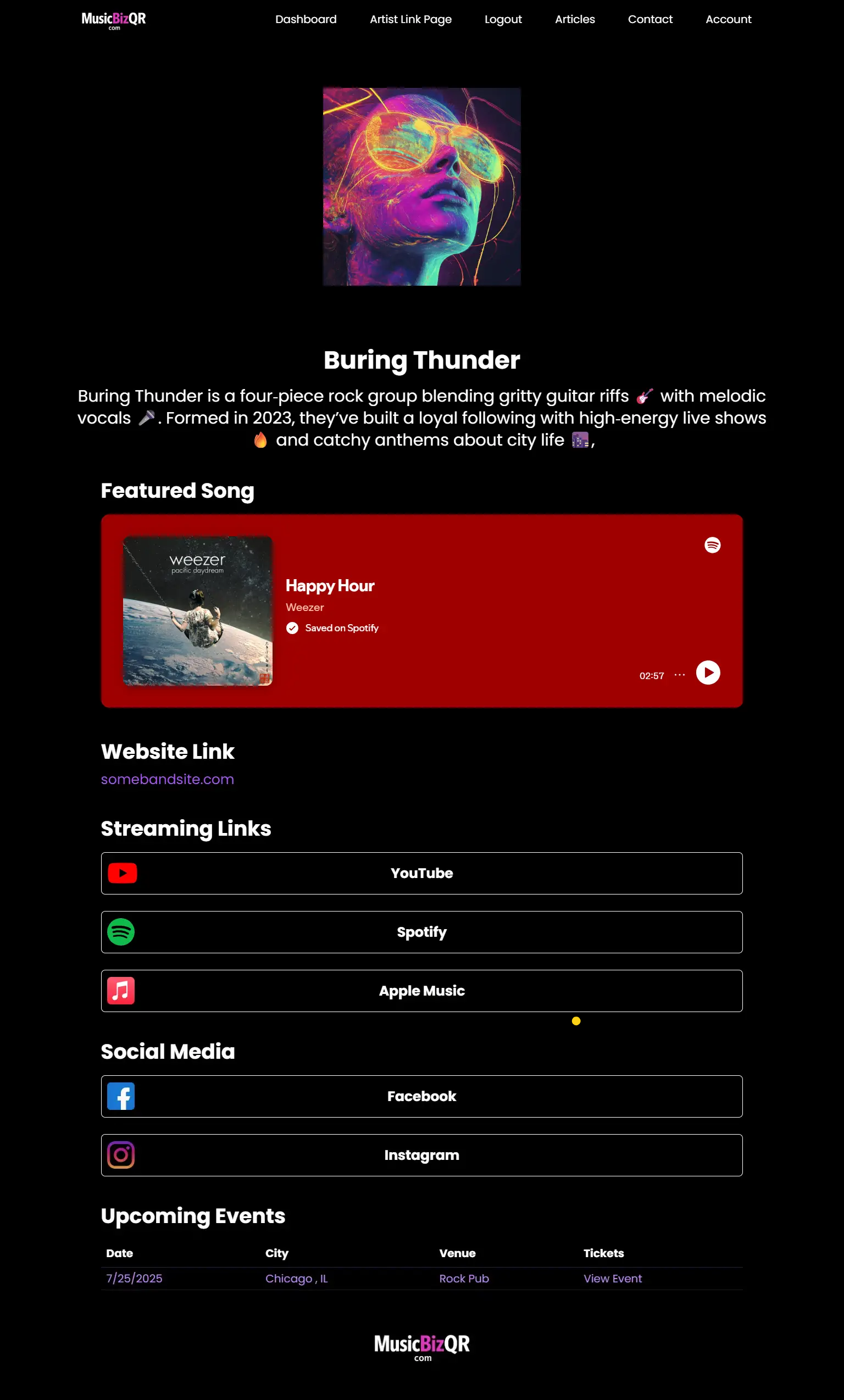
But this time Luna swaps her Linktree for an MBQ smart link — a page that opens with her cover art glowing at the top, her new single ready to play instantly. Below it, a YouTube embed previews the official video. Her tour dates sit right underneath, followed by her curated platform buttons, merch, and a clean newsletter signup that doesn’t feel like an afterthought.
Fans tap the link and hear her chorus immediately — the same moment that hooked them on TikTok. The visuals match her aesthetic. The energy carries through. The world she created in her clip continues on the page, uninterrupted.
And here's where things get real:
The people who scan her QR code at that night’s show? They land on the same MBQ hub. They hear the same song. They see the same identity. That consistency is powerful. It turns curiosity into commitment.
By the end of the day, Luna isn't obsessively refreshing her Spotify dashboard in anxiety. She's watching the surge in real time, seeing her Muse analytics map out where fans discovered her, how they engaged, which cities are reacting hardest, and how her TikTok and QR traffic blended into one cohesive funnel.
It’s no longer chaos.
It’s strategy.
The Reality Musicians Know All Too Well
What happened with Linktree is what happens to thousands of artists every day:
the momentum is real, but the infrastructure breaks.
What happened with MBQ is what musicians wish would happen when their content finally hits:
a system that catches the energy instead of leaking it.
Luna didn’t magically become a better artist.
She simply used a link that understood how music spreads, how fans behave, and how fragile attention is in 2026.
Thousands of musicians live this exact story.
Most never realize the difference wasn’t their music — it was the moment after the click.
And that moment is where careers are built.
📊 MBQ vs Linktree: Feature-by-Feature Comparison
When musicians look for a “Linktree alternative,” they’re not looking for prettier buttons.
They’re looking for the tool that gives them a better shot at being heard — the one that respects how fragile momentum is, how fans behave in real time, and how unpredictable growth can be.
The truth is simple:
Linktree organizes links. MusicBizQR amplifies artists.
To see why the gap has become impossible to ignore, here’s the clearest, most musician-focused comparison available anywhere — not a marketing checklist, but a breakdown of how each platform performs in the moments that actually matter.
🔎 Side-by-Side Comparison
| Feature / Experience | MusicBizQR (MBQ) | Linktree |
|---|---|---|
| Designed For | Musicians, bands, live performers, music marketers | Influencers & general creators |
| Instant Music Playback | Full embeds: Spotify, Apple Music, YouTube, SoundCloud | None (redirect-only) |
| Video Integration | Rich autoplay-capable video blocks | Basic embed or external link |
| Momentum Retention | High — fans hear/see content immediately | Low — user must choose a link first |
| Fan Funnel Logic | Built-in funnel architecture | None (list-based navigation) |
| Tour & Event Modules | Native support with ticket CTAs | No native musician-specific modules |
| Dynamic QR Codes | Integrated with smart link + Muse analytics | QR code redirects to homepage only |
| Offline → Online Fan Tracking | Full scan analytics + time-of-day + city-level insights | Not supported |
| Muse Analytics | Plays, skips, sources, city data, device data, QR scans | Basic click counts |
| Platform Integrations | YouTube (live), Spotify/TikTok/IG (expanding) | Limited link integrations |
| Branding & Identity | Artist-first design that matches your aesthetic | Generic template styles |
| Page Purpose | Digital stage + fan engine | Link menu |
| Conversion Focus | High — built for music actions | Low — built for navigation |
| Live Show Support | Designed around shows, posters, merch tables | Not designed for musicians at all |
| Future Roadmap | AI-powered Muse insights, multi-platform metrics | General creator tools |
🧨 What the Chart Doesn’t Show — but Musicians Feel Immediately
Charts are helpful, but the real difference hits the moment you open an MBQ page.
It feels alive.
It feels like the artist.
It feels like a continuation of the moment a fan discovered your music.
Linktree feels like stepping out of your world and into someone else’s template.
MBQ feels like walking backstage with you.
Artists Feel This Difference in Their Numbers
Musicians using MBQ consistently report:
- higher playback rates
- more platform conversions
- stronger event turnout
- more offline scan activity
- longer fan dwell time
- and a funnel they can actually understand
This is why thousands of artists are moving away from tools that treat them like generic creators — and toward tools that understand the psychology of music discovery.
This comparison table is the technical proof.
But the emotional proof?
You feel it the moment your page loads.
And your fans feel it, too.
📈 How MBQ Helps You Grow Your Fanbase
Growth in music has never been about posting more links.
It’s about shaping the moments where a listener decides — sometimes unconsciously — whether they’re going to step deeper into your world or drift away forever.
Most artists don’t lose fans because of their music.
They lose them because of what happens after the click.
This is where MusicBizQR quietly separates itself from Linktree and every other “bio link” tool. MBQ isn’t just a place to organize your platforms. It’s a growth engine built around how fans behave in real life, in real time, across both the digital and physical world.
Let’s break that down — not as features, but as lived experience.
The Psychology of the First 5 Seconds
When fans click your link, they’re in a heightened emotional state.
They’ve just heard a hook they liked.
They’ve just watched a clip that grabbed them.
They’ve just seen your name on a flyer, a poster, or a setlist.
Those first seconds are a battleground.
Linktree slows the moment.
MBQ accelerates it.
Instant playback keeps the emotional thread alive.
A visual layout that feels like your world deepens it.
A clear path — listen → follow → show → buy — locks it in.
Fans don’t fall in love with menus.
They fall in love with experiences.
MBQ is built entirely around those experiences.
Turning Casual Listeners Into Committed Fans
A fan who just discovered you is fragile — not emotionally, but behaviorally.
They’re curious, but not yet invested.
They want to explore, but won’t work hard to do it.
They’ll engage, but only if the path is frictionless.
This is where MBQ’s layout does something Linktree never could:
It turns curiosity into a guided journey.
Fans hear your music immediately.
Then they see your video.
Then they see your tour dates.
Then they find the platform they prefer — Spotify, Apple, YouTube, TikTok.
Each action reinforces the last.
What looks simple from the outside is actually a well-designed funnel underneath — the same funnel strategy broken down here:
👉 https://musicbizqr.com/article/fan-funnels
Music marketing used to be luck.
Now it’s architecture.
Offline Fans Become Online Fans — Automatically
Most people don’t talk about this, but in 2025–2026, more new fans come from the physical world than the algorithmic one.
- Someone hears you live.
- Someone sees your sticker.
- Someone walks past a poster.
- Someone scans a QR code on a venue door.
With Linktree, that moment breaks the second they hit a dead menu.
With MBQ, that scan becomes a continuation of the show — immediate playback, visuals that match the vibe, and the ability to follow you right then and there without friction.
This is why QR-driven music promotion has exploded in the last two years.
If you want the full strategy behind it, the complete guide is here:
👉 https://musicbizqr.com/article/qr-code-strategy
MBQ doesn’t just help offline engagement.
It transforms it into digital loyalty.
Muse Analytics: Turning Chaos Into Clarity
Growth used to feel mysterious — a spike here, a drop there, a random moment of traction you can’t explain or repeat. Linktree doesn’t solve any of that, because it doesn’t understand the difference between a fan click and an influencer click.
Muse does.
It shows:
- where fans come from
- which songs resonate
- which videos hold attention
- which platforms convert
- which cities are reacting
- what time of day your fans engage
- which QR codes are driving real fans
This isn't analytics.
This is music intelligence.
Muse takes the scattered pieces of your digital footprint and assembles them into a picture you can actually use. That’s how independent artists start thinking like their own marketing team — without feeling like they need one.
Your Growth Isn't Random — It's Engineered
MBQ doesn’t magically “give” you fans.
It gives you something far more valuable:
The structure that turns your moments of attention into lasting growth.
Music spreads through emotion.
Growth happens through design.
MBQ is where those two worlds finally meet.
Artists aren’t using MBQ because it’s a nicer link.
They’re using it because it’s the first tool that understands the real truth of music marketing:
Fanbases aren’t built on features.
They’re built on moments — and MBQ is the only platform designed to protect every one of them.
🧭 When You Should Choose MBQ Over Linktree
There comes a quiet moment in every musician’s journey when you stop operating like someone who’s simply trying to be heard and begin operating like someone who is building a career that can breathe on its own. This moment never announces itself with a viral spike or a sold-out room. It usually arrives in stillness — a late night alone with your analytics, a morning spent replaying a clip that should’ve performed better, or that heavy breath you take before pushing out another link you hope will finally connect.
It’s in those moments that musicians notice something they’ve been trying to avoid: people are discovering their work, but they’re not staying. The music resonates, the content hits, the curiosity is real — yet the conversion evaporates somewhere between the first spark of interest and the page that follows.
And when you look at your link-in-bio long enough, you start to see it clearly.
The template doesn’t feel like you.
The layout doesn’t sound like you.
The page doesn’t match the world you're trying to build.
You realize the issue was never the music.
It was the infrastructure wrapped around it.
This is the moment musicians choose MusicBizQR — not because they want a new tool, but because they’re tired of letting momentum slip through cracks they didn’t notice until it was too late.
You choose MBQ when you’re done watching energy dissolve the second someone taps your link. Linktree creates distance where there should be immersion — a small but devastating pause between curiosity and connection. It interrupts the emotional thread you spent hours, days, years weaving through your songwriting, your visuals, your identity.
MBQ doesn’t hold the listener at arm’s length. It folds them into your world. It extends the atmosphere of the clip they just watched or the moment they just experienced. Instead of forcing fans to navigate a grid of indecision, it places them at the center of your universe — where your sound, your visuals, and your story are already in motion. When a listener enters an MBQ page, the transition feels natural, like stepping from the edge of a stage into the warmth of the crowd that’s been waiting for you.
You choose MBQ when you want your identity to speak before a single button is pressed. Musicians aren’t influencers; the link that represents them shouldn’t feel like an influencer template. It should be an extension of the world your music inhabits. Your colors. Your textures. Your story. Your universe. Every part of MBQ is designed to carry that identity forward, not bury it beneath generic design.
And there’s another moment of clarity: when you realize you need more than counts. You need understanding. Linktree can tally clicks, but it can’t explain fan behavior — one of the most essential forces shaping a modern career. MBQ’s Muse analytics do more than show where people tapped; they reveal how listeners move, what holds their attention, which moments convert, which platforms matter most, and how your offline world fuels the digital one. It pulls chaos into a pattern you can finally make sense of.
Musicians choose MBQ when they understand that growth doesn’t just happen online. It happens in rooms you play, in crowds you surprise, in flyers taped to brick walls, in posters glowing under streetlights outside venues where people first hear your name. MBQ is the only platform that treats those physical moments as part of your funnel, not as disposable encounters lost to time. Every scan, every spark of interest, every in-the-wild interaction folds back into your ecosystem, mapped and measured with the same care as your digital moments.
But more than anything, you choose MBQ when you’re ready to stop treating your link as a utility and start treating it as narrative. Your link-in-bio is not a footnote — it’s the bridge between curiosity and understanding, between a listener hearing your hook once and a listener becoming part of your world. It’s a stage, a first impression, a fan funnel, a digital identity, a body of work condensed into a single, meaningful moment.
And when that moment works, a career stops feeling accidental.
It starts feeling intentional.
That’s when musicians choose MBQ.
🎬 Conclusion: Why MusicBizQR Is the New Standard
Every few years, the music world reaches a quiet turning point — not marked by a feature release, not sparked by a headline, but by a shift in what artists collectively feel. Over the last decade, musicians have become increasingly aware that the tools they rely on weren’t built with their needs in mind. They were built for influencers, affiliates, creators, marketers — anyone except the people whose entire careers depend on translating emotion into momentum.
That’s why the link-in-bio space has started to fracture. Artists aren’t looking for prettier buttons or cleaner templates; they’re looking for something that finally understands the invisible architecture of a music career. Something that can hold a fan’s attention the same way a great chorus can. Something that continues the emotional thread from a TikTok clip, a festival performance, a late-night discovery spiral, or a QR scan outside a venue door.
And this is where MusicBizQR steps past every Linktree alternative and quietly becomes the new standard.
MBQ doesn’t win because of a single feature. It wins because of how those features interact — how smart links, dynamic QR codes, music embeds, show modules, platform integrations, and Muse analytics form a coherent system rather than a scattered toolbox. It’s the difference between having ingredients and having a recipe. Between having data and having direction. Between having clicks and having a career.
The moment someone taps your MBQ page, they don’t fall into a cold menu; they fall deeper into your world. They hear your music instantly, they see your aesthetic, they feel your identity. What would’ve been a dead end with Linktree becomes a continuation — the same emotional current that first pulled them in, extended into a space designed intentionally for who you are and how fans move.
And this is the part most artists don’t realize until they experience it:
good architecture makes growth feel natural.
The funnels explained here — https://musicbizqr.com/article/fan-funnels — stop feeling like theory and start feeling like your day-to-day reality. The smart link strategies that Live Nation artists use at scale — https://musicbizqr.com/article/smart-links — finally make sense for independent musicians. And the QR code tactics outlined here — https://musicbizqr.com/article/qr-code-strategy — stop being “marketing ideas” and start being practical tools that win you fans at shows, on the street, in venues, and everywhere your music travels.
This is the real transformation:
Artists stop feeling like their growth is a string of lucky moments and start feeling like it’s the result of choices — their choices.
By the time you reach this point in the article, you already know whether Linktree fits your future or your past. One path preserves the old structure; the other allows your work to breathe, expand, and carry your momentum with intention. One path organizes links; the other builds a fanbase.
And if your music is built on truth, on heart, on the hope that one day someone will hear what you made and feel something they can’t explain — then you deserve a link that carries that same truth forward.
MusicBizQR isn’t the next cool tool.
It’s the natural evolution of what musicians have needed for years.
It’s the bridge between the spark you create and the growth you deserve.
It’s the moment when your digital presence finally begins to feel as alive as your art.
And for artists who are ready for that evolution, the choice becomes obvious.
MBQ isn’t just the best Linktree alternative.
It’s the new standard — the one built for musicians, shaped by musicians, and ready for the future they’re finally stepping into.
❓ FAQ: Musicians Ask, MBQ Answers
Does MusicBizQR actually help musicians get more streams?
Yes — but not because of hype or theories. MBQ improves streams because it fixes the real leak that kills most conversions: the moment after the click. When fans land on a page where your music plays instantly, where your branding feels alive, and where they’re guided naturally toward Spotify, Apple, and YouTube, your streams rise as a by-product of better architecture.
For the full breakdown, see the Smart Links guide:
👉 https://musicbizqr.com/article/smart-links
Why is Linktree bad for musicians specifically?
Linktree isn’t “bad” — it’s simply not built for music behavior. It interrupts momentum, forces fans to make decisions before they hear anything, and creates emotional distance right when interest is at its peak. Musicians need immersion, not menus.
A deeper comparison lives here:
👉 https://musicbizqr.com/article/smart-links/smart-link-vs-linktree-musicians
How does MBQ help at live shows and on tour?
Live shows are where most new fans are born. MBQ connects the physical world to your digital ecosystem with dynamic QR codes that instantly play your music, show your tour dates, and capture engagement in real time. It turns a room of strangers into fans who stay connected long after the show ends.
See the full QR strategy:
👉 https://musicbizqr.com/article/qr-code-strategy
Will MBQ replace my website?
For many independent artists, yes. MBQ can function as a lightweight, high-conversion microsite with:
- music embeds
- video
- tour dates
- merch
- social links
- analytics
- QR funnels
Artists with full websites often use MBQ as the “front door” — the immersive first impression where fans convert fastest.
Does MBQ integrate with Spotify, YouTube, TikTok, and Instagram?
Yes. MBQ is built for multi-platform music culture. Spotify and Apple Music embeds play instantly. YouTube videos load in-page. TikTok and Instagram drives can be tracked through Muse analytics. And upcoming updates continue expanding integrations across platforms musicians rely on.
How does MBQ track offline fan engagement?
Every dynamic QR code inside MBQ is connected to Muse, our analytics engine. It doesn’t just tell you how many scans you got — it tells you where, when, from which device, and what fans did next.
This is something Linktree and similar tools simply can’t do.
To understand the offline → online funnel, see:
👉 https://musicbizqr.com/article/qr-code-strategy
Will MBQ help me grow on TikTok or Instagram?
Indirectly — absolutely. TikTok and IG create initial sparks of interest, but MBQ ensures those sparks don’t fade. When fans tap your link, they enter an environment designed for deeper listening, platform following, and long-term engagement. Your social content becomes more effective because the link behind it is finally working with you, not against you.
Is MBQ only for artists with established fanbases?
No. MBQ is built for artists at every stage — especially emerging ones. If you’re getting your first 1,000 listeners or building your early foundation, MBQ ensures that every moment of attention is captured instead of lost. Emerging artists feel the difference fastest because every fan matters more.
Why does instant playback matter so much?
Because music is emotional. The moment a listener hears your sound — not after choosing a link, not after a redirect, not after scrolling — is the moment you have the best chance of converting them. Instant playback is the core psychological advantage behind smart links.
If you want to understand how this affects fan funnels, this guide breaks it down beautifully:
👉 https://musicbizqr.com/article/fan-funnels
How is MBQ different from a typical “link-in-bio” tool?
Link-in-bio tools organize destinations. MBQ creates experiences. It’s music-first, funnel-driven, QR-native, analytics-powered, and designed to extend the emotional world of your art. It’s less a link tool and more a digital stage where fans fall deeper into your sound without friction.
Is MusicBizQR really better than Linktree?
For musicians, undeniably.
It’s not a matter of preference — it’s a matter of design philosophy.
Linktree is built for creators in general. MBQ is built for the way music spreads, how fans behave, and how careers grow today. If your goal is navigation, Linktree is fine. If your goal is to build a fanbase, MBQ is the next step.
Built for Musicians. Powered by Smart Links.
Faneqo gives you a powerful landing page with streaming links, videos, social buttons, and real-time fan analytics — all from a single QR code.
- 🎯 Unlimited link clicks & analytics
- 📈 Track Spotify streams, YouTube plays, and QR scans
- 📱 Mobile-optimized artist pages
- 🚀 Create your first Smart Link in seconds
Related Posts
Most link-in-bio tools weren’t built for musicians. Discover why smart links create better fan journeys, stronger branding, and higher conversions for your music.
Smart links for musicians explained—how they work, why they matter in 2026, and how to build a fan-converting link that drives your music career.
Discover how music links can help artists guide fans across platforms effortlessly. Learn strategies to boost engagement, streams, and merch sales.
Most link-in-bio tools weren’t designed for musicians. Learn why smart links deliver better fan engagement, stronger branding, and real music-driven revenue.
Smart links aren’t just utility tools — they’re the new frontier in artist branding. Learn how visual design, consistency, and fan-centric smart links define a musician’s digital identity.
Discover how smart links can transform fleeting music streams into lasting fan connections. Learn the strategies indie artists use to grow their audience in the streaming era.
Discover how smart links empower indie artists to create deeper, lasting relationships with fans. Turn every click into meaningful engagement.
Discover 2026’s best smart link tools for artists. We compare top platforms, fan engagement features, and why MusicBizQR stands above the rest.
Learn how direct-to-fan video turns your smart link into a conversion machine. Build trust, drive streams, and make real fan connections with MusicBizQR.
Learn how to use music links to drive fan engagement, increase streams, and promote your music like a pro. Built for modern artists and bands. Shall I begin writing the Markdown content for this article now?
In 2026, discovery is chaotic — and smart links are how artists bring it all together. Explore how music smart links guide fans, boost streams, and create real momentum across every platform.
Tired of generic link tools? Discover the smart link platform built for music: video previews, analytics, and full artist control—all in one sleek page.
Every new release deserves more than a link in your bio. Learn how to use smart links to drive streams, collect fans, and turn a single drop into lasting momentum.
The layout of your smart link page can make or break your fan engagement. Learn the design psychology that turns clicks into superfans.
If you're still sending fans to scattered links, you're leaving money on the table. Here's why every indie artist needs a smart link strategy to grow, connect, and convert.",
Most smart links just sit there. This guide shows musicians how to build a smart link page that turns casual clicks into lifelong fans. Real strategies that work.
Discover the psychology behind smart link layout design and how it shapes fan engagement, conversions, and merch sales.
Master the art of launching music with smart links. This guide shows how to create hype, drive streams, and maximize impact every time you drop a new release.
Your smart link is your new homepage. Learn how to design a 2026-ready page that plays your music instantly, tells your story, and converts fans the moment they land.
Learn how musicians can use smart links to connect directly with fans, bypass algorithms, and drive engagement, streams, and merch sales.
Discover how embedded content like music, videos, and social posts can turn your smart link into a fan engagement engine. Boost streams, merch sales, and loyalty.
Discover why smart links are transforming music marketing in 2025. Learn how a centralized hub can grow your audience, boost streams, and drive real fan engagement.
From Spotify embeds to merch and tour links, MusicBizQR makes music promotion easy. Learn how to use smart links to streamline your entire fan funnel.
Learn five powerful ways smart links can revolutionize your band's music promotion, amplify fan engagement, and strengthen fan loyalty.
Discover how smart links are revolutionizing music promotion, increasing fan engagement, boosting streaming numbers, and enhancing concert attendance.