
Why Every Serious Musician Will Be Using MusicBizQR by Next Year
Introduction — The Quiet Divide Forming in the Music World
There’s a quiet shift happening right now — subtle enough that most musicians don’t notice it yet, but powerful enough that the ones who do are pulling ahead fast. It isn’t a new social platform, a TikTok trend, or an algorithm hack. It’s something far simpler, yet far more foundational:
Musicians are finally taking control of their fan journey.
For years, artists have survived by stitching their digital presence together with whatever tools were available — a Linktree here, an Instagram bio link there, a streaming link buried somewhere else, a ticket link hiding behind three taps. Everything was scattered, disconnected, fragile. And artists adapted because they had no choice.
But 2026 is different.
Fans discover music at light speed now. One viral clip can send thousands of listeners racing to your profile in a single afternoon. And what they find in that moment — that first tap, that first impression — determines everything. It decides whether curiosity becomes connection… or disappears into the feed.
And here’s the truth almost nobody is talking about:
The tools most musicians still rely on were never designed for musicians in the first place.
Generic link-in-bio services flatten your identity. Social platforms bury your best content. Streaming profiles scatter your world across a dozen apps. Nothing works together. Nothing tells a unified story. Nothing guides the fan.
That’s why the smartest artists — the ones building lasting fanbases instead of chasing temporary spikes — are beginning to move differently. They’re building systems instead of patchwork solutions. They’re creating intentional fan journeys instead of hoping for conversions. They’re using tools that show them how fans move, not just what they clicked.
They’re choosing MusicBizQR.
Because the next era of music growth won’t be decided by algorithms. It’ll be decided by the artists who understand this simple truth:
Fans don’t fall in love by accident.
They fall in love through experience.
And MusicBizQR is the first platform designed to give musicians full control over that experience — from discovery to devotion.
By next year, the divide will be obvious.
Today, it’s just beginning.
Table of Contents
- Introduction — The Quiet Divide Forming in the Music World
- The Breaking Point — Why Generic Link Tools Are Holding Artists Back
- The Rise of the Unified Fan Journey
- Why 2026 Demands a Music-First Approach
- The Emotional Economics of a Fan Click
- MusicBizQR vs. Linktree — Two Philosophies, Two Outcomes
- Why Serious Musicians Need a Central Command Hub
- Smart Links as an Artist’s “Always-On” Growth Engine
- How MusicBizQR Turns One Link into a Full Fan Funnel
- The Analytics Advantage — Why Artists Who Measure Win
- QR Codes and the Physical-to-Digital Revolution
- Real Artists, Real Scenarios — What Changes When You Switch
- Why Every Serious Musician Will Be Using MusicBizQR by Next Year
- Conclusion — The Artists Who Win the Next Era
- FAQ
The Breaking Point — Why Generic Link Tools Are Holding Artists Back {#the-breaking-point--why-generic-link-tools-are-holding-artists-back}
For years, musicians have quietly tolerated something that never truly served them:
a “one-size-fits-all” link tool that reduces their art to a list of buttons.
Linktree, Beacons, and every other creator-centric tool were built for a different world —
a world where content is text-forward, transactional, and utility-driven. Coaches, influencers, podcasters, affiliate marketers… they all thrive inside frameworks built on clarity and lists.
But musicians don’t live in lists.
They live in worlds.
A world built from sound.
A world framed by aesthetics.
A world shaped by identity, emotion, and era.
And that world collapses the moment a fan taps a generic link page.
This is the part nobody in the mainstream creator-tool universe understands:
music is experiential, not informational.
When a fan follows the thread of discovery — from TikTok clip → Instagram reel → backstage story — they’re not looking for a directory. They’re looking for the continuation of a feeling.
Generic link tools break that feeling instantly.
The page loads.
Silence.
Buttons.
Neutral UI.
No playback.
No artwork.
No atmosphere.
The emotional voltage drops to zero in under a second.
Musicians feel the cost of this deeply, even if they can’t always articulate it.
Every broken moment is a lost listener.
Every lost listener is a lost follow.
Every lost follow is a lost career milestone delayed by another day.
This is the breaking point the industry has quietly reached — and the reason your smart link strategy matters more than ever. Because musicians who understand this fracture are already shifting toward systems that preserve the emotional thread, not tear it.
MusicBizQR wasn’t built to “store links.”
It was built to protect the moment.
To take that spark of curiosity from TikTok or Instagram and carry it into an immersive, accelerating experience that feels like the world your music came from.
This is the evolution we explore in depth in our pillar:
The Ultimate Guide to Smart Links for Musicians —
and it’s the same evolution shaping the artists who will win 2026 and beyond.
Generic link tools served the last era.
Music-first systems will define the next one.
The Rise of the Smart Link Era — Built for Music, Not Creators {#the-rise-of-the-smart-link-era--built-for-music-not-creators}
There was a moment — quiet, almost invisible — when musicians collectively realized something:
the link in their bio wasn’t a footnote.
It was the first doorway into their world.
Before a follow.
Before a stream.
Before a ticket sale.
That click was the moment a casual listener decided whether they were stepping closer… or slipping away.
And the tools musicians were using for that moment?
They were never built for music.
They were built for creators who communicate through text and buttons, not sound and atmosphere.
This is the origin story of the smart link era.
It didn’t begin as a marketing trend or a tech buzzword.
It began as a correction — a response to the emotional rupture happening every time a fan tapped a link and landed somewhere that felt nothing like the music they had just fallen into.
Smart links emerged with one radical promise:
“What if your link didn’t interrupt the moment… but extended it?”
Suddenly the fan’s journey didn’t collapse on impact.
It continued.
For the first time, musicians could build a link that carried the same emotional signatures as their art:
- Artwork that set the temperature of the experience
- Embedded music that kept the feeling alive
- Video that deepened immersion instead of breaking it
- Layouts that guided instead of scattered
- A world that looked and behaved like the artist, not the template of a tool
Linktree, at its core, is a directory.
A smart link is a moment.
And moments convert at a level directories never will.
Modern fans don’t want to think.
They want to follow the emotional thread that brought them there.
Choice is a cognitive task.
Continuation is a feeling.
That is the real divide between the link-in-bio era and the smart link era.
As we explore more deeply in
The Ultimate Guide to Smart Links for Musicians,
this shift represents more than a new tool category — it marks a new creative frontier where musicians finally gain control of the fan journey instead of surrendering it to generic creator software.
The creator economy got its tools.
2026 is the year the music economy gets its own.
The Fan Psychology Breakpoint — What Really Happens in Those First 3 Seconds {#the-fan-psychology-breakpoint--what-really-happens-in-those-first-3-seconds}
Every musician talks about “fan engagement,” but hardly anyone talks about the exact moment where engagement is born — or dies. It’s the moment right after someone taps your link, when the echo of your song is still hanging in the emotional space of their mind.
Those three seconds determine whether you earn a fan
or lose a ghost.
A fan arrives with their nervous system still humming from discovery.
A hook caught them.
A lyric hit deeper than they expected.
A moment of your world slipped through the noise and reached them.
Inside those first seconds, their brain is in a rare state —
open, warm, impressionable.
And this is precisely where traditional link-in-bio tools fail musicians.
Second 1 — Emotional continuity snaps
The fan expects the feeling to continue — a sense of sliding deeper into your artistic world.
But instead of music, color, or atmosphere, they land on a template identical to thousands of others.
The emotional thread frays instantly.
The brain whispers: “Wait… what happened to the world I was just in?”
Momentum stalls before it even starts.
Second 2 — The cognitive load spike
Now the fan is staring at a wall of buttons.
Uniform. Silent. Directionless.
Each button demands a decision, and decisions burn mental energy.
That micro-task — choosing where to go — is enough to disrupt the emotional flow they arrived with.
Linktree-style layouts assume fans come in rational.
Musicians should know better:
fans come in emotional.
Break that emotional rhythm, and the journey collapses.
Second 3 — Attention collapses or commits
This third second is the decisive one.
The fan either finds something that pulls them deeper —
a sound, a visual, a story, an atmosphere —
or the spark that brought them here evaporates.
A generic link page has no gravity.
Nothing pulls the fan forward.
Nothing preserves the chemistry.
Smart links, on the other hand, are designed for this moment.
They meet the fan where they are emotionally —
not with choices, but with continuity.
Music plays.
Artwork frames the experience.
A mood re-establishes itself.
The journey feels uninterrupted.
This is why smart links outperform button walls by orders of magnitude.
They follow the natural cadence of fan psychology:
emotion → reinforcement → action.
Musicians who understand this don’t just convert more clicks —
they convert more humans.
As we break down in
The Ultimate Guide to Smart Links for Musicians,
the artists who respect the emotional mechanics of fan discovery build deeper, longer-lasting relationships.
Because fans don’t decide to follow you logically.
They follow you because something in them said:
“I want to stay in this feeling.”
And your link didn’t let that feeling break.
The Core Limitation of Link-in-Bio Tools: They Flatten the Artist’s Identity {#the-core-limitation-of-link-in-bio-tools-they-flatten-the-artists-identity}
If Section 4 is about the moment where fans are won or lost, this section is about the deeper structural issue — the flaw built into the DNA of every traditional link-in-bio tool:
They flatten the identity of the artist into a list of options.
That’s the quiet tragedy of the link-in-bio era.
It didn’t just break emotional momentum —
it broke identity continuity.
Musicians spend months, sometimes years, crafting a world around a release.
The artwork.
The tone.
The color palette.
The emotional temperature of a single song.
The entire story arc of an album cycle.
And then, at the moment where a new fan steps forward — curious, open, ready —
the artist’s world collapses into a generic, template-driven UI designed for influencers.
Nothing about Linktree says “this is an artist.”
Nothing says “this is your world.”
Nothing says “keep feeling what you just felt.”
It reduces your entire universe into a menu.
Identity Fragmentation: The Hidden Cost Musicians Don’t See
Music is immersive by nature.
Even a 15-second TikTok clip can generate an entire internal landscape — mood, curiosity, resonance.
But when a fan lands on a generic layout:
- your branding disappears,
- your atmosphere dissolves,
- your aesthetic evaporates.
The fan experiences a kind of psychological altitude drop.
Their emotional brain was climbing…
and the tool forces them back to ground level.
The identity they just connected with becomes abstract again —
a name they faintly remember instead of a presence they feel.
Why This Is Fatal for Emerging Artists
Big artists can survive generic tools because their identity is already carried by fame.
A fan knows who Billie Eilish or The 1975 is before they ever click.
But emerging artists?
Your link page is the identity introduction.
If that introduction feels hollow, fans assume the artist is hollow.
It’s unconscious, but brutally consistent.
And this is where smart links rewrite the rules.
Smart Links Preserve the Artist, Not the Tool
A smart link doesn’t just display your content —
it displays your world.
It says:
- Here is the mood you felt in the clip.
- Here is the sonic atmosphere translated visually.
- Here is the continuation of the story you stepped into.
- Here is one artist, one identity, one world — uninterrupted.
Smart links behave like a landing page for an era, not a filing cabinet for links.
They protect the very thing traditional tools erase: your artistic essence.
This is why MusicBizQR was built the way it was.
Not as a tech tool, not as an aggregator, but as an identity-preserving fan entry point.
Your world stays intact.
Your aesthetic stays consistent.
Your vibe stays alive.
And as we show throughout the
Smart Links pillar page,
identity continuity isn’t a luxury in today’s attention economy.
It’s survival.
Because when fans feel your identity, not your interface,
that’s when they stay —
and that’s when they return.
What Musicians Actually Need: A Music-First Entry Point {#what-musicians-actually-need-a-music-first-entry-point}
For years, musicians have been taught to cram everything into their bio link —
“Make sure you include your Spotify, your Apple Music, your merch, your tour, your website, your EPK…”
But this advice came from the influencer world, not the music world.
It ignored the emotional mechanics of how fans connect with artists.
Musicians don’t need a list.
Musicians need continuity.
Fans don’t arrive on your link page looking for information.
They arrive looking for the next chapter of the feeling they just had.
The real question is not:
“How do I organize all my links?”
but
“How do I continue the emotional moment my fan is still inside?”
That is what a music-first entry point does.
A Music-First Entry Point Recreates the Emotional Conditions of Discovery
When someone hears your track on TikTok or Instagram, their brain is lit up with a cocktail of novelty, curiosity, and sensory memory.
The feeling is warm, immediate, fragile.
A music-first link page doesn’t disrupt that feeling —
it extends it.
It greets the fan with:
- Instant playback, so the emotional thread doesn’t snap
- Visual continuity, so the world they stepped into doesn’t collapse
- Intentional layout, so the journey feels guided, not scattered
- A single clear next step, not six rectangles competing for attention
In other words:
it treats your art like art — not like navigation.
Why “Feeling First, Decision Second” Is the Future of Music Promotion
Traditional link-in-bio pages force fans to decide something before they’ve had a chance to feel something.
This breaks the natural order of fan psychology.
Humans follow this sequence when falling in love with new music:
Feeling → Reinforcement → Action.
But button walls invert it:
Action → Confusion → Exit.
This isn’t a small problem — it’s catastrophic.
It’s why traditional link tools have atrocious conversion rates for musicians.
A music-first entry point realigns the journey:
- The feeling continues as soon as the page loads
- The fan is emotionally re-anchored in your world
- Their brain is primed for the next action
- They move with momentum instead of hesitation
This is how casual listeners become active participants.
A Music-First Page Is Not a Feature — It’s a Strategy
Most musicians think a smart link is a convenience.
But the musicians who grow fastest know it’s actually a psychological bridge.
It bridges:
- discovery → engagement
- curiosity → connection
- interest → identity recognition
- warm listeners → real fans
And it does it without the friction traditional tools create.
This is why MusicBizQR pages are built the way they are —
to act as an extension of your sound, aesthetic, and era, rather than a list of errands.
As we break down in
The Smart Links pillar page,
a music-first entry point isn’t just the future of link design —
it’s the future of fan acquisition itself.
Because when fans tap your link, they don’t want choices.
They want the feeling they just had to keep going.
How Smart Links Turn Attention into Momentum (Not Confusion) {#how-smart-links-turn-attention-into-momentum-not-confusion}
A fan doesn’t arrive on your link page ready to explore a dozen options.
They arrive carrying a single spark — a feeling shaped by the music, the moment, or the clip that pulled them in.
Traditional link-in-bio tools smother that spark.
Smart links ignite it.
This is the fundamental divide between link tools built for creators…
and smart links built for musicians.
Musicians don’t need a menu.
They need momentum.
Where Linktree throws a fan into a static interface, smart links behave like a living extension of your song — something that moves, guides, and deepens curiosity instead of scattering it.
The Fan Journey Has Changed — Smart Links Are Built for the New Reality
A decade ago, a fan might have discovered you on YouTube, clicked your website, then browsed around.
Now? They discover you in two seconds.
One hook.
One riff.
One visual.
One emotional pulse.
And the journey repeats thousands of times a day across TikTok, Instagram Reels, YouTube Shorts, tour posters, and QR codes at shows.
Attention hits fast.
It also evaporates fast.
Smart links are engineered to capture that attention in the same rhythm it arrives.
They don’t treat fan engagement as a cold transaction —
they treat it as a continuation of a moment.
Where older tools say,
“Here are your options,”
smart links say,
“Here’s what you were already feeling — come deeper.”
This is exactly why so many musicians are transitioning to platforms like
MusicBizQR and its
Smart Links pillar page.
They aren’t looking for a prettier link tool.
They’re looking for a smarter pathway.
Momentum Beats Choice — Every Time
Ask any behavioral psychologist which one wins:
- a wide set of choices, or
- a single, emotionally aligned next step
The answer is the same across every study:
too much choice kills momentum.
When a fan lands on your page, they don’t need twelve buttons.
They need one direction that matches the emotional energy they’re in.
Smart links do this by:
- highlighting the release, tour, or video you want fans to see first
- embedding content immediately, reducing decision fatigue
- creating a hierarchy of attention (what matters first, what matters next)
- removing dead ends and replacing them with guided flow
The fan doesn’t wander — they move.
And in music marketing, movement is everything.
Emotion Creates Engagement. Engagement Creates Fans.
Traditional link tools break emotion.
Smart links stabilize it.
Once the emotional thread is preserved, fans:
- scroll deeper,
- click more,
- watch longer,
- listen intentionally,
- and follow more often.
This is how curiosity becomes fandom —
not in a single action, but through compounded engagement.
Smart links transform that engagement into a sequence rather than a guess.
They don’t wait for the fan to figure it out —
they lead them through the world you’ve built.
And in a digital landscape where every swipe competes with a hundred distractions, musicians who build momentum win.
Because fans don’t remember tools.
They remember experiences.
And smart links turn your link page into an experience worth remembering.
The Analytics Gap: Why Most Artists Are Flying Blind (And Don’t Know It) {#the-analytics-gap-why-most-artists-are-flying-blind-and-dont-know-it}
Most musicians think they’re tracking their growth.
In reality, they’re tracking outcomes, not behavior — and the difference between the two is the difference between guessing… and winning.
Traditional link-in-bio tools give you surface-level numbers:
- total clicks
- top button
- maybe a traffic source
It looks useful at first glance — until you try to answer a real question, like:
- Which content brought the most engaged listeners today?
- What do fans do after hitting my page?
- Where are fans dropping off?
- Which city reacts strongest to my new video?
- Do TikTok fans behave differently from Instagram fans?
Linktree can’t answer any of that.
Button lists can’t answer any of that.
Because they were never built to track the journey.
Smart links — especially the ones powered by
MusicBizQR’s Muse Analytics — were built for exactly that.
Artists Don’t Need More Clicks. They Need Clarity.
Understanding what happened tells you nothing about why it happened.
Clicks tell you the final step, not the story.
A fan might click Spotify, but:
- did they scroll first?
- did they watch a video before deciding?
- were they seconds away from bouncing?
- did they come from TikTok or a QR code at last night’s show?
- did Android users behave differently than iPhone users?
This is the hidden world musicians don’t see.
Traditional link tools flatten it into a single number.
Smart links illuminate it.
Muse Analytics reveals the journey behind the click — the invisible sequence of micro-actions that separates casual listeners from real fans. You can see:
- page flow (how fans move across your smart link)
- media engagement (plays, pauses, completions, replays)
- scroll depth (how far into your world fans explore)
- geo patterns (city-level hotspots)
- referrers (TikTok, IG, YouTube, QR scans, tour posters)
- device differences
- peak engagement times
This isn’t data for the sake of data.
This is strategy fuel.
The “Invisible Fan Drop-Off” Problem
Every musician has the same nightmare:
a fan is right there — curious, open, ready — and then vanishes.
Most artists blame the algorithm.
They should be blaming their link experience.
When you can’t see where fans disengage:
- you can’t fix the friction
- you can’t optimize your layout
- you can’t redesign the journey
- you can’t build momentum
You’re promoting blind.
But when you can see where the drop-off happens, everything changes:
- if fans stop at the artwork → tighten the layout
- if fans scroll past the video → move it higher
- if QR fans bounce faster → adjust your show signage
- if TikTok fans only watch → make video-first landing sections
Suddenly, you’re not guessing anymore.
You’re refining.
This is the kind of iteration labels spend entire budgets trying to unlock.
Why General Link Tools Will Never Catch Up
Linktree wasn’t designed around fan psychology.
It wasn’t designed around music.
It wasn’t designed to understand emotional momentum, playback behavior, or the rhythm of release cycles.
It was designed to count buttons.
Smart links — and MBQ specifically — were designed around:
- the emotional arc of a fan journey
- the split-second nature of modern discovery
- the need for clarity over clutter
- the importance of multimedia experiences
- the analytics musicians actually need
This is why the competitive gap is widening every month.
The musician relying on button lists is promoting in the dark.
The musician using smart links is promoting with vision.
And the musicians who use
MBQ’s Smart Links pillar system
are promoting with a map — a clear, behavioral picture of how fans move, feel, and act.
In 2026, Insight Is the New Advantage
Streams matter. Followers matter. But what matters more than anything is understanding the path that leads to them.
Because when you understand the path, you can shape it.
And when you can shape it, you can scale it.
Musicians who master analytics win not by chance —
but by design.
Smart links don’t just improve your fan experience.
They improve your vision.
And vision is the foundation of every sustainable music career.
The Embedded Experience: Why Music Needs More Than Buttons {#the-embedded-experience-why-music-needs-more-than-buttons}
Music has always lived in the space between emotion and sensation — in the way a melody shifts the air or a lyric lingers in the body long after the sound fades. Yet for years, musicians have been sending fans to links that contain none of that feeling. A listener arrives carrying the emotional residue of your clip, your hook, your moment… and lands somewhere silent, motionless, and disconnected from the world that brought them there.
Silence is momentum’s harshest enemy.
This is why embedded content — the players, visuals, videos, and movement that form the heartbeat of a smart link — has become more than an aesthetic upgrade. It’s a structural one. Embedded content preserves the emotional charge a fan brings with them. It turns your landing page into an extension of the music itself rather than a utility page that exists outside the emotional experience.
Why Embedded Content Works: The Psychology Beneath the Surface
A fan tapping your link isn’t looking for information; they’re looking for continuity. Their brain is still processing the spark that drew them in — the chorus that hit just right, the vibe of your performance clip, the atmosphere of your album artwork. Embedded content keeps them inside that emotional frame instead of forcing them into a thinking mindset.
A Spotify player that loads instantly doesn’t just offer convenience — it restarts the emotional loop. A looping video doesn’t merely decorate the page — it reinforces the mood. Hero art doesn’t serve as a cover image — it becomes the doorway into your world. Embedded content ensures fans don’t have to work to stay connected; they simply continue what they were already feeling.
Buttons Demand Decisions. Embedded Content Encourages Experience.
Buttons force a moment of choice, and choice demands cognition. The fan has to stop, evaluate, decide — and that pause often breaks the fragile momentum you worked to create. Embedded content does the opposite. It removes the need for decision-making and replaces it with immersion. Instead of asking, “What do you want to do?”, the page subtly says, “Here’s what you’re already experiencing — follow it further.”
This shift from decision-making to feeling is why engagement time skyrockets on embedded-first smart links. Fans scroll deeper not because they’re told to, but because the page gives them something to feel before asking them to act.
Embedded Content Controls the Emotional Pace of the Journey
Musicians often underestimate how influential pacing is in a fan’s decision to stay or bounce. Button walls move too fast — they jump from feeling to choice in a single beat. Smart links, by contrast, let the moment breathe. A TikTok viewer who arrives still humming your hook finds the full track waiting. A fan who opened your link because of a cinematic tour teaser sees that same mood spilling into your page.
Embedded content stabilizes the emotional thread and subtly guides the fan deeper, creating a rhythm that mirrors the arc of your music rather than the structure of a menu.
Stronger Calls-to-Action Start With Stronger Feelings
When fans feel immersed, their actions become more intentional. “Listen Now” becomes the next logical step, not a request. “Get Tickets” feels like a continuation of the energy, not a detour. “Watch the full video” feels natural because the visual tone is already present. Embedded content doesn’t just increase clicks — it increases meaning behind those clicks.
Fans don’t convert because they were told what to do. They convert because the moment they’re in makes the action feel inevitable.
Why Linktree and Older Tools Can’t Keep Up
Tools built for general creators can’t replicate this because they weren’t designed around sensory experience. They don’t know how to carry the emotional weight of music, how to reinforce an artistic aesthetic, or how to orchestrate fan flow. They flatten identity into uniform templates. They replace mood with menus.
Smart links — especially those built through platforms like MusicBizQR — solve the single biggest problem musicians face: how to preserve the feeling that made the fan click in the first place.
For musicians, embedded content isn’t just a feature.
It’s the language your art speaks.
Without it, the fan lands in silence.
With it, they step into your world before they take even one action.
And fans don’t become loyal because of what they clicked.
They become loyal because of what they felt.
Buttons Kill Momentum — Smart Links Keep the Story Moving {#buttons-kill-momentum--smart-links-keep-the-story-moving}
Every artist online is fighting the same invisible battle: the battle against lost momentum. A fan taps your link at the peak of their emotional curiosity — the moment where something in your music opened a tiny doorway in them. What happens next determines whether that doorway widens into connection or closes before anything meaningful can unfold.
Most link-in-bio tools slam that door shut without meaning to.
They load a flat layout of identical buttons, each demanding a choice, each interrupting the emotional arc the fan arrived with. This is the moment where attention dies — where the fan’s intuition gets replaced with decision-making, and decision-making destroys the spark that made them click in the first place.
Music is not logical.
Fan connection is not logical.
It’s emotional, sensory, atmospheric.
And anything that forces a fan to stop and think — to evaluate options, to choose a path, to pause long enough for the emotional imprint to fade — works against the way fans actually bond with artists.
Why Buttons Break the Emotional Story
Buttons behave like speed bumps. They fracture the continuity of the moment. Before a fan can feel the next beat of your world, they have to decide which button leads to the “right” destination — and in the hesitation, the feeling dissolves.
This is the core problem Linktree, Beacons, and most general creator tools never solved:
they treat the fan journey like a menu, not a story.
Smart links flip that dynamic entirely.
Instead of “Select an option,” the page says, “Here’s the world you just stepped into — stay here a moment.”
And that moment is where connection forms.
Musicians Need Flow, Not Friction
A well-constructed smart link page — especially when built through MusicBizQR, which was designed specifically around music psychology — does more than organize your links. It creates flow, the psychological state where a person moves through an experience without interruption, without friction, without anything breaking the atmosphere you’ve created.
Flow is what allows a casual listener to become a fan.
Flow is what transforms curiosity into emotional attachment.
Flow is what turns an artist’s world into a place a fan wants to return to.
Buttons, on the other hand, ask the fan to step out of that world and choose a doorway before they’ve even taken in the room.
The Modern Fan Journey Has Changed — Tools Must Change With It
Today’s fans don’t just want access to your music — they want immersion. They want to feel closer, faster. They want to be drawn into your aesthetic, your mood, your storytelling. That’s impossible when the page they land on feels like a directory.
The best smart links create a universe — one that continues the emotional energy from the video, teaser, clip, or moment that inspired the fan to tap in the first place. This is why the biggest lifts in engagement, streams, watch time, merch clicks, and ticket sales come from musicians who treat the landing page as Act 2 of the emotional story, not a list of destinations.
If the fan lands and immediately feels,
“I’m still inside the song,”
your link is working.
If they land and think,
“Okay, where do I go from here?”
you’ve already lost them.
This is the difference between old link-in-bio thinking and new smart-link thinking — the difference between friction and flow, between a bounce and a conversion, between someone who almost became a fan and someone who actually does.
As we explore throughout the pillar article
The Ultimate Guide to Smart Links for Musicians,
the artists who master momentum don’t need more buttons.
They need better stories — and a link that knows how to carry one.
The Technical Gap Between Generic Link Tools and Music-First Smart Links {#the-technical-gap-between-generic-link-tools-and-music-first-smart-links}
Most musicians never see the technical side of their bio link — they only see the buttons. But underneath that surface is a deeper problem, one that shapes the entire fan experience long before a listener ever makes a choice. The truth is simple and rarely talked about:
Generic link-in-bio tools are built on architecture that was never designed to carry music.
They were built to list, not to evoke. To store, not to guide. To organize, not to move someone emotionally from curiosity to connection. And the difference in that underlying philosophy creates a massive gap in what artists can actually do with their digital presence.
Why the Tech Matters More Than Musicians Realize
Fans today behave differently. They travel fast, decide fast, and leave fast if the experience doesn’t meet the emotional moment they’re in. That means your link page can’t afford to be slow, static, or overly dependent on user decisions.
Yet generic tools like Linktree, Beacons, and others rely on:
- Minimal interactivity (buttons as the entire experience)
- Limited embedding support
- Template-based layouts with no identity
- Basic click analytics with no behavioral context
- Zero ability to react to a fan’s intent
- No sense of narrative flow or momentum
This isn’t a small difference.
It’s the difference between an index and an experience.
Music Requires a Different Engine Entirely
A song isn’t a piece of information — it’s a feeling. A world. A moment that fans want to keep living inside. So the tools musicians need must support things that most bio link tools never attempted:
- Instant playback that matches the discovery moment
- Embedded visuals that extend the emotional universe
- A layered fan journey rather than a single, static page
- Aesthetic continuity that preserves the “era” of your music
- Analytics that measure attention, not just clicks
- QR tracking for live shows and real-world fan movement
This is where tools like MusicBizQR aren’t just ahead — they’re in a different category entirely.
Smart links built specifically for musicians don’t operate like creator tools. They operate like micro-websites, powered by real fan behavior, emotional psychology, and narrative design. They don’t ask fans to think — they guide fans to feel.
The Hidden Frictions That Kill Fan Engagement
Generic link tools introduce invisible friction points that most musicians never notice:
- A split second of load time before images appear
- A pause between landing and hearing any sound
- The cognitive effort of deciding which button to press
- The disconnect between the song’s mood and the page’s design
- The absence of story, movement, or identity
Each one seems tiny.
But together, they break the emotional thread.
Smart links solve this by removing friction and replacing it with momentum — music that starts immediately, visuals that set the tone, and navigation that feels less like a list and more like a journey.
Where MBQ Pushes the Category Forward
MusicBizQR isn’t competing with Linktree.
It’s competing with the entire digital fan journey.
It offers:
- Instant media loading optimized for mobile-first discovery
- Integrated video + audio embeds that keep fans immersed
- Tour dates, merch, files, and fan funnels in one experience
- Muse Analytics, which measures behavior, not just clicks
- QR-powered insights that track the offline → online journey
- Design systems built around album-era aesthetics
- Dynamic layouts shaped by how fans actually move through your world
This is not a “bio link upgrade.”
This is a music marketing engine.
One that behaves like an extension of your artistry, not a tool attached to it.
The Category Shift: From Tools to Ecosystems
When we talk about smart links now, we’re not talking about buttons or layouts. We’re talking about a digital ecosystem — a living, breathing extension of the artist’s identity that carries fans from the first moment of discovery to the deeper story beneath it.
This is why the pillar article
The Ultimate Guide to Smart Links for Musicians
frames smart links not as utilities, but as experiences, funnels, and narrative pathways.
The technical gap isn’t just about features.
It’s about philosophy.
It’s about understanding that music doesn’t belong on a template.
It belongs in a world built for it.
And fans feel that immediately — long before they click anything.
Why MusicBizQR Leads the Smart Link Space for Musicians {#why-musicbizqr-leads-the-smart-link-space-for-musicians}
Every era of music has a defining technology that separates the artists who adapt from those who fade into the noise. In the streaming age, it was distribution. In the TikTok era, it was vertical video. And in the era we’re entering now — the era of rapid discovery, fragmented attention, and hyper-fluid fan journeys — it’s the ability to control what happens immediately after someone discovers your music.
MusicBizQR isn’t just another smart link platform.
It’s the first system built entirely around that moment.
At the heart of MBQ is a simple belief that generic tools have never understood:
fans don’t move linearly anymore — they move emotionally.
And emotional movement requires a platform that can guide fans, not just hold links.
Designed for Musicians — Not Generic Creators
Most link-in-bio tools flatten everyone into the same template. An influencer, a travel blogger, and a metal band all get the same structure, the same UI, and the same journey. That sameness is fatal for musicians. Your world isn’t interchangeable. Your identity isn’t utilitarian. And your fan journey isn’t built around tasks — it’s built around feeling.
MusicBizQR treats your link as a living extension of your artistry:
- Artwork becomes atmosphere
- Video becomes the emotional anchor
- Your song becomes the heartbeat of the page
- Your era becomes a guided journey instead of a static menu
It’s not a landing page.
It’s a micro-verse — a place where your music lives, breathes, and moves people.
The Power of Embedded Experience
Traditional link-in-bio pages force fans to leave the page before they feel anything. MBQ inverts that. It keeps fans inside your world long enough for connection to form.
This is why MBQ pages can include:
- high-impact video embeds that autoplay
- audio players that reinforce the discovery moment
- dynamic tour sections that feel like part of your narrative
- merch highlights that convert warm fans, not cold visitors
- event modules that mirror the artist’s own branding
Fans don’t bounce because nothing pushes them out.
Everything pulls them deeper.
This is also why the article
Smart Links as Fan Funnels — Turning Curiosity Into Fandom
is foundational — it shows how MBQ leverages emotional momentum instead of interrupting it.
Muse Analytics: The Engine Behind the Curtain
No other link tool comes close to what MBQ tracks.
While competitors show you click counts, MBQ shows you:
- page flow
- scroll depth
- media engagement behavior
- QR scan origins
- city-level hotspots
- device behavior patterns
- top-performing sections
- platform-specific referral pathways
This is not analytics for vanity metrics.
This is analytics for strategy.
Artists using Muse learn what actually moves fans — not what they assume works. These insights shape future releases, touring decisions, ad strategies, rollouts, and content templates. They even impact branding decisions: when artists understand where fans emotionally “linger,” they start designing page layouts that amplify those zones.
No other platform gives musicians this level of control — not Linktree, not Hootsuite, not Beacons, not Later, and not any of the “music-friendly” platforms barely scratching the surface of fan behavior.
QR Codes as a Superpower for Real-World Fans
Music isn’t consumed only online.
Shows, meetups, festivals, venues, posters, merch — these are all places where fans are primed for connection.
MusicBizQR treats the physical world as part of the fan journey.
Using QR codes, MBQ lets artists:
- capture fans directly from live shows
- measure which city is most engaged
- see which moments in a concert generate the most scans
- run merch-exclusive experiences
- build geo-targeted funnels for future releases
This online → offline → online loop is the future of music marketing.
And MBQ is already built for it.
A System, Not a Tool
If there’s a theme to this entire comparison, it’s this:
Competitors offer tools.
MusicBizQR offers a system.
A system that integrates:
- fan psychology
- narrative-driven design
- embedded content
- funnel theory
- QR insights
- Muse behavioral analytics
- touring logic
- era-based branding
- multiple page types (release, band, event, merch, etc.)
Everything works together because it was designed to work together.
This is what sets MBQ apart.
And it’s why the future growth of smart links — as described in
The Future: Links Are Becoming Experiences —
will revolve around systems, not button lists.
Why Artists Who Switch to MBQ Don’t Switch Back
Once an artist sees what a real music-first ecosystem feels like — once they see fans actually move through their world, not bounce out of it — they don’t go backward.
Because now they know what's possible.
They’ve seen:
- higher conversions
- deeper engagement
- better analytics
- stronger branding
- smoother fan flow
- rising ticket sales
- more video completions
- stronger merch clicks
- momentum instead of randomness
They’ve experienced the difference between a link that stores and a link that moves.
MusicBizQR doesn’t just outperform competitors.
It redefines what musicians should expect from a link in the first place.
When Link-in-Bio Tools Are Fine — And When They Absolutely Aren’t {#when-link-in-bio-tools-are-fine-and-when-they-absolutely-arent}
Not every creator needs a fully immersive digital world. Not every link needs to be an experience. And not every moment in your career requires a smart link that behaves like a fan funnel. The truth is, there are situations where a traditional link-in-bio tool is perfectly adequate — even helpful.
But those moments are the exception, not the rule.
And when it comes to musicians, they’re rare.
Understanding the difference between “fine” and “fatal” is the whole point of this section. Because when you look closely at the fan journey — the psychology, the emotion, the friction, the behavior — it becomes painfully obvious why general-purpose link tools break down for almost every musical use case.
When Link-in-Bio Tools Are Fine
Let’s start generously. There are a few scenarios where the simplicity of Linktree-style pages can be helpful. These cases usually involve creators whose audiences need immediate navigation rather than emotional immersion.
A link-in-bio tool is “fine” when:
You’re not asking fans to feel anything.
Coaches, vloggers, podcasters, educators, and influencers often lead with utility. Their audience expects a menu, not a mood.You have one main action and everything else is secondary.
For example, “Book a call,” “Shop my store,” or “Read my latest article.” None of these actions require aesthetic continuity or an emotional bridge.Your brand isn’t tied to a visual or sonic identity.
Musicians, on the other hand, live inside the world they create — audio, visuals, era aesthetics, the emotional arc of a release. Button lists flatten all of that.You don’t need analytics beyond basic link clicks.
If your career doesn’t depend on understanding fan behavior, journey depth, or platform performance, then surface-level metrics might be enough.
In other words:
Linktree is fine when your brand is informational, not experiential.
But musicians don’t operate in that world.
They create experiences by definition.
And that’s where everything changes.
When Link-in-Bio Tools Fail Completely
Once you’re a musician — independent, emerging, or established — every traditional link-in-bio tool hits the same wall: it cannot carry emotion across the link click.
That emotional breakdown destroys the fan journey at the exact moment when the fan is most open, curious, warm, impressionable, and willing to take action.
Link-in-bio tools fail whenever musicians need:
- Continuity between a TikTok discovery and the next step
- Atmosphere connected to a song or visual era
- Immediate playback to reinforce the moment of discovery
- A guided journey instead of a decision-heavy button list
- A branded environment that looks and feels like the artist
- Analytics that show behavior, not just clicks
- QR-powered fan capture in real-world spaces
- Funnels instead of flat menus
- Multiple page types (release, event, merch, EPK, tour, etc.)
This is why our comparison in
The Fan Psychology Breakpoint — What Happens in the First 3 Seconds
is so important: link-in-bio tools force fans into cognitive mode too early. Emotion dies. Curiosity collapses. Bounce rates spike.
Musicians can’t afford that.
Not today.
Not when discovery is so fast and attention so fragile.
The Hidden Cost: Lost Fans You Never Know About
The most damaging part of using a generic link isn’t the low engagement.
It’s the unmeasured loss.
Link-in-bio tools don’t show you:
- how many fans dropped off
- when they dropped
- why they dropped
- what they were looking for
- what would’ve kept them engaged
- what content resonates most
- which traffic sources yield the most loyal fans
Losing fans is painful.
Losing them silently is devastating.
That’s why
The Analytics Divide — Buttons Tell You Nothing, But Journeys Tell You Everything
exists: because without journey-level analytics, artists can’t evolve. They can’t improve. They can’t optimize. They can only guess.
And guessing is the enemy of growth.
The Bottom Line: Musicians Need an Experience, Not a Menu
At their core, link-in-bio tools are built for clarity and convenience.
But musicians don’t win through convenience.
They win through connection.
A generic link page can organize information.
But it cannot:
- preserve mood
- continue emotional momentum
- create immersion
- increase attachment
- guide the fan
- deepen engagement
- reveal fan behavior
- fuse visuals + audio into a single world
That’s why smart links — especially the kind built by MusicBizQR — aren’t a luxury.
They’re a necessity.
Because once you understand your fan journey, and once you see how fragile those first few seconds are, you realize:
A button wall isn’t harmless.
It’s a conversion killer.
And musicians deserve better.
The Future: Links Are Becoming Experiences (And Musicians Who Adapt Will Win) {#the-future-links-are-becoming-experiences-and-musicians-who-adapt-will-win}
Every major shift in the music industry begins quietly — a few early adopters, a handful of visionary artists, a new behavior fans don’t have a name for yet. Then one day, the shift becomes impossible to ignore. Suddenly, what felt optional becomes the new standard. What felt experimental becomes the expected baseline.
Smart links are on the edge of that exact transformation.
For years, artists treated their bio link as a formality — a place to dump everything so fans could sort it out themselves. But now that discovery happens at the pace of a swipe, and fan enthusiasm lasts only seconds unless nurtured properly, musicians need more than menus. They need experiential spaces that function like miniature extensions of their artistic world.
And the musicians who adopt this now — not next year, not “when they have time,” but now — will become the ones the rest of the industry scrambles to emulate.
From Links to Micro-Worlds
The smartest artists are already thinking beyond “links” entirely. They’re asking:
- What does a fan feel the moment they tap my link?
- Does my world begin immediately, or does it load behind a wall of buttons?
- How much momentum do I lose in those first three seconds?
This brings us back to
The Fan Psychology Breakpoint — What Happens in the First 3 Seconds
because every future-facing artist understands this:
the first impression isn’t visual — it’s emotional.
Smart links of the future aren’t simply landing pages.
They are fan engines — immersive micro-environments that recreate the texture of a song, the aesthetic of a release cycle, or the electricity of a live show.
The old link-in-bio tools weren’t built for this.
They were built for navigation.
The future is built for connection.
Experience Will Overtake Utility
We’re entering an era where fans don’t want to “click through” an artist’s world.
They want to step into it immediately.
That’s why the next generation of smart links will emphasize:
- instant playback
- embedded visuals that animate the emotional tone
- smooth transitions between content types
- guided fan funnels instead of flat link menus
- dynamic layouts that adapt to context (release, tour, event, merch)
- seamless integration of QR-triggered experiences in the real world
This is the direction of the entire industry, and it’s no coincidence that tools like MusicBizQR already operate on this wavelength — because the product is built for musicians, not influencers.
Analytics Will Become Predictive, Not Passive
Another future shift is already visible in
The Analytics Divide — Buttons Tell You Nothing, But Journeys Tell You Everything.
Right now, data helps you understand what fans did.
Soon, data will help you understand what fans are likely to do.
Smart links will evolve into intelligent fan systems:
- predicting which fans are most likely to buy tickets
- identifying hotspots for tour routing
- surfacing genre-based behavior patterns
- recommending best times to release based on prior engagement
- automatically optimizing layouts based on daily traffic trends
Musicians who embrace these systems early won’t just keep up —
they’ll become the ones setting the pace.
QR Codes Will Explode Into Real-World Experiences
QR-driven engagement is still massively underrated. Most artists use QR codes for simple tasks: “scan to listen,” “scan for tickets,” “scan for merch.” But fans are beginning to expect richer, more creative real-world extensions of an artist’s digital identity.
QR → Smart Link → Experience
becomes the backbone of a new fan journey.
Imagine:
- a fan scanning your poster and instantly landing on a page already playing your tour trailer
- a QR code inside your vinyl jacket triggering an exclusive video message
- venue screens that link fans to a real-time tour diary
- merch tags that unlock collector-only content
- local audiences receiving tailored experiences based on their city
This is only possible because the smart link isn’t the end point —
it’s the portal.
Musicians Who Delay Will Be Left Behind
Every industry shift creates two groups:
- The early adopters, who adapt so seamlessly fans assume they invented the trend
- The laggards, who cling to the old tools until they realize everyone else moved on without them
Musicians who stick with generic link-in-bio tools will slowly start to feel outdated — not because of aesthetics, but because their fan journey will be less fluid, less emotional, and less immersive than what fans experience elsewhere.
Fans don’t compare you only to other musicians.
They compare you to the best digital experiences they encounter every day.
The artists who win the next decade will be the ones whose digital presence feels alive, intentional, and connected end-to-end.
The Future Belongs to Artists Who Treat Their Link Like a Stage
A link is no longer a technical asset.
It’s a performance space.
It’s the moment fans step into your world — the first frame, the opening note, the lighting cue. The artists who understand that will build deeper fandom, stronger engagement, and a more resilient career.
And the tools built specifically for musicians — tools like MusicBizQR — will sit at the center of that evolution.
Because the future isn’t about keeping links organized.
It’s about keeping fans connected.
Conclusion — What a Musician’s Link Says About Their Art {#conclusion--what-a-musicians-link-says-about-their-art}
Every musician lives with a quiet truth: your art is more than the sound you make. It’s the world you build around that sound — the imagery, the atmosphere, the narrative, the emotional color that fans step into the moment they encounter you. For decades, that world lived in album covers, stage design, and the mythology bands built on the road.
Today, it lives in something far smaller, far simpler, and far more powerful:
the moment a fan taps your link.
A link is not a utility.
A link is not a list.
A link is not a chore fans must complete to find your music.
A link is the first doorway into your universe.
And the truth is unavoidable now:
that doorway says almost everything.
If it’s silent, generic, or emotionally disconnected, the fan feels it instantly — even if they don’t have the language for why the connection fizzles. It’s the same sensation as walking into a venue with the wrong lighting for the mood of the song. The chemistry slips. The energy fades. The moment loses clarity.
But when the doorway is alive — when it feels like your music feels — something remarkable happens.
The fan doesn’t just continue listening.
They continue feeling.
That’s what smart links make possible:
continuity, momentum, immersion, and identity.
This article has explored every layer of that transformation — the psychology, the design, the analytics, the emotional sequencing, the marketing implications, the future of links as experiences. But we arrive now at the core idea beneath all of it:
Your link is not the end of the fan journey.
It is the beginning of your story.
A story that should be shaped with intention.
A story that should carry the emotional residue of your sound.
A story that should guide fans gently, confidently, toward the next chapter of your art.
Traditional link-in-bio tools can’t do this for one simple reason:
they were never built for musicians.
Smart links are.
MusicBizQR, especially, is built from the inside out with one guiding principle:
give musicians a link that feels like their music.
Because fans don’t fall in love with menus.
They fall in love with worlds — the ones that feel like they belong to someone.
And when a fan steps through your link and enters a space that feels unmistakably you, the relationship changes. It deepens. It grows. It becomes something real. Something lasting.
The musicians who understand this will own the next decade.
The ones who ignore it will slowly fade behind artists who embrace the emotional, experiential, fan-first future.
So the real question isn’t:
“Which link tool should I use?”
It’s much simpler, much more personal, and far more important:
“What does my link say about my art?”
When the answer feels true —
when the link reflects your world, your vision, your voice —
fans feel it.
And when they feel it,
they stay.
FAQ {#faq}
What makes MusicBizQR different from Linktree or other link-in-bio tools?
Most link-in-bio platforms were designed for creators who communicate through text, lists, and practical calls to action. Musicians operate in an entirely different emotional language. MusicBizQR was built specifically for artists who need continuity between the moment a fan discovers them and the moment that fan chooses to go deeper. Instead of a sterile list of buttons, MBQ offers an immersive, music-first environment that plays your content, showcases your visuals, guides fan behavior, and tracks every movement through Muse Analytics. Linktree shows clicks. MBQ shows the journey.
For more context on smart link evolution, see
The Ultimate Guide to Smart Links for Musicians.
Do smart links genuinely help grow a real fanbase, or are they just another industry trend?
Smart links grow fanbases because they preserve something traditional link tools break: emotional momentum. When a listener taps your link, the echo of the music they just heard is still alive inside them. If they land on a silent button wall, that emotional charge evaporates. If they land on a page that continues the feeling — music, artwork, video, and a guided next step — that spark develops into engagement, and engagement becomes connection. Smart links aren’t a trend. They are infrastructure for the modern fan journey.
Why does embedding music or video on the page matter so much?
Sound and motion re-ignite the emotional state the listener was in before tapping your link. Neuroscience shows that emotional states decay rapidly without reinforcement. When fans hear your song or see the visual tone of your world immediately upon arrival, their brain stays in the “I want more” state instead of shifting into “I need to decide what to click.” Embeds aren’t decoration — they are continuity devices that protect the moment of discovery.
How does MusicBizQR use analytics differently from other platforms?
Most platforms treat analytics as a scoreboard — views, clicks, taps, maybe referrers. MBQ treats analytics as storytelling. Muse reveals the path a fan takes: which section held their attention, how long they stayed, what they engaged with, where they came from, and how they moved. It also merges QR scans, video interactions, link behavior, and city-level insights into a single narrative. Instead of asking, “How many people clicked?” you begin asking, “Why did they move the way they did?” That kind of insight changes careers.
Are smart links still useful if I already have a website?
Absolutely. Your main website is a deep archive — a place for long-form storytelling, press, EPKs, merch stores, and content that requires exploration. A smart link is a high-velocity entry point designed for modern attention spans. Fans who arrive from TikTok or Instagram do not want to navigate a full site. They want one clear moment that keeps the feeling alive and shows them what to do next. MBQ complements your website by capturing fans at the exact moment their interest is hottest.
How do QR codes enhance the smart link experience for artists?
QR codes allow musicians to bridge the physical and digital worlds seamlessly. At shows, on posters, on wristbands, inside vinyl sleeves — every scan becomes an instant portal into your world. MusicBizQR tracks where and when these scans happen, giving you insights like which cities are responding most strongly, whether openers are exposing you to new fans, and which pieces of physical merch are driving digital activity. QR insights become a living map of your offline impact.
Can smart links really help me earn more from my music?
Yes — not because they magically generate revenue, but because they guide fans toward the actions that actually matter. When the fan journey is shaped intentionally, more people save your track, watch your video, follow you on streaming platforms, join your mailing list, buy merch, purchase tickets, or engage in ways that deepen long-term value. A confused fan does nothing. A guided fan becomes a supporter. Revenue follows clarity.
Do I need technical skills or design ability to create a high-quality smart link on MBQ?
No. MusicBizQR was built for musicians, not developers. You choose a layout, add your music, video, links, events, or merch, and MBQ assembles a polished, mobile-optimized page automatically. The system handles spacing, structure, formatting, analytics hooks, QR generation, and visual balance, so your focus stays on the art — not the code.
Will smart links still matter as algorithms evolve and new platforms emerge?
Yes, and increasingly so. Social platforms are unpredictable by design; they shift rules, formats, and visibility constantly. Smart links sit outside that chaos. They give you a stable, permanent home for fan engagement — a place you control completely. As discovery accelerates and digital environments fragment, artists who maintain a consistent, centralized entry point will outlast the volatility. Smart links are not just useful now; they are future-proof.
What’s the biggest mistake musicians make with their link in bio?
They treat it like a storage locker instead of a storytelling moment. Musicians stack every link they can think of and hope fans will navigate the maze. But fans don’t want to navigate. They want to feel. The biggest mistake is assuming your link is a list. In reality, it’s a doorway — the first frame of a world only you can create. When that frame is emotionally rich, fans step through it. When it’s generic, they step away.
How does MusicBizQR help artists stand out in an oversaturated industry?
Every artist posts on the same platforms, uses the same tools, and competes for the same dopamine-driven spaces. Musical identity gets flattened by uniform interfaces. MusicBizQR restores individuality at the moment it matters most. Your page feels like you. Your analytics tell a real story. Your QR codes expand your reach. And the entire journey reflects intention — something most artists never express in their digital presence. Standing out isn’t about shouting louder; it’s about creating an experience fans don’t forget.
Built for Musicians. Powered by Smart Links.
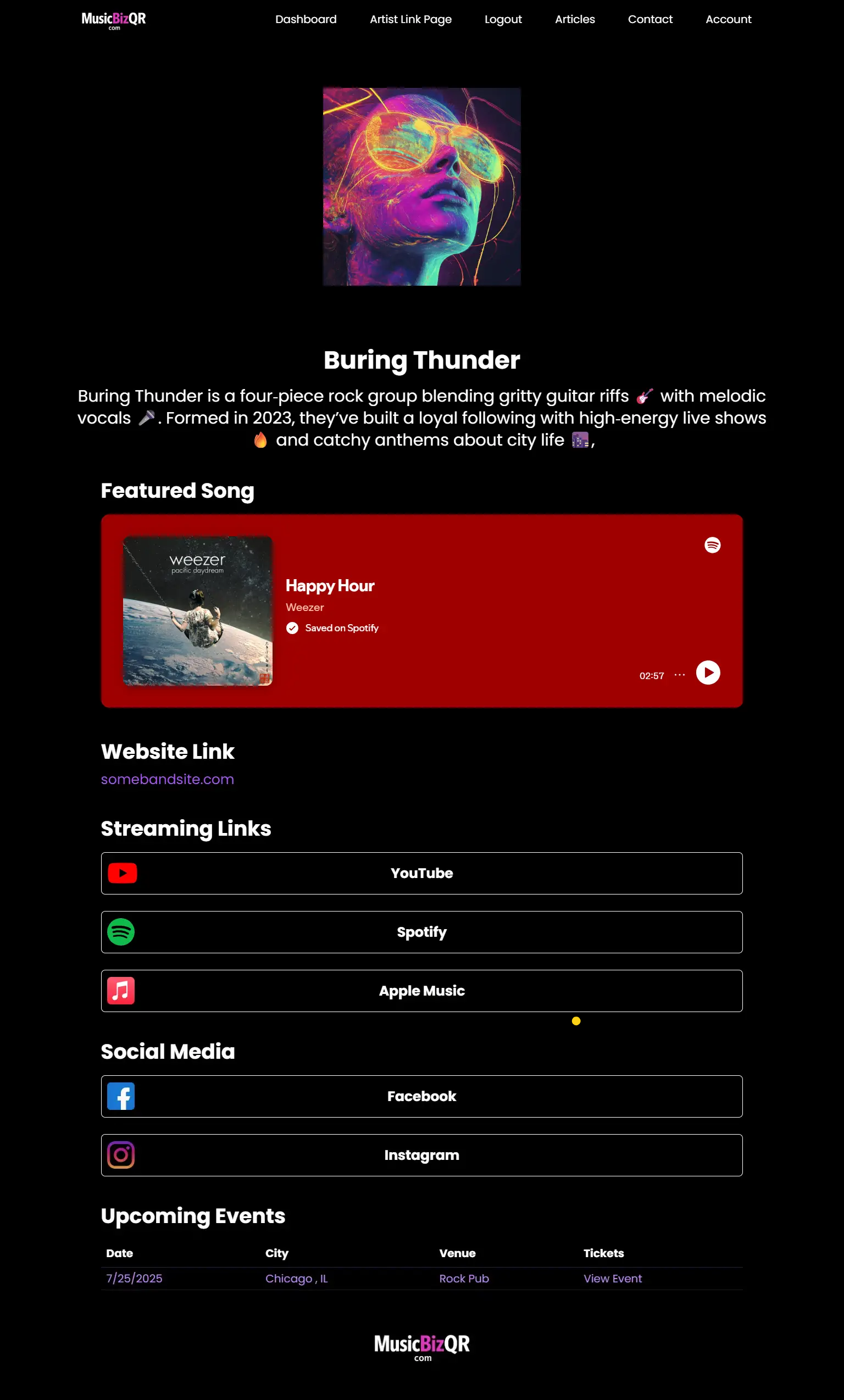
Faneqo gives you a powerful landing page with streaming links, videos, social buttons, and real-time fan analytics — all from a single QR code.
- 🎯 Unlimited link clicks & analytics
- 📈 Track Spotify streams, YouTube plays, and QR scans
- 📱 Mobile-optimized artist pages
- 🚀 Create your first Smart Link in seconds
Related Posts
Most link-in-bio tools weren’t built for musicians. Discover why smart links create better fan journeys, stronger branding, and higher conversions for your music.
Smart links for musicians explained—how they work, why they matter in 2026, and how to build a fan-converting link that drives your music career.
Discover how music links can help artists guide fans across platforms effortlessly. Learn strategies to boost engagement, streams, and merch sales.
Most link-in-bio tools weren’t designed for musicians. Learn why smart links deliver better fan engagement, stronger branding, and real music-driven revenue.
Smart links aren’t just utility tools — they’re the new frontier in artist branding. Learn how visual design, consistency, and fan-centric smart links define a musician’s digital identity.
Discover how smart links can transform fleeting music streams into lasting fan connections. Learn the strategies indie artists use to grow their audience in the streaming era.
Discover how smart links empower indie artists to create deeper, lasting relationships with fans. Turn every click into meaningful engagement.
Discover 2026’s best smart link tools for artists. We compare top platforms, fan engagement features, and why MusicBizQR stands above the rest.
Learn how direct-to-fan video turns your smart link into a conversion machine. Build trust, drive streams, and make real fan connections with MusicBizQR.
Learn how to use music links to drive fan engagement, increase streams, and promote your music like a pro. Built for modern artists and bands. Shall I begin writing the Markdown content for this article now?
In 2026, discovery is chaotic — and smart links are how artists bring it all together. Explore how music smart links guide fans, boost streams, and create real momentum across every platform.
Tired of generic link tools? Discover the smart link platform built for music: video previews, analytics, and full artist control—all in one sleek page.
Every new release deserves more than a link in your bio. Learn how to use smart links to drive streams, collect fans, and turn a single drop into lasting momentum.
The layout of your smart link page can make or break your fan engagement. Learn the design psychology that turns clicks into superfans.
If you're still sending fans to scattered links, you're leaving money on the table. Here's why every indie artist needs a smart link strategy to grow, connect, and convert.",
Most smart links just sit there. This guide shows musicians how to build a smart link page that turns casual clicks into lifelong fans. Real strategies that work.
Discover the psychology behind smart link layout design and how it shapes fan engagement, conversions, and merch sales.
Master the art of launching music with smart links. This guide shows how to create hype, drive streams, and maximize impact every time you drop a new release.
Your smart link is your new homepage. Learn how to design a 2026-ready page that plays your music instantly, tells your story, and converts fans the moment they land.
Learn how musicians can use smart links to connect directly with fans, bypass algorithms, and drive engagement, streams, and merch sales.
Discover how embedded content like music, videos, and social posts can turn your smart link into a fan engagement engine. Boost streams, merch sales, and loyalty.
Discover why smart links are transforming music marketing in 2025. Learn how a centralized hub can grow your audience, boost streams, and drive real fan engagement.
From Spotify embeds to merch and tour links, MusicBizQR makes music promotion easy. Learn how to use smart links to streamline your entire fan funnel.
Learn five powerful ways smart links can revolutionize your band's music promotion, amplify fan engagement, and strengthen fan loyalty.
Discover how smart links are revolutionizing music promotion, increasing fan engagement, boosting streaming numbers, and enhancing concert attendance.