
QR Codes for Musicians: Get More Fans From Every Scan | MusicBizQR

Executive Summary
Introduction — Why QR Codes Matter Now
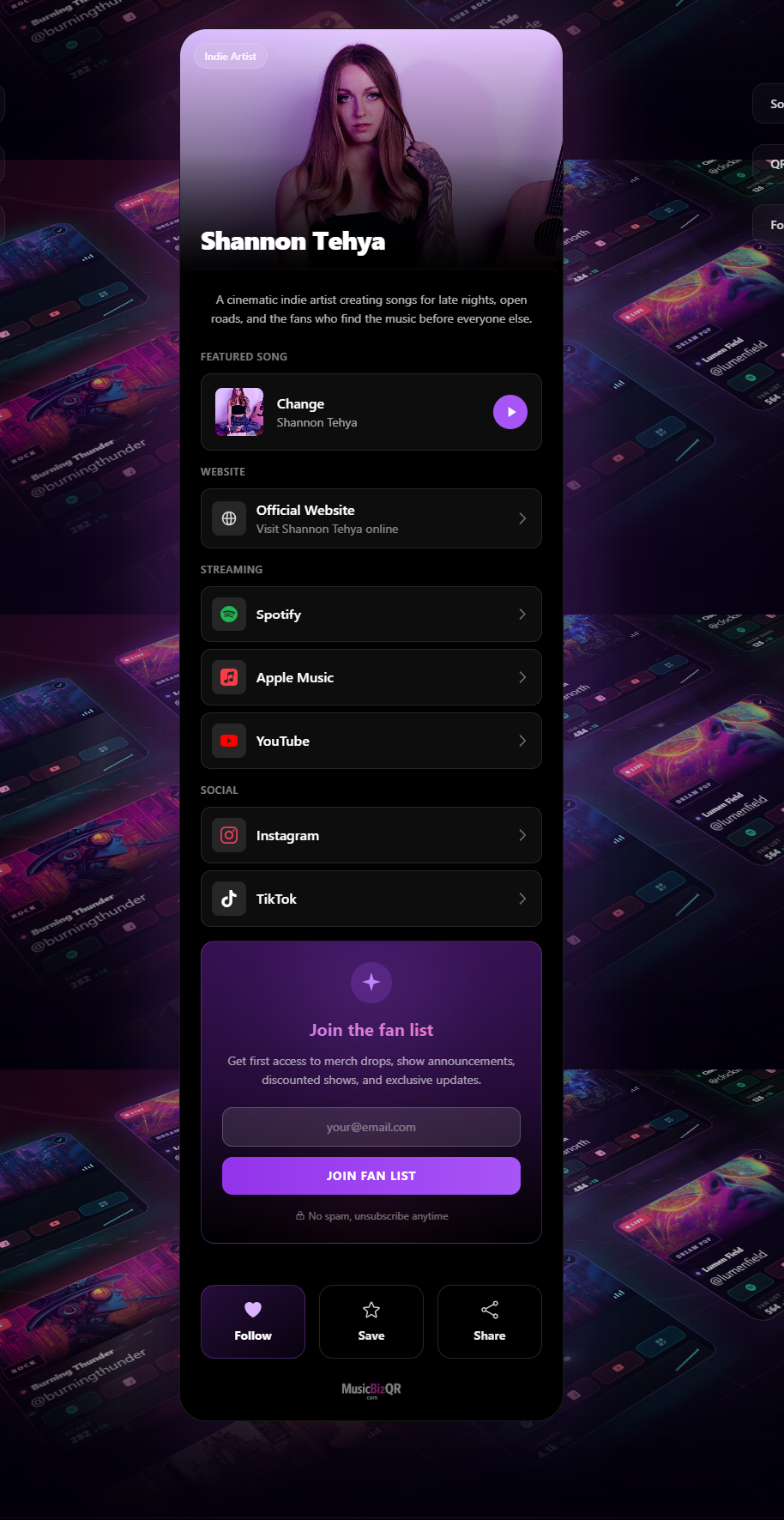
MusicBizQR articles help musicians turn QR codes, smart links, and fan data into a real growth system.
There’s a moment every musician recognizes.
The show just ended. Sweat still clings to the room. Someone lingers near the merch table, phone in hand, scanning the poster taped to the wall. For a split second, you have their attention — not the algorithm’s, not a platform’s — theirs.
That moment is fragile.
What happens next determines whether they become a passing listener or the beginning of a real fan relationship.
For years, QR codes promised to capture moments like this. And for years, they mostly disappointed. Musicians were told to print a code, point it somewhere — Spotify, a website, a random link-in-bio — and hope for the best. Sometimes people scanned. Rarely did anything meaningful happen after.
The conclusion felt obvious: QR codes are fine, but they’re not game-changers.
That conclusion was wrong.
QR codes didn’t fail because the technology was weak. They failed because the ecosystem wasn’t ready — and because musicians were never taught to think beyond the scan. The code was treated as the outcome instead of the beginning. The moment was wasted.
In 2026, that has changed.
Fans now expect frictionless transitions between physical and digital spaces. Mobile behavior is instinctive. Privacy shifts have made first-party relationships more valuable than ever. And musicians are waking up to a hard truth: platforms come and go, but owned fan connections compound.
In this environment, QR codes aren’t shortcuts — they’re handoff points. They are the bridge between a live moment and a digital journey. When used strategically, a single scan can lead to a stream, an email signup, a merch sale, or a long-term fan relationship. When used poorly, it leads nowhere, and the moment disappears forever.
The difference isn’t whether you use QR codes.
It’s how you think about them.
This guide isn’t about printing codes or chasing gimmicks. It’s about understanding QR codes as part of a modern fan-growth system — one that connects live shows, physical media, digital touchpoints, and data into a repeatable strategy.
If you’ve ever felt like QR codes should be more powerful than they’ve been for you, you’re right. The problem was never the code.
It was the strategy behind it.
QR Codes as Entry Points
The most common mistake musicians make with QR codes is also the most subtle.
They treat the scan as the finish line.
A fan scans a code.
They land somewhere.
Job done.
But in modern music marketing, nothing meaningful happens at the destination. What matters is what the destination starts.
A QR code is not a link. It is a handoff moment — the instant when a fan’s attention moves from a physical space into a digital one. That moment is rare, fragile, and incredibly valuable. Once it’s gone, you don’t get it back.
When musicians point QR codes directly to platforms like Spotify, YouTube, or generic link-in-bio pages, they give up control at the exact moment control matters most. The fan lands in an environment designed to distract, not convert. Algorithms take over. Context disappears. The relationship dissolves into noise.
This is why so many QR campaigns “worked” on paper — people scanned — but failed to move careers forward. It’s also why why every indie band needs a QR code strategy is no longer a theoretical question, but a practical one.
The problem wasn’t interest.
The problem was no journey.
In a strategic QR system, the scan is the beginning, not the end. It initiates a sequence:
Scan → context-aware landing page → clear first action → data capture → follow-up opportunity
Each step compounds the value of the one before it. Miss any step, and the entire chain breaks.
Think of QR codes the way venues think about doors. A door doesn’t exist to be admired — it exists to move people into a space intentionally designed for what comes next. If that space is chaotic, irrelevant, or overwhelming, people turn around and leave.
The same is true here.
A well-designed QR strategy respects the psychology of the moment. It assumes the fan has limited attention, high curiosity, and zero patience for confusion. The goal isn’t to show them everything. The goal is to guide them to the one action that matters most right now, which starts with choosing the right landing page for the context of the scan.
When you treat QR codes as entry points instead of destinations, they stop being passive links and start becoming active growth mechanisms. They connect physical moments — shows, posters, merch, festivals — to systems that remember, measure, and respond.
This shift is the foundation of every effective QR strategy in 2026. Without it, everything else in this guide collapses into tactics without direction.
With it, QR codes become one of the most reliable bridges between attention and ownership a musician can build.
Dynamic vs Static QR Codes
Not all QR codes are created equal.
On the surface, a QR code is just a pattern — black squares on white space that point somewhere. That simplicity is exactly why so many musicians assume one code is as good as another. Print it. Scan it. Done.
But under the hood, there’s a fundamental difference between static and dynamic QR codes — and that difference determines whether your QR strategy can grow with you or quietly break over time.
A static QR code is fixed. Once it’s printed, the destination can never change. No updates. No tracking beyond basic scans. No ability to adapt when your priorities shift. Whatever link you chose at the moment of creation is the link you’re stuck with — forever.
That might sound fine at first. Until reality sets in.
Songs change. Tours evolve. Merch rotates. Campaigns end. Platforms rise and fall. A static QR code locks you into decisions you didn’t even know you were making. Over time, it turns real-world assets — posters, stickers, merch, stage banners — into dead ends.
This is why many musicians eventually feel like QR codes “stop working.” The code didn’t fail. The strategy became rigid.
Dynamic QR codes solve this by separating the code itself from the destination behind it. The printed code stays the same, but what happens after the scan can change at any time. You can update links, test different landing pages, track performance by campaign, and respond to real-world data instead of guessing.
If you’ve never used dynamic QR codes before, this shift alone explains what a dynamic QR code is and why every musician should use one — not as a feature upgrade, but as a strategic one.
The real power of dynamic QR codes isn’t convenience. It’s feedback.
With dynamic QR codes, you stop asking, “Did anyone scan this?” and start asking better questions:
- Which placements actually convert?
- Which shows drive email signups?
- Which merch items lead to repeat engagement?
- Which calls-to-action perform best in different contexts?
These answers don’t come from intuition. They come from data — and data only exists when the system is flexible enough to capture it.
Static QR codes still have limited use cases. If you’re printing something disposable, temporary, or purely informational, they may be sufficient. That’s why tools like a free QR code generator for bands can make sense in narrow situations.
But if your goal is growth — building a fanbase, learning what works, and compounding momentum over time — static QR codes cap your upside. They freeze strategy in place while your career keeps moving.
Dynamic QR codes, on the other hand, are built for iteration. They allow you to treat every scan as a signal, every placement as an experiment, and every campaign as a learning loop. Over time, this turns QR codes from one-off tactics into living assets that improve as you do.
In 2026, the question isn’t whether QR codes work.
It’s whether your QR codes are flexible enough to work with you instead of against you.
Key Takeaways
“We were playing in front of 12 people at a dive bar. But one scan turned into 500 streams, three merch sales, and a fan who’s followed us ever since.”
— Lena Cruz, Indie Soul Artist
Welcome to 2026 — where the most powerful tool in a musician’s marketing arsenal might just fit on a sticker.
MusicBizQR articles help musicians turn QR codes, smart links, and fan data into a real growth system.
QR codes have gone from restaurant gimmick to underground legend. And now? They’re the most underused growth hack in independent music.
Whether you’re handing out flyers or headlining festivals, a well-placed QR code can bridge the physical and digital world in one scan — turning fleeting moments into lasting fan relationships.
🎯 Why QR Codes Matter for Musicians
QR codes give you something rare: frictionless access. One scan can trigger a cascade of actions:
- Stream your latest release
- Buy tickets or merch
- Follow you on Spotify, TikTok, or Instagram
- Join your email or SMS fan club
- Watch your newest video
That’s power in a pocket-sized graphic.
🛠️ How to Set Up a Music-Focused QR Code Strategy
1. Create a Smart Landing Page
Use a platform like MusicBizQR to build a mobile-first landing page that includes:
- 🎧 Embedded music or video
- 🎫 Links to tour dates and tickets
- 🛍️ Merch with one-click checkout
- 📬 Email or SMS sign-up form
- 🔗 All your social links
- 📊 Built-in analytics to track fan behavior
This is your digital hub — the destination behind every QR scan.
2. Generate a Custom QR Code
Make it memorable:
- Match your artist branding (colors, style)
- Use a dynamic QR code so you can update the destination later
- Export it in high-resolution formats for print and web
- Test it on different phones before using it live
With MusicBizQR, you can do this in minutes.
3. Put It Everywhere (Seriously)
QR codes work best when they’re visible, scannable, and timely:
- Posters & Flyers — add near tour dates or at the bottom corner
- Merch Tags & Packaging — bonus points for making it feel exclusive
- Venue Signage — before, during, and after your set
- Livestream Overlays — fans watching from home can still engage
- Social Posts — stories, pinned tweets, or even profile pics
- Handwritten Notes or Zines — go DIY and it still works
🔍 Real-Time Fan Data That Doesn’t Lie
The magic behind the code isn’t just the scan — it’s the data. When you use MusicBizQR, every scan gives you:
- 📍 Location (down to city-level)
- 📱 Device type
- ⏰ Time-of-day activity
- 🔗 Link click behavior
- 🎯 Conversion tracking
Imagine knowing which city to book next just based on QR scan data from tour posters.
🚀 Advanced Strategies to Try
- Split Test Designs: A/B test two different QR flyers to see which gets more scans
- Add Urgency: “Scan now for a free unreleased demo”
- Use QR in Fan Packages: Turn one merch customer into a lifelong subscriber
- Pair with NFC: Stick QR+NFC tags on vinyls or backstage lanyards
🤘 QR Codes and the Future of Indie Music
QR codes aren't just tech—they’re a movement.
They represent a shift in how independent artists connect with fans: direct, instant, and real.
You're no longer just building audiences. You're building relationships — one scan at a time.
🎤 Final Take
If you're not using QR codes to power your music career in 2025, you're leaving attention—and money—on the table.
With platforms like MusicBizQR, you get:
- Beautiful, branded smart pages
- Dynamic QR codes you can change anytime
- Embedded music, merch, and ticket links
- Analytics that drive smarter decisions
Start scanning. Start growing. Start now.
👉 Create your free QR code for music today
Fan Context and Scan Intent
A QR code doesn’t exist in a vacuum.
It lives in a moment — and that moment carries intent.
This is the part most musicians miss. They treat a QR code like a universal remote: one code, one link, one destination, used everywhere. But the fan scanning your code at a live show is not the same fan scanning it on a poster in a coffee shop. The mood is different. The attention span is different. The motivation is different. The expectations are different.
And when your QR strategy ignores context, the scan becomes a coin flip.
In 2026, the most effective QR strategies are built around a simple principle:
The scan is a psychological moment, not a technical action.
A fan scans because something inside them says now.
Now I’m curious.
Now I’m impressed.
Now I’m open.
Now I want to take the next step.
Your job is to make that next step feel obvious.
The Four Most Common Scan Contexts (and what fans actually want)
1) The live show scan (high emotion, low patience)
A show is pure momentum. If someone scans during or right after your set, they’re riding a feeling. That’s when the best “first action” is usually something immediate: a song, a follow, a save, a quick signup for show updates, or a merch link that doesn’t require hunting.
This is why guides like how to use QR codes at live shows to drive merch sales matter — because the live show QR is not a “learn more” moment. It’s a “take action while the feeling is still alive” moment.
2) The merch table scan (high intent, high trust)
At the merch table, people are already leaning toward commitment. They’re ready to support you. QR codes here can do more: bundles, upsells, exclusive drops, VIP lists, limited-time offers, even post-show follow-ups.
If you only point merch QR codes to a generic page, you waste the strongest purchase intent you’ll ever get in person.
3) The poster / flyer scan (medium curiosity, low commitment)
Posters are often cold traffic. The fan might not know you yet. They might be scanning because the design caught their eye, or the venue name is familiar, or the phrase “Nashville’s loudest…” made them smirk.
Here, the landing experience has to be frictionless and self-explanatory. One clear action. One clear story. If the page feels messy or generic, they bounce and forget you.
4) The festival / venue scan (high noise, split attention)
Festivals are chaos: multiple bands, loud environments, distracted fans. QR codes can still work here — but only if the action is simple and instantly rewarding. Trying to push a long funnel in a high-noise environment is like whispering a pitch in a hurricane.
This is why how artists are using QR codes to crush music festivals and tours is really a context guide in disguise — it’s about designing a first action that survives distraction.
The Real Skill: Match the First Action to the Moment
Once you understand context, the strategy becomes clearer.
You stop asking:
“Where should my QR code link?”
And you start asking:
“What is the fan most ready to do in this exact moment?”
That one question upgrades your entire QR system.
Because when you match scan intent to the landing experience, QR codes stop feeling random. They start feeling inevitable — like the next step the fan wanted to take anyway.
And that’s when you get the result most musicians are actually chasing:
Not more scans.
More momentum.
More conversion.
More owned connection.
In the next section, we’ll talk about how the landing page itself determines whether that momentum survives — or dies on arrival.
Choosing the Right QR Landing Page
The scan gets the credit — but the landing page decides the outcome.
This is where most QR strategies quietly fail. The fan scans with interest, curiosity, or momentum… and then lands on a page that wasn’t designed for the moment that brought them there. Too many options. Too much friction. No clear next step.
Momentum evaporates.
A QR landing page is not a homepage. It’s not a profile. It’s not a dumping ground for links. It is a transition layer — the bridge between a physical moment and a digital action.
When musicians send QR traffic straight to Spotify, YouTube, or a generic link-in-bio, they give up the most valuable thing they had in that moment: direction. Platforms are built to scatter attention, not focus it. The fan arrives inside an ecosystem that wasn’t designed for your goals — and your message disappears into noise.
This is why the question isn’t what should I link to?
It’s what should happen next?
Why “Just Link to Spotify” Kills Momentum
Streaming platforms are excellent destinations — later.
But as first-touch landing pages, they create three problems:
- No context — the fan forgets why they scanned
- No guidance — dozens of competing options
- No ownership — no way to continue the relationship
A fan who lands on Spotify might stream a song. Or they might tap away. Or they might get distracted by another artist entirely. You’ll never know which — and you won’t be able to follow up.
That’s why guides like choosing the right landing page for your QR campaigns matter. The landing page isn’t a technical choice. It’s a psychological one.
The One-Action Rule
Effective QR landing pages obey a simple rule:
One page. One purpose. One next step.
That doesn’t mean hiding everything else forever. It means prioritizing the first action based on the scan context:
- At a show → listen or follow
- At merch → buy or unlock something exclusive
- On a poster → discover quickly
- At a festival → get rewarded immediately
The moment you ask a fan to decide between six equal options, you’ve already lost them.
Smart Links vs Generic Link-in-Bio Pages
Link-in-bio tools were built for social profiles, not scan moments. They assume casual browsing, not time-bound intent. That’s why they often feel generic and underperform in QR campaigns.
Smart link pages, on the other hand, are built to adapt to context:
- Different CTAs for different campaigns
- Control over layout and hierarchy
- Clear primary action
- Room for ownership (email, SMS, follow-ups)
- Measurement of what actually happens after the scan
This is the difference explained in why MusicBizQR is the Linktree alternative built for musicians — not as a branding argument, but as a functional one.
Landing Pages as Momentum Filters
A good QR landing page does one thing exceptionally well:
It filters momentum in the right direction.
It doesn’t overwhelm.
It doesn’t distract.
It doesn’t ask the fan to think.
It simply answers the question the fan is already asking in their head:
“What should I do next?”
When that answer is clear, QR codes stop feeling like experiments and start behaving like systems. Scans turn into actions. Actions turn into signals. Signals turn into strategy.
In the next section, we’ll talk about what happens after the click — how to measure, attribute, and learn from every scan so your QR strategy improves instead of guessing in the dark.
QR Code Analytics and Attribution
Most musicians think they want more scans.
What they actually want is clarity.
This is where QR strategies either mature — or stall out. Because a scan by itself doesn’t tell you anything useful. It’s a signal that something happened, but not why, not what followed, and not what to do next.
Without analytics, QR codes are guesses printed on paper.
With analytics, they become feedback loops.
Why Scan Counts Are a Trap
It’s easy to celebrate scan numbers. They’re visible. They go up. They feel like progress.
But scan counts alone can’t tell you:
- Which QR placements actually convert
- Which shows outperform others
- Which CTAs work in real-world conditions
- Which campaigns deserve more investment
- Which moments produce owned connections
A poster might get hundreds of scans and zero follow-ups.
A merch-table code might get ten scans and five email signups.
Which one is more valuable?
Until you track what happens after the scan, you don’t know — and you can’t optimize.
This is the mindset shift behind artist analytics 101: how to track streams, scans, and clicks like a pro. Analytics aren’t about dashboards. They’re about decision-making.
Attribution: Connecting the Physical to the Digital
Attribution answers one simple question:
“What caused this action?”
In traditional digital marketing, attribution is already hard. In music marketing — where physical and digital worlds collide — it’s even harder. QR codes are one of the few tools that can bridge that gap cleanly.
When set up correctly, QR codes let you attribute:
- Email signups to specific shows
- Merch sales to specific tables or posters
- Streams to specific campaigns
- Engagement to specific physical placements
This is why dynamic QR codes matter so much here. They let you tag, segment, and measure performance without reprinting anything. Each QR code becomes a data source — not just a shortcut.
Guides like how to track QR code campaign performance in music marketing exist because attribution isn’t obvious. It has to be designed.
What “Good” QR Analytics Actually Look Like
Effective QR analytics answer practical questions:
- Which shows should we prioritize?
- Which cities respond best?
- Which merch items drive follow-ups?
- Which landing pages convert?
- Which QR placements are wasting space?
The goal isn’t to track everything. It’s to track the next decision.
Once you have that clarity, QR strategy stops being reactive. You stop guessing where to place codes, what to promote, and how to follow up. The data tells you.
From Measurement to Momentum
Analytics don’t just measure results — they create momentum.
When you know what works:
- You repeat it
- You scale it
- You refine it
- You stop wasting time on what doesn’t
This is the hidden advantage of QR-driven systems. They turn real-world interactions into learnable patterns. Over time, that learning compounds — and your strategy gets smarter without adding complexity.
In the next section, we’ll talk about what most musicians miss entirely: how QR codes can help you build owned audiences instead of renting attention from platforms that can disappear overnight.
Building Owned Audiences with QR Codes
There’s a hard truth most musicians eventually run into:
Followers don’t belong to you.
Streams don’t belong to you.
Likes don’t belong to you.
Algorithms definitely don’t belong to you.
They’re rented.
Platforms control reach, visibility, and access — and they can change the rules at any time. Musicians feel this every time engagement drops for no obvious reason, or a post underperforms despite real fan interest.
QR codes don’t fix that problem by themselves.
But when used strategically, they give you a way out.
Attention vs Ownership
Most music marketing strategies are built around attention:
- More views
- More streams
- More follows
- More impressions
Attention is useful — but it’s fragile. It disappears the moment the platform decides something else deserves the spotlight.
Ownership is different.
Owned audiences are relationships you can reach directly:
- Email lists
- SMS lists
- Fan accounts
- Memberships
- Direct communication channels
These channels compound. Every new fan strengthens the whole system instead of resetting it.
QR codes are one of the most effective bridges between attention and ownership because they operate at the moment interest is highest — when a fan chooses to scan.
Why QR Codes Excel at Ownership (When Used Correctly)
A QR scan is intentional. Nobody scans by accident.
That intention gives you a rare opportunity to ask for something small but meaningful in return:
- An email for tour updates
- Access to exclusive content
- Early merch drops
- VIP or fan club access
- Behind-the-scenes material
This is why strategies like how to use QR codes to capture fan emails at live shows outperform passive “follow me” requests. You’re meeting fans at the exact moment they’ve already said yes.
And once that connection is owned, everything else becomes easier:
- Album launches
- Tour announcements
- Merch drops
- Crowdfunding
- Community building
Monetization Follows Ownership
Monetization doesn’t come from platforms.
It comes from relationships.
When you own the connection, you don’t have to fight algorithms to reach fans. You can speak directly. You can test ideas. You can offer value without friction.
That’s the foundation behind how indie artists can monetize fans using QR codes — QR codes aren’t just discovery tools. They’re relationship builders.
The strongest QR strategies don’t ask fans to do everything at once. They ask for one small step now, then nurture the relationship over time.
The Compounding Effect
Owned audiences compound quietly.
A fan who joins your list today might:
- Buy merch six months from now
- Attend a show next year
- Share your music with friends
- Support future releases
- Stick with you through career phases
None of that shows up in scan counts.
But it shows up in sustainability.
QR codes don’t replace platforms — they reduce dependence on them. They give musicians a way to convert fleeting moments into durable connections.
In the final section, we’ll zoom out and explain why this strategy works now, and why QR codes are positioned to matter more in the coming years than they ever did in the past.
Why QR Codes Work Now
QR codes have existed for decades.
So the real question isn’t why musicians should use QR codes — it’s why they finally work now.
The answer isn’t technological.
It’s behavioral.
Mobile Behavior Has Become Instinctive
Scanning a QR code used to feel awkward.
Now it feels automatic.
Smartphone cameras scan natively. No apps. No friction. Fans don’t “decide” to scan — they react. That shift matters because QR codes live in moments where speed and instinct determine everything: live shows, merch tables, posters, festivals, street-level discovery.
When scanning becomes subconscious, the barrier disappears.
Fans Expect Physical → Digital Transitions
Modern fans move fluidly between worlds.
They discover artists in physical spaces — shows, bars, festivals, flyers, merch — and immediately expect a digital continuation. QR codes provide the cleanest, fastest handoff between those worlds.
That expectation didn’t exist years ago. Now it’s assumed.
A poster without a QR code feels unfinished.
Merch without a digital connection feels disconnected.
Live shows without a follow-up path feel temporary.
QR codes fill that gap.
Platform Volatility Changed the Stakes
Algorithms used to be accelerators.
Now they’re filters.
Organic reach is unstable. Paid reach is expensive. Discovery is unpredictable. Musicians have learned the hard way that platforms reward momentum — not loyalty.
This is why why QR codes are becoming essential for music promotion isn’t about trends. It’s about risk mitigation.
QR codes don’t fight platforms.
They hedge against them.
They give musicians a way to capture relationships outside the algorithm, where rules don’t change overnight.
First-Party Data Became Non-Negotiable
Privacy shifts didn’t just affect ads — they reshaped marketing.
Email lists, direct fan accounts, and owned analytics are no longer optional if you want to understand what’s actually working. QR codes create clean, consent-based entry points into those systems.
This is why artist analytics now matter more than raw reach. Growth without insight doesn’t scale.
QR codes turn offline moments into measurable signals:
- Where fans came from
- What they did next
- Which actions led to real engagement
That feedback loop simply didn’t exist before.
QR Codes Evolved from Links into Systems
The final shift is the most important one.
QR codes used to point somewhere.
Now they start something.
Dynamic destinations. Context-aware landing pages. Campaign tracking. Follow-ups. Iteration.
This evolution is why the ultimate QR code strategy for indie bands works as a system instead of a tactic.
The code isn’t the strategy.
The system behind it is.
The Real Reason QR Codes Matter in 2026
QR codes work now because they align with how fans actually behave:
- Fast
- Mobile
- Contextual
- Relationship-driven
They don’t ask fans to remember you later.
They meet fans now — and give you a way to continue the relationship after the moment passes.
That’s the difference.
QR codes aren’t a shortcut.
They’re infrastructure.
And for musicians building careers in a fragmented, platform-dominated landscape, infrastructure is what lasts.
Frequently Asked Questions About QR Codes for Musicians
Do QR codes actually work for musicians?
Yes — when they’re used as part of a strategy, not just as links.
QR codes work best when they connect a physical moment (like a live show, poster, or merch table) to a clear digital action. Musicians who treat QR codes as entry points into a fan journey — rather than destinations — consistently see higher engagement, email signups, and long-term fan retention.
Should musicians use static or dynamic QR codes?
Dynamic QR codes are almost always the better choice for musicians.
Static QR codes can’t be updated or tracked once they’re printed. Dynamic QR codes let you change destinations, track performance, and optimize campaigns over time — which is essential for tours, merch, and evolving marketing goals.
What should a QR code link to for best results?
QR codes should link to a purpose-built landing page, not directly to a platform like Spotify or YouTube.
The most effective destinations are mobile-optimized pages that provide context, guide fans to a single clear action, and allow you to capture data or continue the relationship after the scan.
Are QR codes effective at live shows?
Live shows are one of the strongest use cases for QR codes.
Fans are already emotionally engaged, mobile-ready, and curious. QR codes placed on merch tables, posters, stage screens, or flyers give fans an immediate way to continue the experience digitally — whether that’s joining an email list, following a tour, or accessing exclusive content.
How do QR codes help musicians build owned audiences?
QR codes help convert fleeting attention into owned relationships.
Instead of relying on algorithms or social platforms, musicians can use QR codes to invite fans into email lists, SMS updates, fan clubs, or direct communication channels. These owned audiences compound over time and provide stability as platforms change.
Can QR codes help musicians sell more merch?
Yes — when used strategically.
QR codes can link fans directly to merch drops, exclusive items, limited-time offers, or post-show follow-ups. They reduce friction at the exact moment fans are most likely to buy and allow musicians to continue merch conversations after the show ends.
Do QR codes still matter in 2026?
More than ever.
Mobile behavior, platform volatility, and the importance of first-party data have all increased the value of QR codes. In 2026, QR codes aren’t novelty tools — they’re infrastructure for connecting physical discovery with digital ownership.
Are QR codes only useful for big or touring artists?
No. QR codes are especially powerful for independent and early-stage artists.
They allow musicians without large followings to capture real fan relationships from small shows, local events, and physical touchpoints — turning limited exposure into long-term growth.
Built for Musicians. Powered by Smart Links.
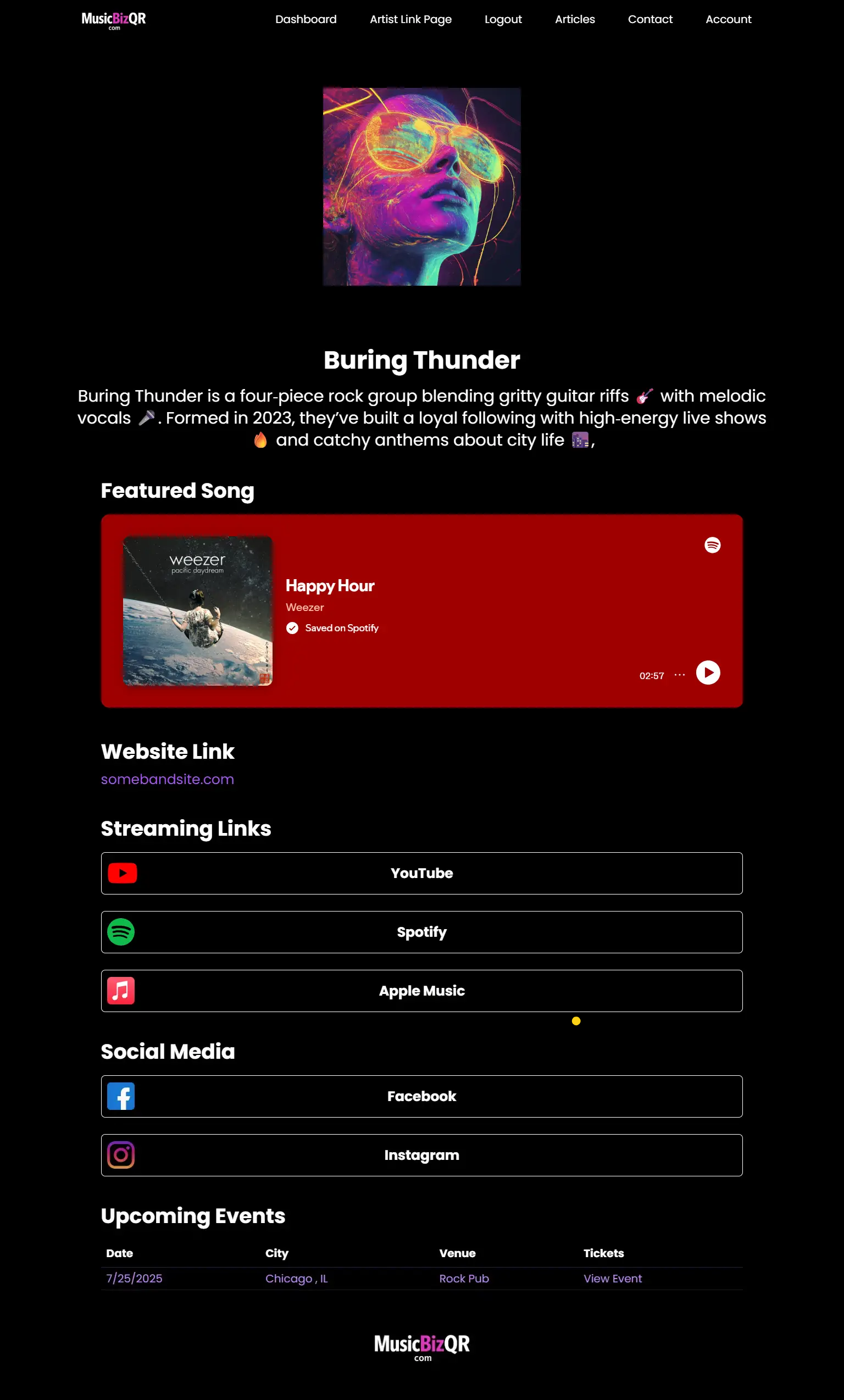
Faneqo gives you a powerful landing page with streaming links, videos, social buttons, and real-time fan analytics — all from a single QR code.
- 🎯 Unlimited link clicks & analytics
- 📈 Track Spotify streams, YouTube plays, and QR scans
- 📱 Mobile-optimized artist pages
- 🚀 Create your first Smart Link in seconds
Related Posts
Discover the art and science of crafting QR codes that scan flawlessly every time—from sizing and contrast to placement and branding. This in‑depth guide walks musicians through each step with real‑world stories and expert tips.
Discover how bands can use QR code marketing to grow their fanbase, boost engagement, and increase revenue with real-world strategies and examples.
Get more scans at shows. Exact sizes, contrast, distances, and placements for QR codes on posters, stage screens, and merch—battle-tested.
Dynamic QR codes let artists edit links, track scans, and grow fan funnels—without reprinting. Here’s why every musician should use them (and how).
Learn how indie bands can boost merch sales at live shows using QR codes. Engage fans, simplify purchases, and track what works—all with MusicBizQR.
Discover how QR codes are helping musicians grow their audience, boost engagement, and drive merch and ticket sales in 2025.
Learn how musicians are using QR codes to collect email addresses from fans during concerts and tours. Build your fanbase with smarter tech.
Discover how artists are using QR codes at live shows to turn fleeting moments into lasting fan relationships and revenue.
Learn how musicians use QR codes to grow fans, sell merch, promote tours, and build owned audiences in 2026. A complete, modern QR code strategy guide.
Discover how musicians are using QR codes to grow their fanbase, sell more merch, and promote shows. Learn why QR is the most underrated tool in music marketing.
Discover how to craft landing pages that turn every QR code scan into streams, signups, or sales. Learn narrative‑driven best practices, real‑world examples, and pro tips for mobile‑first experiences that engage and convert.
Discover how a thoughtful QR strategy can transform fan engagement, drive traffic to your music, and unlock new revenue streams for independent artists. Learn best practices and real‐world examples to build your own QR roadmap.
Discover how musicians are using QR codes to turn festival sets and tour stops into major fan growth engines. Real-world tactics that convert.
Learn how musicians can use QR codes at live shows to drive fan engagement, stream growth, and merch sales. Step-by-step tactics that actually work.
Discover the story of how an unknown indie band used QR codes and smart fan engagement to grow their audience and turn local shows into viral momentum.
Discover how QR codes are helping artists grow their fanbase, boost streams, and drive merch and ticket sales. Learn how to use QR codes to build your music career.
Discover how QR codes are revolutionizing music marketing, empowering bands and artists to engage fans, drive streams, and increase revenue.
Learn how QR codes are revolutionizing music discovery, making it easier for fans to connect instantly with new bands, content, and experiences.
How QR Codes Are Redefining Music Promotion for Indie Artists
Explore how QR codes are transforming the music industry's gig economy by empowering independent artists to connect, monetize, and grow without middlemen.
Discover how musicians are using QR codes at live shows to build long-term fan relationships. Learn proven strategies that turn casual listeners into superfans.
Learn how to design and deploy a high-converting QR code campaign for your next album drop. Includes tips on branding, analytics, and maximizing engagement.
Learn how indie musicians can use QR codes strategically to generate income, boost merch sales, and create lasting connections with fans.
Discover how bands can turn every live show into a powerful fan engagement moment using QR codes. Learn tactics that convert concertgoers into lifelong fans.
Discover how bands and solo artists can use QR codes to supercharge tour promotion, grow their fanbase, and drive ticket sales with ease.