How to Make a QR Code for Your Music (That Actually Grows Your Fanbase)

Executive Summary
QR codes have quietly become one of the most powerful — and most misunderstood — tools in modern music marketing.
For years, musicians were told to print a code, link it to Spotify or a link-in-bio page, and hope for results. Sometimes fans scanned. Rarely did anything meaningful happen next. The problem wasn’t the technology — it was the lack of strategy behind it.
In 2026, QR codes are no longer shortcuts. They are handoff points — moments where attention moves from the physical world into a digital system you control. When used intentionally, a single scan can lead to a stream, an email signup, a merch sale, or the beginning of a long-term fan relationship. When used poorly, the moment disappears forever.
This guide breaks down how to build a complete QR code system for musicians — not just how to generate a code, but how to design the journey after the scan. You’ll learn why QR codes should be treated as entry points instead of destinations, how dynamic QR codes unlock growth and flexibility, what to track after the scan, and how to optimize campaigns over time using real fan behavior.
The goal isn’t more scans.
The goal is turning fleeting moments — live shows, posters, merch, festivals — into repeatable, measurable fan growth.
Used correctly, QR codes become one of the few marketing channels musicians truly own — and one that compounds as your career evolves.
Key Takeaways
QR codes should initiate a fan journey, not dump fans onto generic platforms where attention and context are lost.
Dynamic QR codes allow updates, tracking, and optimization, turning physical assets into flexible, evolving growth tools.
Post-scan behavior like clicks, signups, and engagement reveals real fan intent and drives smarter decisions.
By testing one variable at a time and learning from real data, QR campaigns improve and compound over time.
When QR codes connect physical moments to owned digital journeys, they become a durable fan-growth engine.
Introduction: Why Most QR Codes for Music Fail
Making a QR code for your music is easy.
That’s exactly why most of them fail.
In a few clicks, any musician can generate a code, slap it on a poster, drop it on merch, or flash it on a screen at a show. The technology works. Fans scan. Something opens on their phone.
And then… nothing changes.
No new fans to reach later.
No clearer understanding of what worked.
No momentum beyond the moment.
This is where the confusion starts. On the surface, QR codes seem to be doing their job. People are scanning them. But scans alone don’t build careers. They don’t create relationships. They don’t compound over time.
The mistake happens at the very beginning.
Most musicians treat a QR code as a shortcut — a faster way to send someone somewhere. A link to Spotify. A link to YouTube. A link to whatever page happens to exist right now.
That approach misunderstands the role a QR code is supposed to play.
A QR code isn’t meant to be the destination. It’s meant to be the handoff — the moment where a fan moves from a physical experience into a digital journey that actually continues the relationship.
When that journey doesn’t exist, the scan becomes a dead end. The fan disappears back into the noise of platforms designed to distract, not connect. The moment passes, and the opportunity is gone.
This is why so many musicians walk away feeling like QR codes should be more powerful than they are.
They’re right.
The problem was never the code.
It was the lack of intention behind it.
In the sections ahead, we’ll break down what QR codes for music are actually supposed to do, how to build them correctly, and how a single well-designed QR system can turn casual interest into real fan growth.
What Most Musicians Get Wrong When Making QR Codes
Most musicians don’t fail with QR codes because they did something reckless.
They fail because they did something reasonable.
They made a QR code the same way they make most links — quickly, practically, and without much ceremony. The code points to a song, a profile, or a link-in-bio page. It feels efficient. It feels modern. It feels like progress.
But efficiency is not the same thing as effectiveness.
The core mistake is treating QR codes like shortcuts instead of strategic touchpoints. When a QR code simply dumps a fan onto a platform page, the musician gives up control at the exact moment control matters most.
Platforms are designed to do one thing well: keep people moving. Autoplay, recommendations, notifications, and endless scrolling pull attention away immediately. The fan who scanned because you were interesting is suddenly surrounded by thousands of distractions that have nothing to do with you.
This is why QR codes often “work” in the narrowest sense — people scan — but fail to move a career forward.
There’s no context.
No intentional next step.
No way to continue the relationship.
The scan becomes a dead end.
This mistake is so common that it’s the reason why every indie band needs a QR code strategy in the first place. Without a strategy, QR codes don’t amplify momentum — they leak it.
Another quiet failure happens when musicians treat QR codes as one-off tools. A code is created for a specific song, a specific show, or a specific moment, then forgotten. When priorities change — new releases, new tours, new goals — the QR code stays frozen in the past.
That rigidity turns physical assets into liabilities. Posters age. Stickers become outdated. Merch keeps circulating long after the link behind the code has stopped making sense.
All of these mistakes share the same root problem:
The QR code was never designed to do a job beyond “send someone somewhere.”
In the next section, we’ll redefine that job entirely — and explain what a QR code for music is actually supposed to do when it’s built to grow your fanbase instead of just generating scans.
What a QR Code for Music Is Actually Supposed to Do
A QR code for music isn’t meant to send fans somewhere.
It’s meant to start something.
That distinction changes everything.
When a fan scans a QR code, they’re not looking for a destination. They’re responding to a moment — a live show, a poster on a wall, a sticker on a guitar case, a merch table buzzing with energy. The scan is an act of curiosity, not commitment.
The real job of a QR code is to respect that moment and guide it forward.
At its best, a QR code acts as a bridge between worlds: the physical experience that sparked interest and a digital environment designed to continue the relationship. This is the foundation of every effective system outlined in QR Codes for Musicians: The Complete 2026 Guide.
That system always follows the same logic:
Scan → clarity → intention → next step
If any part of that chain breaks, the opportunity disappears.
This is why QR codes fail when they’re treated as links. A link assumes the destination will do the work. A QR strategy assumes the journey needs to be designed.
A well-built QR code for music should accomplish three things immediately:
First, it should provide context. The fan should instantly understand why they’re there and what they’re being invited to do. Confusion kills momentum faster than disinterest.
Second, it should offer a single clear action. Not a menu of options. Not every platform at once. One intentional step that matches the moment of the scan.
Third, it should create a path forward. Whether that’s an email signup, a follow, a stream, or access to exclusive content, the scan should open a door — not close one.
This is why the destination matters more than the code itself. Sending fans directly to platforms or generic link pages removes context and hands control to systems that aren’t designed to grow your fanbase. Purpose-built landing pages, on the other hand, are designed specifically for this handoff — which is why choosing the right landing page for your QR campaigns is one of the most important decisions in the entire process.
Once you understand the real job of a QR code, everything else becomes clearer. Design choices, tracking, placement, and even whether a code should exist at all start to feel intentional instead of experimental.
In the next section, we’ll break this down step by step — not just how to generate a QR code, but how to build one that actually works in the real world.
Step-by-Step: How to Make a QR Code That Actually Works
Once you understand what a QR code is supposed to do, the process of making one becomes much clearer — and much more intentional.
This isn’t about clicking buttons in the right order. It’s about designing the system behind the code before you ever generate it.
Step 1: Decide the Moment the Code Will Be Scanned
Every effective QR code starts with a question:
Where will this be scanned, and what is the fan feeling in that moment?
A QR code at a live show carries a very different emotional context than one on a flyer, a poster, or a merch tag. Fans at shows are energized and curious. Fans scanning a street poster are intrigued but distracted. Fans scanning merch are already invested.
If you don’t define the moment, you can’t design the next step.
Step 2: Choose the Right Destination (Not a Platform)
This is where most QR codes lose their power.
Sending fans directly to Spotify, YouTube, or a generic link-in-bio page hands control to platforms designed to pull attention away from you. Instead, your QR code should point to a destination that exists for this moment — a page that provides clarity, context, and a single clear action.
This is why choosing the right landing page for your QR campaigns matters more than the code itself. The destination does the real work.
Step 3: Use a Dynamic QR Code, Not a Static One
If you want a QR code that works beyond a single moment, it needs to be flexible.
Dynamic QR codes allow you to change destinations after printing, track performance, and improve results over time. Static codes lock you into decisions you’ll outgrow.
This distinction becomes critical once you start treating QR codes as long-term assets instead of disposable tools — which is why dynamic QR codes for musicians are the foundation of any serious strategy.
Step 4: Design for Scanning, Not Aesthetics
QR codes don’t need to look clever. They need to scan instantly.
Contrast, size, spacing, and placement matter far more than custom colors or decorative tweaks. If a fan has to adjust their phone, step closer, or guess where to aim, you’ve already lost momentum.
Scan-friendly design keeps the moment intact — especially in low-light or fast-moving environments like live shows.
Step 5: Decide What You’ll Measure After the Scan
A QR code without measurement is a missed opportunity.
At minimum, you should know:
- How often the code is scanned
- Where it’s being scanned
- What fans do next
This is where basic artist analytics turn QR codes from guesses into feedback loops. Tracking scans, clicks, and follow-up actions lets you improve placements, refine destinations, and stop repeating mistakes.
When these five steps work together, the QR code stops being a novelty and starts functioning as infrastructure — something you can build on, improve, and reuse across your entire career.
In the next section, we’ll zoom in on one of the most important decisions in this process: where your QR code should point — and where it absolutely shouldn’t.
Where Your QR Code Should Point (And Where It Shouldn’t)
Where your QR code points matters more than the code itself.
This is the decision that determines whether a scan becomes the start of a relationship — or the end of one.
Where QR Codes Shouldn’t Point
The most common destinations are also the weakest.
Sending fans directly to Spotify, YouTube, or other streaming platforms feels logical. That’s where the music lives, after all. But platforms are built to keep people moving, not to deepen a connection with you.
The moment a fan lands on a platform page, they’re surrounded by distractions:
- Recommendations
- Notifications
- Other artists
- Endless scroll
The context that made them scan disappears instantly.
Generic link-in-bio pages create a different problem. They overwhelm instead of guide. Too many buttons, too many choices, and no clear reason for a fan to take any one action right now.
Both approaches share the same flaw: they outsource the most important moment to systems that weren’t designed for fan growth.
Where QR Codes Should Point
Effective QR codes point to destinations that exist for one reason: to continue the moment that triggered the scan.
That usually means a purpose-built landing page designed around a single context:
- A show-specific page
- A song-specific page
- A merch or drop-specific page
- A fan signup or exclusive access page
These pages don’t try to do everything. They do one thing well.
This is why choosing the right landing page for your QR campaigns is such a critical decision. The page should immediately answer three questions in the fan’s mind:
- Where am I?
- Why am I here?
- What should I do next?
When those answers are clear, fans move forward without friction.
Why “All-In-One” Pages Often Underperform
Tools that promise to put everything behind one link feel convenient — but convenience for the artist often creates confusion for the fan.
When a QR scan leads to ten options, the fan chooses none.
This is the core difference explored in MusicBizQR vs Linktree for musicians. Growth doesn’t come from offering more choices. It comes from offering the right choice at the right moment.
A QR code at a live show should not behave the same way as a link in an Instagram bio. Context matters.
Once you start treating destinations as moment-specific instead of universal, QR codes stop feeling blunt and start feeling precise.
In the next section, we’ll look at how this plays out in the real world — live shows, posters, merch, and street-level promotion — where QR codes are scanned under very different conditions.
Real-World Examples: Shows, Posters, and Merch
QR codes don’t live in theory. They live in real spaces, under real conditions, with real distractions competing for attention.
This is where many strategies quietly fall apart — not because the idea was wrong, but because the context was ignored.
Live Shows: High Energy, Low Attention Span
Live shows are one of the most powerful environments for QR codes — and one of the easiest to misuse.
Fans are energized, curious, and already engaged with you. But their attention window is short. They’re moving, talking, buying merch, or trying to catch the last song.
A QR code at a show needs to do one thing extremely well: continue the experience without slowing it down.
This is why strategies like how to use QR codes at live shows focus on simplicity. The destination should feel like a natural extension of the night — not a menu of decisions. One clear action beats ten options every time.
Posters and Flyers: Curiosity Without Commitment
Posters and flyers operate under very different conditions.
The fan scanning a poster is interested, but distracted. They might be walking past, waiting in line, or glancing quickly before moving on. There’s no emotional momentum to rely on.
In this context, QR codes work best when they promise immediate clarity:
- What kind of music is this?
- Why should I care?
- What happens if I tap?
Overloaded destinations kill curiosity here. A simple, fast-loading page that explains the value in seconds keeps the moment alive long enough to matter.
Merch: Already-Invested Fans
Merch is the most underrated QR environment.
Anyone scanning a code on a shirt, sticker, or tag has already crossed an important threshold — they’ve chosen to support you. That makes this an ideal place to deepen the relationship, not restart it.
QR codes on merch work best when they unlock something:
- Early access
- Bonus content
- Future discounts
- Fan-only updates
This is why using QR codes to sell more band merch isn’t just about transactions. It’s about turning buyers into long-term supporters.
One Strategy, Many Contexts
The mistake is trying to use one QR destination everywhere.
The opportunity is using one system that adapts.
The same QR code infrastructure can power all of these scenarios — but only if it’s flexible enough to respond to different moments. That flexibility is what separates QR codes that age poorly from ones that keep working as your career evolves.
In the next section, we’ll explain why this flexibility matters more than it seems — and why the choice between static and dynamic QR codes determines whether your system can grow with you or quietly break over time.
Static vs Dynamic QR Codes: What Most Musicians Miss
On the surface, all QR codes look the same.
They scan.
They open a link.
They seem interchangeable.
But the difference between static and dynamic QR codes isn’t technical — it’s strategic. And once you understand it, you start seeing why so many QR campaigns feel promising at first and disappointing later.
Static QR Codes: Fixed Decisions in a Moving Career
A static QR code points directly to a single destination. Once it’s created and printed, that destination can never change.
That might sound harmless — until time passes.
Songs rotate.
Campaigns end.
Tours change.
Links break.
A static QR code freezes your thinking at one moment in time. Every poster, sticker, or merch item becomes a permanent bet on a decision you didn’t know you were making.
This is why musicians often feel like QR codes “stop working.” The code didn’t fail. The strategy outgrew it.
Static QR codes still have limited use cases — temporary flyers, disposable materials, or one-off informational links. That’s where tools like a free QR code generator for bands can make sense.
But static codes cap your upside the moment you want to improve, measure, or adapt.
Dynamic QR Codes: Systems That Evolve
Dynamic QR codes separate the printed code from the destination behind it.
The code stays the same.
The experience can change.
This single difference unlocks everything that makes QR codes powerful in the long run:
- You can update destinations without reprinting
- You can test different landing pages
- You can measure performance by placement or campaign
- You can respond to real-world data instead of guessing
This is why dynamic QR codes for musicians aren’t just a feature upgrade — they’re a mindset shift.
Dynamic QR codes let you treat every scan as feedback. Over time, your strategy improves because it’s allowed to learn.
Why This Matters More Than It Seems
Most musicians don’t fail with QR codes because they chose the wrong design or link.
They fail because they locked themselves into systems that couldn’t grow.
A dynamic QR code turns posters, merch, and stage visuals into living assets — not relics of past campaigns. It lets your physical world stay relevant as your digital priorities evolve.
Once this flexibility is in place, a new question becomes unavoidable:
What exactly should you be measuring after the scan?
That’s what we’ll tackle next — because without analytics, even the most flexible QR system is flying blind.
What to Track After the Scan (and Why It Changes Everything)
Most musicians think analytics start with streams.
That’s already too late.
If you wait until a song is playing on Spotify or a video is loading on YouTube, you’ve already surrendered the most valuable information — intent. QR codes create a rare opportunity to measure what fans choose to do in the moment before platforms take over.
But only if you’re tracking the right things.
Scans Are the Beginning, Not the Metric
A scan by itself is almost meaningless.
High scan counts can feel validating, but they don’t tell you whether:
- The placement worked
- The message resonated
- The fan took action
- The experience was worth repeating
This is why musicians get stuck celebrating vanity numbers instead of building momentum. Scans are entry signals — not outcomes.
The real value begins after the scan.
The Core Metrics That Actually Matter
In a functional QR strategy, you’re not tracking everything — you’re tracking decision points.
At minimum, every QR flow should answer these questions:
- Did the fan take a first action?
- Which action did they choose?
- Where did they drop off?
- Which placements convert best?
- Which campaigns compound over time?
This is where artist analytics stop being abstract dashboards and start becoming strategic tools.
The most important post-scan metrics include:
- Link clicks (not just page views)
- Email or SMS signups
- Merch interactions
- Repeat scans from the same source
- Engagement by placement (poster vs merch vs stage screen)
Each of these tells a different story about fan behavior — and together, they reveal what’s actually working.
Context Is the Multiplier
A scan at a live show does not mean the same thing as a scan from a sticker, poster, or social post.
That’s why tracking QR campaign performance in music marketing requires separating intent by context. When you know where a scan came from, you can understand why it happened — and what to do next.
Without context, analytics are just noise.
With context, they become leverage.
Why This Changes Everything
Once you can see what fans do after the scan, QR codes stop being passive tools and start becoming feedback loops.
You stop guessing:
- Which call-to-action works best at shows
- Which merch placements convert
- Which cities engage most
- Which content actually moves fans forward
Instead, you iterate.
This is the moment where QR codes transition from “nice add-ons” to a core growth system — because now every physical interaction teaches you something about your audience.
And once you can measure behavior…
The next step is obvious.
How do you optimize the journey itself?
That’s where QR strategy becomes repeatable, scalable, and predictable — which is exactly where we’re headed next.
How to Optimize QR Campaigns Over Time
Once you can see what fans do after the scan, something shifts.
QR codes stop being experiments.
They start becoming systems.
Optimization isn’t about tweaking colors or swapping links randomly. It’s about learning from real behavior and intentionally shaping the journey so each scan is more likely to produce value than the last.
This is where most musicians either level up — or stall out.
Optimization Starts With Small, Intentional Changes
The biggest mistake musicians make at this stage is overcorrecting.
They change everything at once:
- New landing page
- New copy
- New call-to-action
- New placement
When results shift, they don’t know why.
Effective optimization isolates variables. You change one thing at a time, then let real-world behavior tell you whether it helped or hurt.
Common high-impact variables include:
- Call-to-action wording
- Primary link position
- First screen content
- Context-specific messaging (show vs poster vs merch)
This is why choosing the right landing page isn’t a one-time decision — it’s an evolving one.
Let Placement Teach You What Fans Want
Not all scans are equal.
A scan at a live show carries urgency.
A scan from merch implies intent.
A scan from a poster suggests curiosity.
When you treat all scans the same, you flatten meaning. When you separate them, patterns emerge.
This is how artists discover things like:
- Posters drive discovery, not conversion
- Merch drives repeat engagement
- Stage screens drive email capture
- Certain cities outperform others
Articles like where to use QR codes for musicians stop being theoretical once you can validate them with your own data.
Optimization is simply listening to what your placements are already telling you.
Build Feedback Loops, Not One-Off Wins
The real power of optimization is compounding.
When you:
- Launch a QR placement
- Track post-scan behavior
- Make a targeted adjustment
- Measure again
You create a loop.
Over time, this loop does more than improve individual campaigns — it teaches you how your audience behaves across contexts. That knowledge transfers to new releases, tours, merch drops, and cities.
This is how musicians move from “trying QR codes” to running QR-driven growth systems, which is the core idea behind the ultimate QR code strategy for indie bands.
When to Scale (and When Not To)
Optimization tells you what works.
Scaling is simply doing more of it.
But scaling too early locks in assumptions. The goal is not volume — it’s confidence. Once a QR flow consistently produces desired actions in one context, then you replicate it across more placements, cities, or campaigns.
At that point, QR codes stop feeling experimental. They become predictable.
And predictability is the foundation of sustainable growth.
The final step is pulling everything together — turning strategy, tracking, and optimization into a system that supports your career long-term.
That’s where we’re going next.
The Complete QR Code System for Musicians in 2026
By now, one thing should be clear:
QR codes are not tools.
They are interfaces.
They sit at the boundary between the physical world and your digital ecosystem. And like any interface, their value depends entirely on what happens on both sides of the interaction.
When musicians struggle with QR codes, it’s rarely because they picked the wrong generator or printed the wrong size. It’s because they treated QR codes as isolated actions instead of parts of a system.
The System, End to End
A modern QR strategy in 2026 isn’t complicated — but it is intentional.
At its core, it follows a simple arc:
Physical moment → QR entry point → context-aware landing page → clear first action → data capture → feedback loop → optimization → scale
Each piece reinforces the next. Remove one, and the system weakens. Align them, and QR codes become one of the few marketing channels musicians actually control.
This is why why every indie band needs a QR code strategy isn’t about trends or hype — it’s about ownership.
Why This System Wins Long-Term
Platforms change. Algorithms shift. Reach fluctuates.
But a QR-driven system compounds because it’s built on:
- Owned fan relationships
- First-party data
- Real-world intent
- Continuous learning
Each scan teaches you something. Each campaign improves the next. Over time, your physical presence — shows, merch, posters, festivals — becomes smarter, more responsive, and more valuable.
This is how artists turn live moments into lasting momentum, a theme we explore deeper in from the stage to the screen.
The Strategic Advantage Most Artists Miss
The biggest advantage of QR codes isn’t convenience.
It’s timing.
QR codes capture fans at moments when emotion, curiosity, and attention are already high — moments social platforms can’t create on demand. When you meet those moments with a clear journey instead of a dead end, you build relationships instead of traffic.
That’s the difference between growth that spikes and growth that stacks.
Where to Go From Here
If you’re just starting, focus on:
- One dynamic QR code
- One intentional landing page
- One primary action to track
If you’re already using QR codes, focus on:
- Separating placements
- Measuring post-scan behavior
- Optimizing one variable at a time
And if you’re ready to turn QR codes into a core growth engine, explore how tools like MusicBizQR unify links, analytics, and fan journeys into a single system — built specifically for musicians.
QR codes won’t build your career on their own.
But when they’re embedded into a system that respects attention, context, and learning…
They become one of the most reliable bridges between discovery and ownership a musician can build.
And that’s a strategy that holds up — no matter how the industry shifts next.
Frequently Asked Questions About QR Codes for Musicians
Do QR codes actually work for musicians?
Yes — but only when used as part of a system.
QR codes fail when they point to generic destinations like Spotify profiles or link-in-bio pages with no context. They work when they act as entry points into an intentional fan journey that captures data, guides action, and allows follow-up. This is why a full QR code strategy for musicians matters more than the code itself.
What should a musician’s QR code link to?
It depends on context.
A QR code at a live show should lead somewhere different than a QR code on merch or a poster. In most cases, the best destination is a context-aware landing page that presents one clear next action — not a list of distractions. Choosing the right destination is covered in detail in choosing the right landing page for your QR campaigns.
Are dynamic QR codes better than static QR codes?
For growth, yes — by a wide margin.
Static QR codes lock you into a single destination forever. Dynamic QR codes let you update links, track performance, and optimize over time. If your goal is learning what works and compounding results, dynamic QR codes are essential. This is why dynamic QR codes for musicians are considered the foundation of modern QR strategies.
What metrics should musicians track from QR codes?
Scans alone are not enough.
The most important metrics happen after the scan:
- Link clicks
- Email or SMS signups
- Merch interactions
- Repeat engagement
- Performance by placement or campaign
Tracking these behaviors turns QR codes into feedback loops instead of guesswork. A deeper breakdown is available in artist analytics 101.
Can QR codes help musicians grow their email list?
Yes — extremely well.
QR codes capture fans at moments of peak attention, especially at live shows. When paired with a focused landing page and a clear value exchange, QR codes can outperform social links for email capture. This strategy is explored further in how to capture fan emails with QR codes.
Where should musicians place QR codes for best results?
Not all placements perform equally.
Posters, merch, stage screens, stickers, and flyers each attract different types of intent. The key is separating placements so you can track and optimize them individually. A practical breakdown is available in where to use QR codes for musicians.
Do QR codes still matter in 2026?
More than ever.
As privacy changes reduce the effectiveness of third-party tracking and algorithms become less predictable, first-party fan relationships are increasingly valuable. QR codes create a direct bridge between real-world moments and owned digital connections — something platforms cannot replace.
What’s the biggest mistake musicians make with QR codes?
Treating the scan as the goal.
The scan is just the beginning. Without a clear journey, tracking, and optimization, QR codes become dead ends. The most common failures come from thinking in links instead of systems — a mistake this guide is designed to eliminate.
Built for Musicians. Powered by Smart Links.
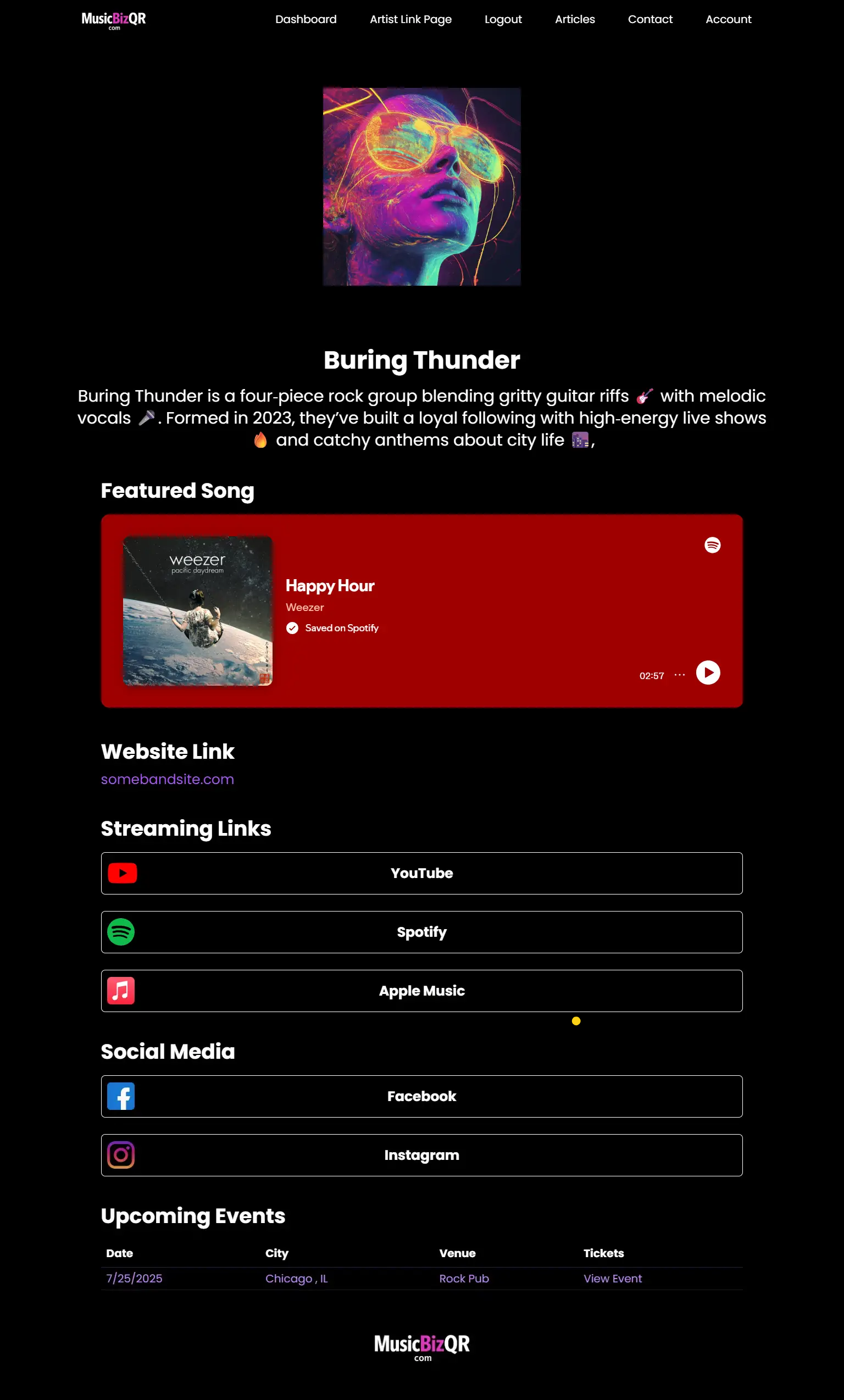
MusicBizQR gives you a powerful landing page with streaming links, videos, social buttons, and real-time fan analytics — all from a single QR code.
- 🎯 Unlimited link clicks & analytics
- 📈 Track Spotify streams, YouTube plays, and QR scans
- 📱 Mobile-optimized artist pages
- 🚀 Create your first Smart Link in seconds
Related Posts
Discover the art and science of crafting QR codes that scan flawlessly every time—from sizing and contrast to placement and branding. This in‑depth guide walks musicians through each step with real‑world stories and expert tips.
Discover how bands can use QR code marketing to grow their fanbase, boost engagement, and increase revenue with real-world strategies and examples.
Get more scans at shows. Exact sizes, contrast, distances, and placements for QR codes on posters, stage screens, and merch—battle-tested.
Dynamic QR codes let artists edit links, track scans, and grow fan funnels—without reprinting. Here’s why every musician should use them (and how).
Learn how indie bands can boost merch sales at live shows using QR codes. Engage fans, simplify purchases, and track what works—all with MusicBizQR.
Discover how QR codes are helping musicians grow their audience, boost engagement, and drive merch and ticket sales in 2025.
Learn how musicians are using QR codes to collect email addresses from fans during concerts and tours. Build your fanbase with smarter tech.
Discover how artists are using QR codes at live shows to turn fleeting moments into lasting fan relationships and revenue.
Learn how musicians use QR codes to grow fans, sell merch, promote tours, and build owned audiences in 2026. A complete, modern QR code strategy guide.
Discover how musicians are using QR codes to grow their fanbase, sell more merch, and promote shows. Learn why QR is the most underrated tool in music marketing.
Discover how to craft landing pages that turn every QR code scan into streams, signups, or sales. Learn narrative‑driven best practices, real‑world examples, and pro tips for mobile‑first experiences that engage and convert.
Discover how a thoughtful QR strategy can transform fan engagement, drive traffic to your music, and unlock new revenue streams for independent artists. Learn best practices and real‐world examples to build your own QR roadmap.
Discover how musicians are using QR codes to turn festival sets and tour stops into major fan growth engines. Real-world tactics that convert.
Learn how musicians can use QR codes at live shows to drive fan engagement, stream growth, and merch sales. Step-by-step tactics that actually work.
Discover the story of how an unknown indie band used QR codes and smart fan engagement to grow their audience and turn local shows into viral momentum.
Discover how QR codes are helping artists grow their fanbase, boost streams, and drive merch and ticket sales. Learn how to use QR codes to build your music career.
Discover how QR codes are revolutionizing music marketing, empowering bands and artists to engage fans, drive streams, and increase revenue.
Learn how QR codes are revolutionizing music discovery, making it easier for fans to connect instantly with new bands, content, and experiences.
How QR Codes Are Redefining Music Promotion for Indie Artists
Explore how QR codes are transforming the music industry's gig economy by empowering independent artists to connect, monetize, and grow without middlemen.
Discover how musicians are using QR codes at live shows to build long-term fan relationships. Learn proven strategies that turn casual listeners into superfans.
Learn how to design and deploy a high-converting QR code campaign for your next album drop. Includes tips on branding, analytics, and maximizing engagement.
Learn how indie musicians can use QR codes strategically to generate income, boost merch sales, and create lasting connections with fans.
Discover how bands can turn every live show into a powerful fan engagement moment using QR codes. Learn tactics that convert concertgoers into lifelong fans.
Discover how bands and solo artists can use QR codes to supercharge tour promotion, grow their fanbase, and drive ticket sales with ease.